On October 24, a gathering in Barcelona's Plaça Catalunya quickly devolved into a violent scene where masked youths smashed shop windows and confronted police. While the event presented itself as a legitimate mobilization for public school improvements, local authorities and researchers have identified it as a 'fabricated' protest. The coordination was driven by approximately 20 TikTok accounts linked to an anonymous platform called Blocus. These accounts used QR codes to funnel participants into private chats where the instructions shifted from political organizing to looting. The resulting chaos led to 130 arrests—76 of whom were minors—and left 14 police officers injured.
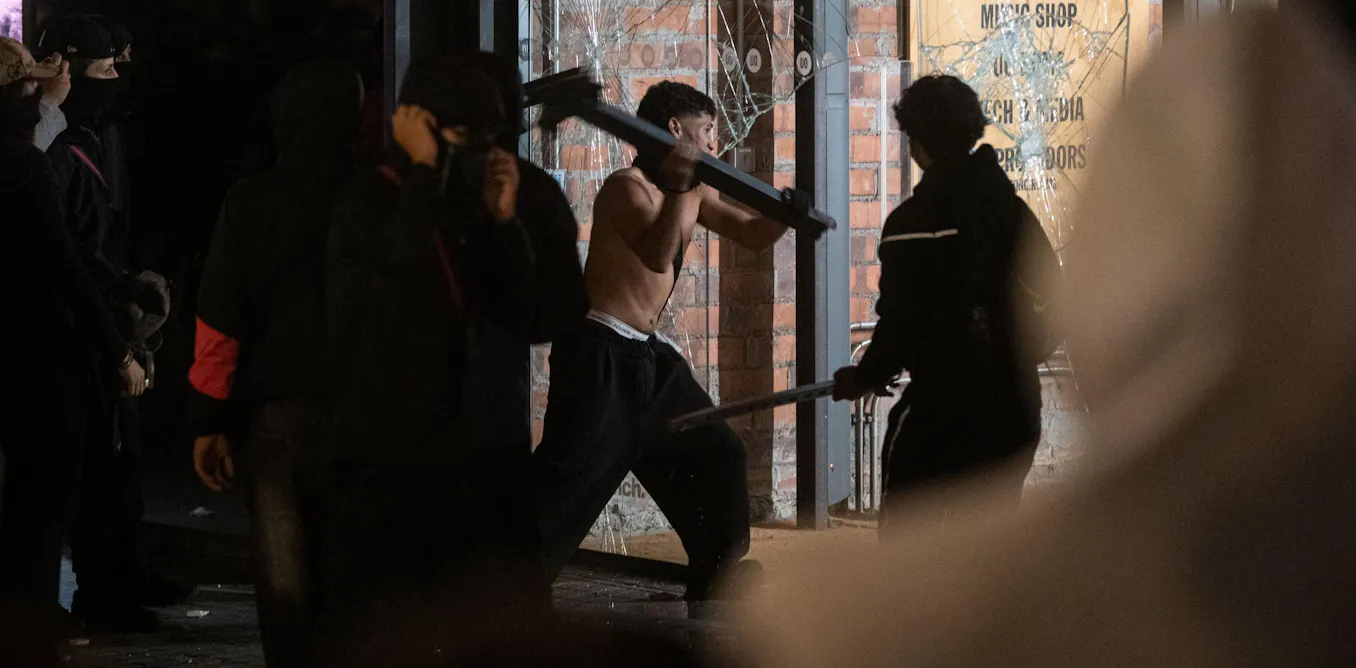
The image illustrates the physical manifestation of the 'fabricated' protest and the resulting violence in Barcelona.
The mechanism of this mobilization relied heavily on shared digital aesthetics and AI-generated content. Blocus-linked accounts across Spain and Europe utilized AI-generated posters featuring dark imagery of burning streets and slogans like 'Youth Revolution.' These posters often incorporated regional flags, such as those of Catalonia and the Basque Country, to evoke specific political sentiments. This coordinated effort has expanded beyond Barcelona; fact-checkers have identified similar 'Halloween' calls in nine European countries, including Germany and the Netherlands. Some of these calls reference 'The Purge,' a film where crime is temporarily legal, suggesting a deliberate attempt to manufacture a climate of lawlessness using social media reach.
The primary consequence of these fabricated protests is the creation of political narratives that may overshadow legitimate grievances. Because the violence was real, images of the looting have been weaponized by various political factions to argue about immigration, government failure, or foreign interference. While some officials have investigated potential Russian or Israeli involvement, the immediate impact remains the erosion of public trust and the displacement of actual protests regarding housing and education from the news cycle. By using TikTok to manufacture a spectacle of unrest, the organizers successfully created a wealth of alarming imagery that fuels a climate of fear just weeks before a general election, regardless of the specific political intent behind the initial coordination.