The integration of AI agents into software engineering has introduced a shift in how work is structured. Rather than completing a single linear task—such as a feature or a bug fix—engineers now often manage multiple agents running in parallel. Each agent might be performing a different function, such as implementing a change, investigating a production issue, or conducting research. While these agents do not require constant supervision, they periodically return with questions, plans for approval, or code diffs that require human intervention. This creates a new form of mental fatigue: the constant need to switch contexts between different problems, repositories, and decision sets.
Data from a technology leader's GitHub history illustrates this shift. During years spent as a Principal Engineer and Vice President of Technology, their activity levels were relatively low, as their roles focused on architecture and planning. However, since the widespread adoption of AI agents in 2026, their contribution counts have returned to the high levels seen during their early years as a full-stack engineer. This increase is attributed to the fact that when implementation becomes 'cheap' through AI, the natural friction that previously limited the scope of projects disappears. This allows for the pursuit of more ideas, more experiments, and more bug fixes that would have been too time-consuming to attempt manually.
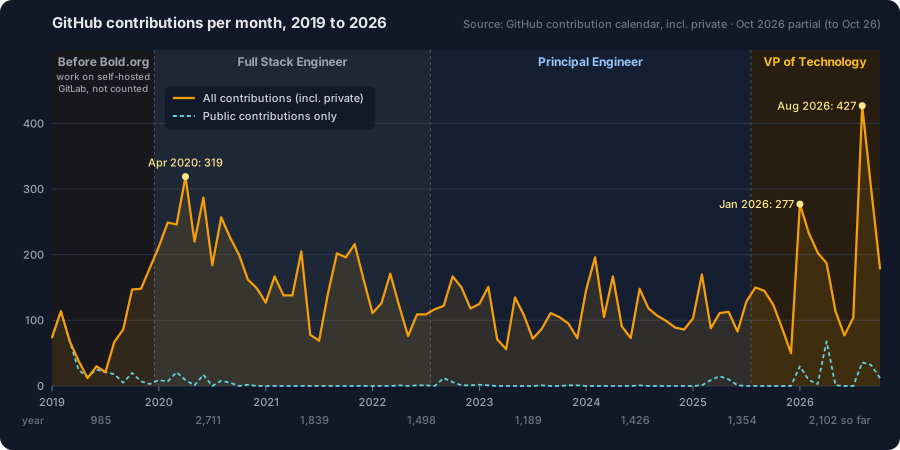
The graph illustrates the shift from lower activity during leadership roles to a high volume of contributions enabled by 'cheap' AI implementation.
This increased capacity leads to a cycle of 'bursts' and subsequent exhaustion. A new model or workflow makes a new set of tasks possible, leading to a period of high activity as many new agents and threads are opened simultaneously. Eventually, the cognitive load of reviewing these outputs and managing the parallel workflows leads to a period of pullback. This dynamic suggests that while AI can automate mundane tasks, it may also expand the total volume of work an individual feels capable of undertaking. The trade-off is a shift from the exhaustion of manual labor to the exhaustion of high-volume oversight and constant context-switching, where the primary challenge is no longer the effort of execution, but the mental bandwidth required to manage the expanded scope of possibilities.
It remains uncertain how this trend will affect long-term career sustainability or if organizational structures will adapt to this increased output. Furthermore, while the primary source focuses on the personal experience of a technology leader, the impact of these 'cheap implementation' cycles may vary significantly depending on an individual's specific role, the quality of the AI tools used, and the specific demands of their employer.
One notable limitation of this observation is that it relies on self-reported GitHub activity, which reflects private contributions and personal initiative rather than a standardized metric of organizational productivity. Additionally, the experience highlights a personal struggle with balance; as the capacity to implement ideas grows faster than the capacity to think about them, the challenge becomes deciding which tasks are worth the mental energy of oversight.