In 1965, Alan Stillman opened a bar on Manhattan's Upper East Side that would eventually become the first T.G.I. Friday's. At the time, the local social scene for single people consisted primarily of private cocktail parties. Stillman observed that while there were many single people in the neighborhood—including airline stewardesses and models—there was no public venue where they could meet casually. He noted that existing establishments, such as P.J. Clarke's, functioned as male-oriented beer hangouts rather than inclusive meeting places. Stillman aimed to recreate the atmosphere of a private cocktail party in a public setting, a move he timed with the emergence of the sexual revolution.
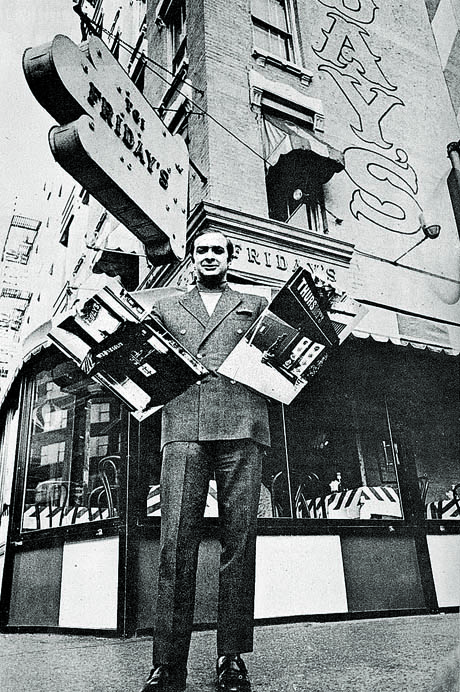
This image identifies the founder and the original location of the first T.G.I. Friday's on the Upper East Side.
To achieve this, Stillman focused on creating a specific 'experience' rather than following traditional restaurant design. He utilized simple aesthetic choices, such as painting the building blue, hanging fake Tiffany lamps, and dressing waiters in red and white striped soccer shirts. The goal was to make patrons feel as though they were visiting someone's apartment for a drink. This approach proved highly successful; within months, the venue gained national press coverage in publications like Time and Newsweek. The popularity was so immediate that the establishment had to hire a doorman and eventually use velvet ropes to manage the crowds, a practice that was unconventional for the era of casual dining.

This photo illustrates the early branding and menu offerings of the establishment.
As the business grew, it underwent a significant transformation from a local bar to a national franchise. Stillman expanded the brand into the American South, where the demographic shifted from singles to families seeking informal meals like omelets and hamburgers. This transition eventually changed the identity of the restaurant into a different 'animal' than its original Manhattan roots. Stillman later applied similar principles of differentiation to the steakhouse industry by founding Smith & Wollensky, where he introduced a sophisticated wine list—including Californian and European selections—to distinguish it from the more limited offerings of contemporary steakhouses.
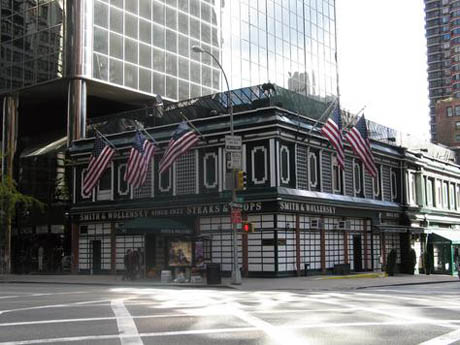
This image depicts the steakhouse brand founded by Stillman later in his career.