The 'Six Degrees of Kevin Bacon' game is a cultural staple based on the premise that any actor can be linked to Bacon through a chain of co-stars in fewer than six steps. However, a data-driven analysis of a 169,000-actor dataset reveals that Bacon's 'remoteness' score—the average number of steps required to connect any actor to him—is 2.28. While this makes him highly connected, he actually ranks 175th among all Hollywood actors in this specific metric.
The image provides a visual reference for Kevin Bacon, who serves as the cultural benchmark for the connectivity analysis discussed in the first paragraph.
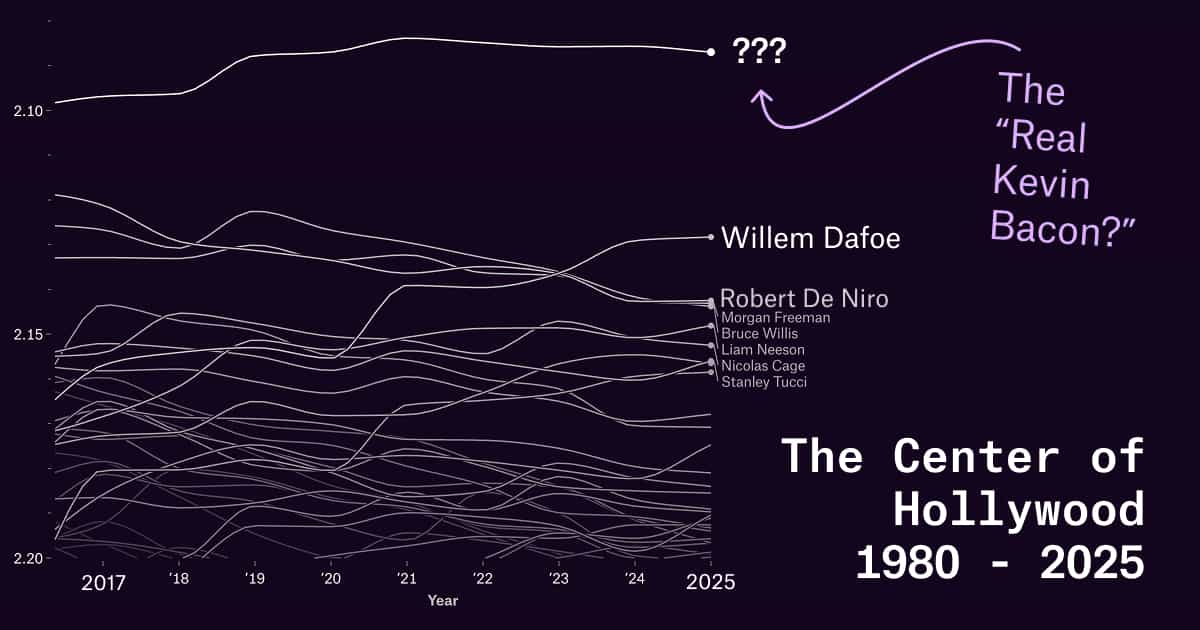
The analysis identifies Samuel L. Jackson as the current 'center of Hollywood' with a remoteness score of 2.09, followed closely by Willem Dafoe (2.13) and Robert De Niro (2.14). The study highlights that an actor's connectivity is driven by two primary factors: total film count and the 'prolificness' of their co-stars. For instance, while Natalie Portman and Anna Kendrick may have similar film counts, Portman is more connected because she frequently works with 'big dog' actors—those who have appeared in a high volume of films. This co-star film count is calculated by averaging the film counts of an actor's 50 most prolific co-stars.
To predict who might eventually unseat Samuel L. Jackson, the study used a simulation modeling the career trajectories of 99 Gen Z actors who have appeared in at least five films. By comparing their current film counts and co-star data against historical career paths, the simulation ran 10,000 times to identify potential successors. Chloë Grace Moretz emerged as the most likely candidate, winning 11.6% of the simulations. However, the study notes that her median projected film count of 66 is still significantly lower than Jackson's 116 career films, suggesting that while she is a frontrunner, the transition of the 'center of Hollywood' title remains a long-term projection. The analysis also notes that as Jackson eventually stops appearing in new films, his connections to new actors will diminish, eventually allowing younger actors to overtake his status as the industry's central hub. (Source: primary, hn-50169499)
One limitation of this specific dataset is that it focuses on a subset of actors and films, which can yield different results than broader datasets. For example, the 'Oracle of Bacon' project, which utilizes the full IMDb dataset, identified Eric Roberts as the most connected actor and Samuel L. Jackson as fifth. Additionally, the simulation's reliance on historical career trajectories assumes that future career paths will mirror past patterns, which may not account for shifts in industry trends or individual career choices. (Source: hn-50169499)
Furthermore, the study highlights a gender disparity in the data: women are significantly underrepresented among the top 100 most connected actors, occupying only 16 spots. Nicole Kidman is the highest-ranking woman at #21. This suggests that the 'center of Hollywood' metric may reflect historical casting trends and the distribution of prolific roles rather than just individual talent or popularity. (Source: primary)
Finally, the analysis points out that while the 'Six Degrees' game is a fun cultural fact, the actual average distance between any two actors is even shorter. The data suggests that most actors can be reached in approximately 2.6 moves, making the 'six degrees' a generous upper bound for Hollywood's interconnected web. (Source: hn-50169499)