Kimi has introduced K3.1 Pro, the first model in its K3.1 series and its most capable 3T-class open-weights model to date. Designed to advance open intelligence, the model features a 1-million-token context window and is optimized for agentic capabilities across several domains, including coding, 3D creation, and financial research. To support high-speed interactions, the company also released Kimi K3.1 Pro Highspeed, which provides 2-3x faster performance than the standard Pro version. While the models are currently available via Kimi's API and web platforms, the full model weights are scheduled for public release on November 4, 2026.
The model's performance is driven by a substantial increase in post-training compute compared to its predecessor, Kimi K3. On coding benchmarks, K3.1 Pro demonstrates competitive results against major proprietary models. For example, on Terminal-Bench 4.0—which evaluates coding agents on resource-constrained terminal tasks—K3.1 Pro scored 65.7%, surpassing GPT-6 Astra (58.2%) and trailing only slightly behind Claude Opus 5.5 (66.4%). In 3D modeling, the model can infer spatial relationships from text or sketches to generate usable CAD-compatible assets, scoring 92.7% on the BenchCAD benchmark. Furthermore, K3.1 Pro shows significant gains in financial workflows, achieving a 4.2x performance increase over K3 in simulated business operations and improving its factual accuracy on the Kimi Hallu Bench Hard stress test.
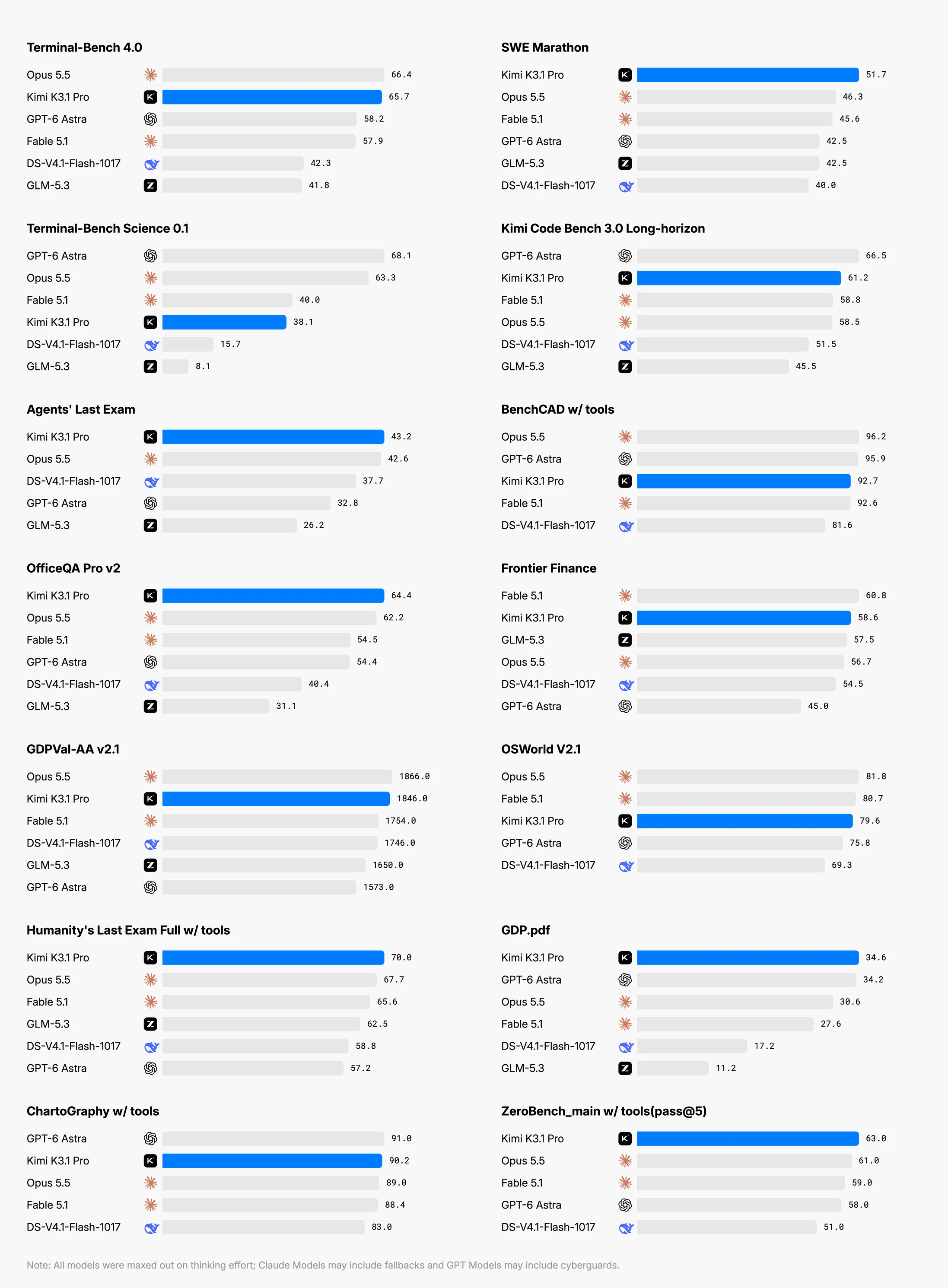
The model's performance is driven by a substantial increase in post-training compute compared to its predecessor, Kimi K3. On coding benchmarks, K3.1 Pro demonstrates competitive results against major proprietary models.
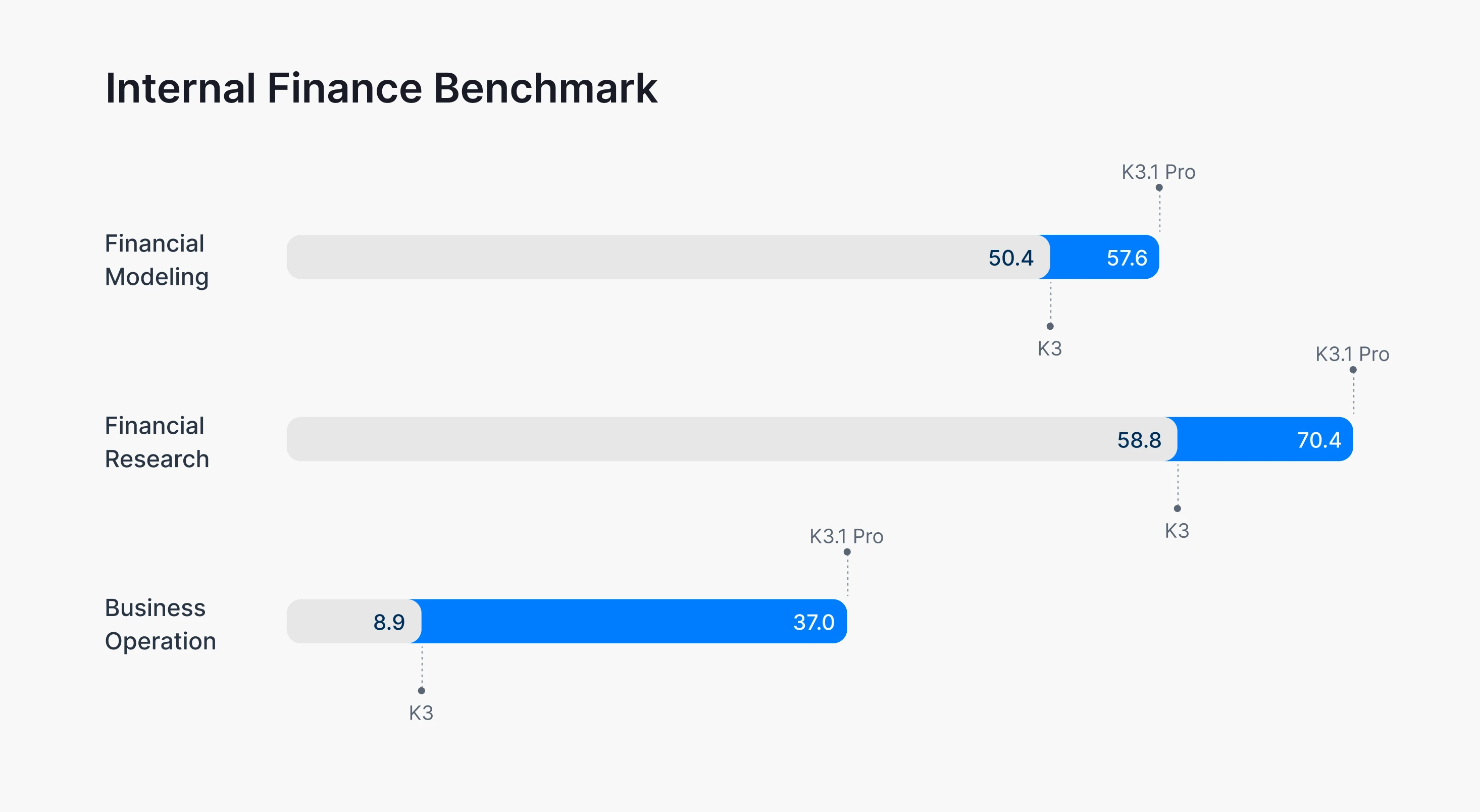
Furthermore, K3.1 Pro shows significant gains in financial workflows, achieving a 4.2x performance increase over K3 in simulated business operations and improving its factual accuracy on the Kimi Hallu Bench Hard stress test.
To manage the risks associated with high-capability models, Kimi implemented targeted controls during the training process to reduce offensive cyber capabilities. The company identified that cyber-related content was naturally embedded in the general mid-training corpus and RL environments; by removing this specific data while retaining general-purpose coding tasks, they successfully reduced the model's vulnerability research performance. In internal testing, the version without these risk-reduction measures solved 90.5% of problems on the xdev-bench-hard benchmark, while the final K3.1 Pro version reached 81.0%. Kimi maintains that while these measures reduce offensive capabilities, the model remains a useful tool for defensive purposes, such as auditing legacy codebases for security vulnerabilities.
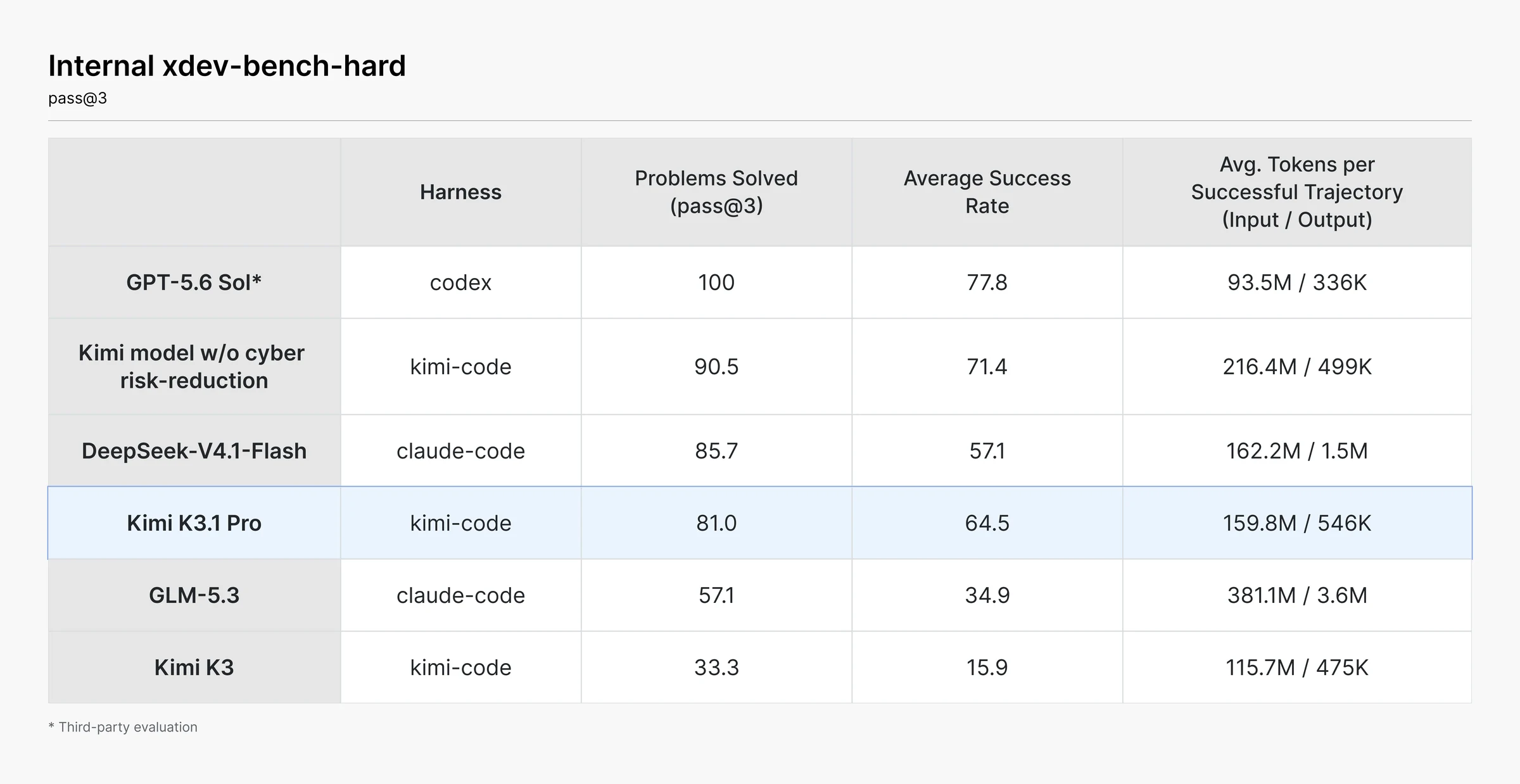
In internal testing, the version without these risk-reduction measures solved 90.5% of problems on the xdev-bench-hard benchmark, while the final K3.1 Pro version reached 81.0%.