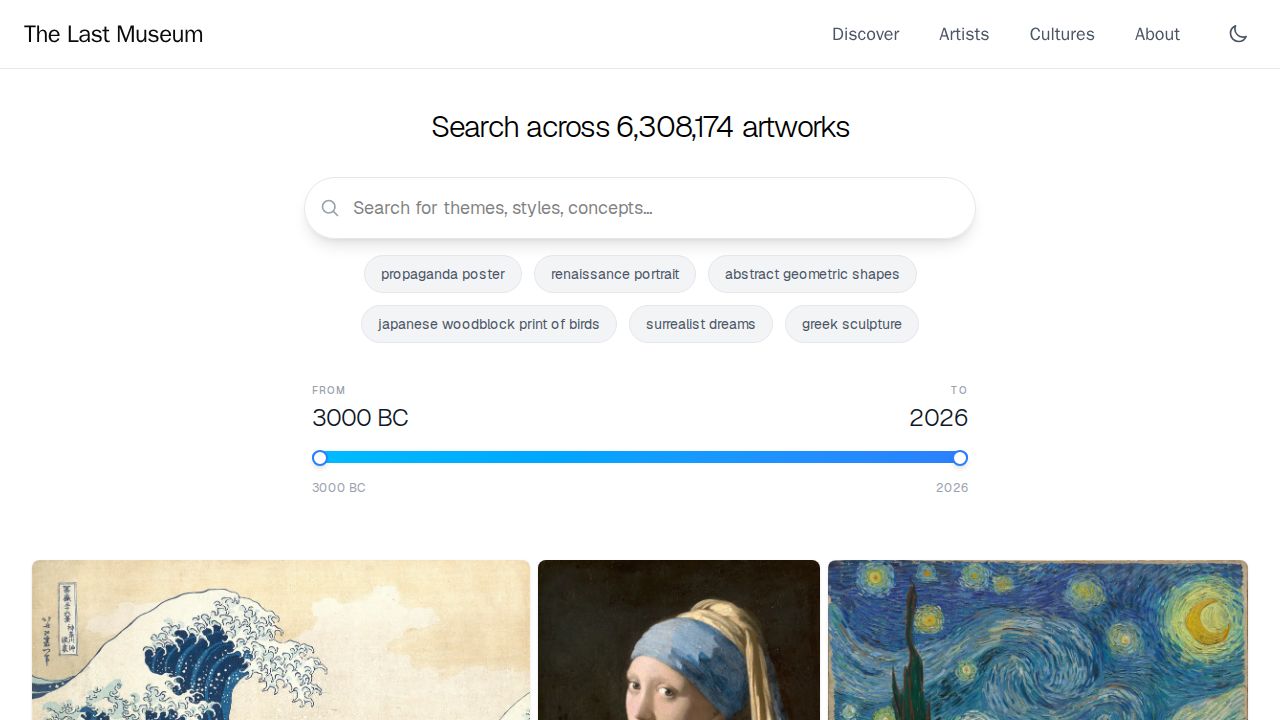
The Last Museum is a project designed to facilitate semantic search across a vast repository of over 5.8 million artworks sourced from major museums. Unlike traditional museum databases that rely on specific metadata or keyword matching, this platform utilizes artificial intelligence to understand the conceptual context of a query. This allows users to discover art based on themes, styles, or abstract descriptions, effectively creating a searchable index of humanity's collective artistic output.
Technical discussions surrounding the project highlight the use of embedding models, such as those in the Gemma family, to process and index these works. These models convert information into high-dimensional vectors, enabling the system to identify 'similar' items based on proximity in a conceptual space. However, users have noted practical challenges with this approach. For instance, some queries for specific historical figures or themes have returned aesthetically similar but contextually incorrect results, suggesting that the nuance of artistic intent can be difficult for current embedding models to capture perfectly.
While the project offers a novel way to interact with art history, it faces hurdles regarding data quality and user experience. Commenters have pointed out that museum metadata is often inconsistent—ranging from detailed descriptions to brief labels like 'Vase, terracotta'—which can affect the accuracy of the underlying embeddings. Additionally, without robust filtering systems, the sheer volume of results can make navigation difficult. There is also an ongoing debate regarding the role of such tools: some see them as a way to enhance human creativity by making art more accessible, while others argue that a digital index cannot replace the curated, interpretive experience of a physical museum exhibit.
Furthermore, the project's scope involves navigating complex copyright landscapes. Users have suggested that a public domain filter would be a necessary addition to help researchers and enthusiasts identify works they are legally permitted to use. As the project evolves, it remains to be seen how it will balance the massive scale of its dataset with the need for precise, context-aware results that respect the unique history of each individual piece of art.
Ultimately, The Last Museum represents a shift toward 'intelligent' discovery. By moving away from the limitations of manual cataloging, it attempts to surface connections between works that might otherwise remain hidden. Whether it succeeds in becoming a primary tool for art discovery depends on its ability to refine its search accuracy and provide a more manageable interface for its millions of entries.
Key technical and conceptual points discussed include: - The use of embedding models to facilitate conceptual rather than literal search. - The challenge of inconsistent museum metadata affecting search reliability. - The trade-off between automated discovery and the curated experience of traditional museums. - The need for copyright filters to distinguish public domain works from protected content. - The potential for AI to support human creativity by surfacing relevant historical context.
Evidence: - The project's primary goal of semantic search across 5.8M artworks is established by the primary source (primary). - The discussion regarding the limitations of current embedding models and the impact of inconsistent metadata is documented in the Hacker News thread (hn-50194522).
Editorial Notes: - The article focuses on the technical and conceptual implications of semantic search in the arts. - It addresses the limitations of AI-driven discovery as highlighted by user feedback. - It clarifies the distinction between keyword search and semantic embeddings.
editorial.evidence_sufficient: true