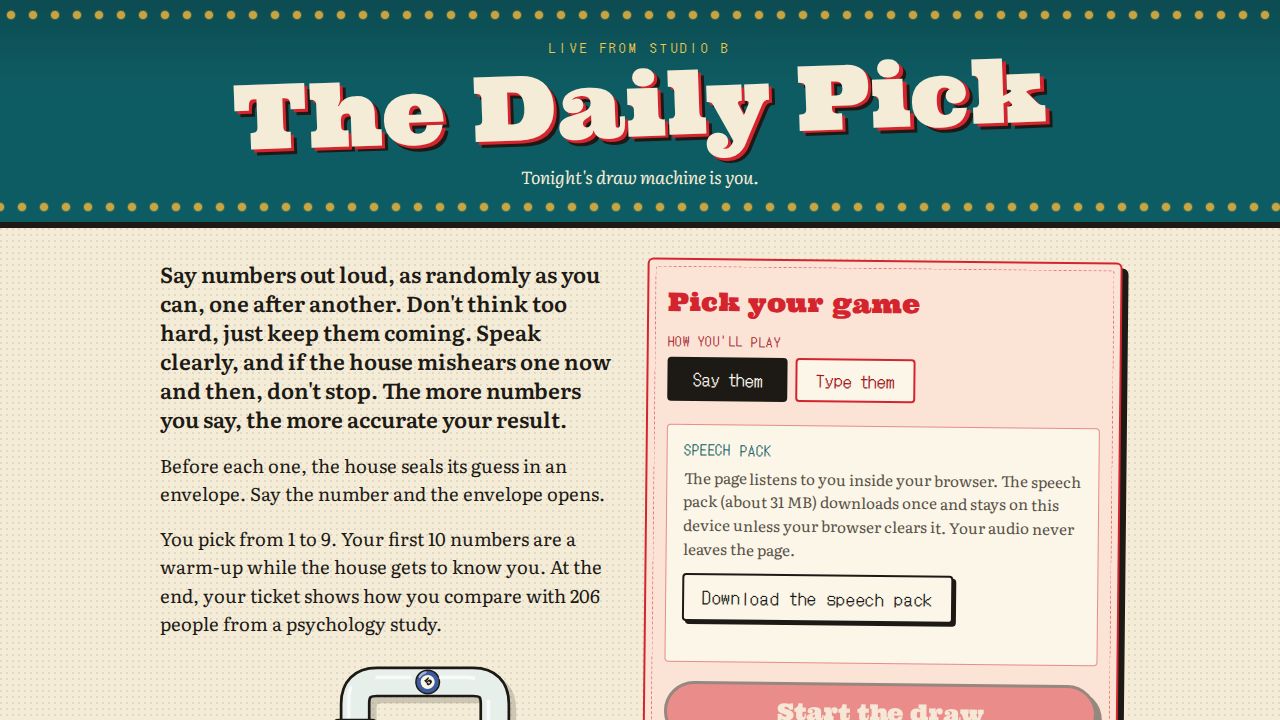
A web-based tool, 'Rigged Draw,' serves as a practical demonstration of the 'Aaronson oracle'—a concept exploring how easily human behavior can be modeled and predicted. The experiment asks users to provide a sequence of numbers, while an underlying algorithm attempts to guess the next number in the sequence. The goal is to determine how 'random' a human's choices truly are by comparing their performance against a baseline of blind guessing, which typically yields a success rate of approximately 11.11%.
Technical discussions around the project reveal that humans are often surprisingly predictable. One commenter noted that even crude probabilistic models can predict human keystrokes with 70% to 80% accuracy because people tend to follow subconscious patterns and avoid certain alternations. The tool's effectiveness stems from its ability to identify these patterns in real-time. Some users reported achieving results that were 'extremely hard to read' by the house, meaning their numbers were predicted less frequently than a blind guess would be, suggesting a high degree of perceived randomness.
However, the experiment also highlights the adversarial nature of human cognition. Some participants reported shifting their strategies as soon as they noticed the algorithm's predictions, consciously trying to avoid the numbers the 'house' called out. This creates a feedback loop where the user's awareness of the prediction model changes the very data the model is trying to predict. Additionally, some users pointed out that the ultimate goal isn't necessarily to achieve a 0% prediction rate, but to hit the 11.11% blind guessing mark; if a user consistently avoids the predicted number, they may still be following a predictable pattern of avoidance, effectively narrowing their own pool of choices.