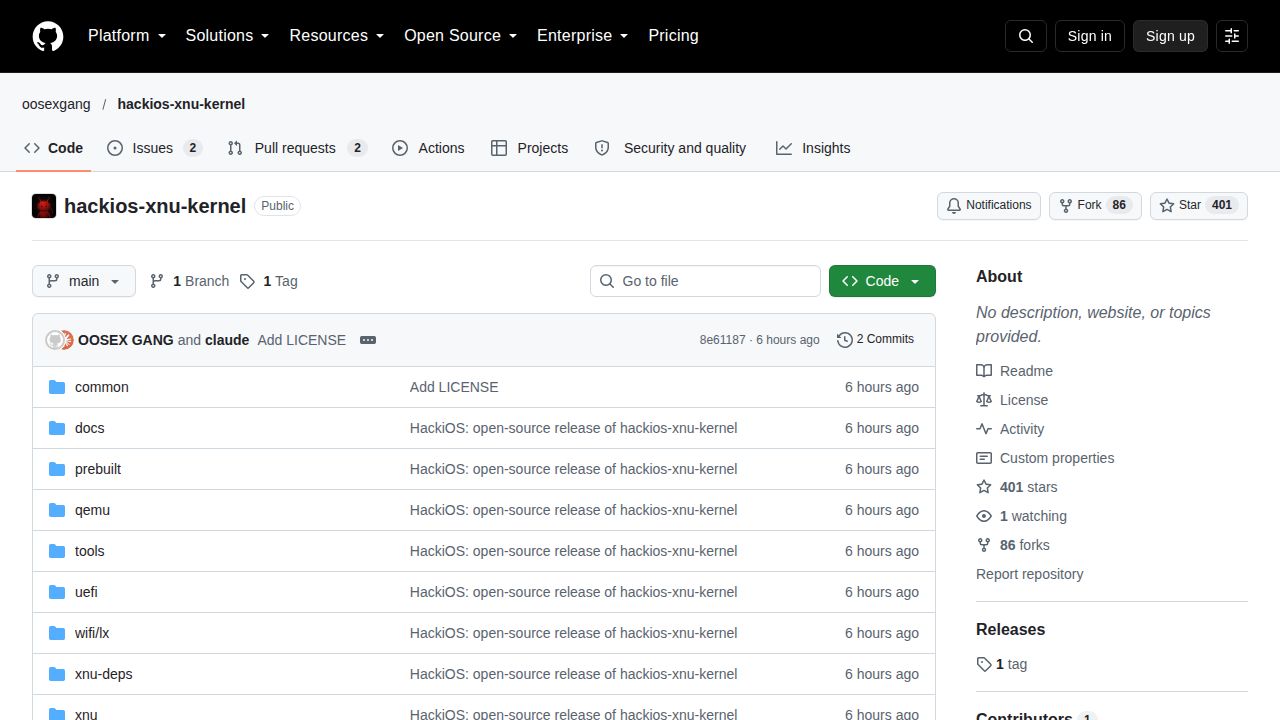
A developer has shared a project that enables running full iOS 16.5 firmware on Android devices, a feat that mirrors the historical 'Hackintosh' movement where macOS was ported to non-Apple hardware. The project, hosted on GitHub as hackios-xnu-kernel, utilizes a custom kernel to bridge the gap between Apple's proprietary software and the hardware architectures of Android smartphones. According to the project's documentation and community feedback, the firmware has been successfully booted on QEMU, the POCO X5 Pro 5G, and several Xiaomi devices.
The technical implementation involves significant hurdles, particularly regarding hardware abstraction and power management. One reported limitation is that the current kernel version does not yet support charging; while the OS can run, the device only discharges during use. Furthermore, the project faces substantial roadblocks regarding Apple's security ecosystem. Because the hardware lacks a Secure Enclave—a dedicated security chip in iPhones—features like App Store content and Apple ID sign-in currently do not function, as the FairPlay daemon exits when it cannot find the required security hardware.
Community discussion surrounding the project highlights both its research potential and its practical limitations. Some users noted that while this is a significant milestone for research, many modern iOS apps may still fail to run due to the age of the firmware version (16.5). Others raised concerns about the implications for the market, suggesting that such technology could facilitate the creation of more convincing 'replica' phones that mimic the iOS interface. Despite these concerns, the project is being viewed by some as a potential path toward a fully jailbroken iOS environment where the kernel can be modified freely, a feat restricted on standard iPhone hardware. The project also maintains a community-funded model via a token on the BNB Chain to support ongoing development.
While the project demonstrates that hardware boundaries are becoming increasingly fluid, the lack of integration with Apple's proprietary security protocols remains a primary barrier to a seamless user experience. For now, the project serves primarily as a proof-of-concept for cross-platform OS execution and a tool for researchers interested in the inner workings of the XNU kernel.