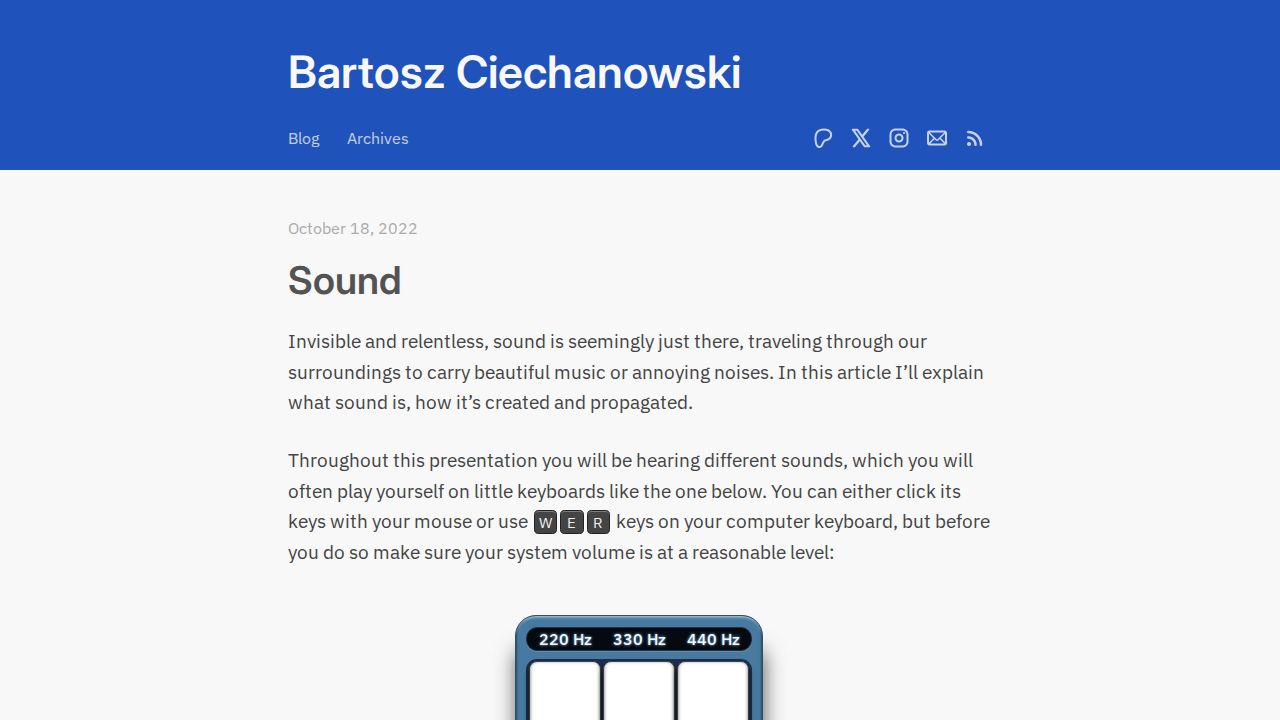
Bartosz Ciechanowski’s interactive project, "Sound (2022)," provides a comprehensive educational journey into the mechanics of acoustics. The piece is designed to guide readers through a logical progression of physical concepts, beginning with the behavior of individual air molecules. By visualizing how these molecules bounce and interact, the project establishes the foundational mechanics of pressure waves before moving into more complex territory.
The core of the project lies in its ability to connect these microscopic movements to macroscopic auditory experiences. As users interact with the visualizations, the content explains how simple molecular collisions evolve into the phenomena of harmonics and interference. This approach aims to provide a deeper understanding than traditional music theory, which often presents concepts like "the third" or "the fifth" as abstract rules without explaining the underlying physics of the audio signal.
Discussion surrounding the project highlights its value as a high-quality educational tool, with some users noting its utility for children and students of music. Commenters on Hacker News observed that the project's meticulous attention to detail and "artistry" distinguishes it from more common, lower-quality visualizations. While some expressed concern that the rise of easily generated content might overshadow such labor-intensive, high-fidelity work, others praised the project as a prime example of what the web can achieve for public science education. The project has also served as a structural inspiration for other complex scientific explainers, such as browser-based climate models.