During the late 14th century, the mechanical clock emerged as a prominent fixture in European civic and ecclesiastical life. However, these early machines were technically imperfect and required constant specialized care to remain functional. Because they were prone to breaking down, they became unique intellectual tools for medieval thinkers. Rather than representing a self-sustaining system, the clock served as a metaphor for a world that required continuous maintenance and skilled intervention to maintain its regularity.
One of the most notable examples of this metaphor appears in the work of the theologian Nicole Oresme. In his 1377 translation of Aristotle’s 'On the Heavens,' Oresme compared the movement of celestial spheres to a man-made clock. He described the heavens moving according to 'motive forces' and 'resistances,' terms that evoked the internal mechanics of a clock's weight and escapement. While some historians view this as a precursor to the modern 'clockmaker' theory of the universe, Oresme’s work also explicitly included angels as movers. This apparent contradiction—a self-moving clock that still requires external actors—is resolved by understanding the medieval context: the clock was seen as a machine that could only run if it was properly 'watched over' and repaired.
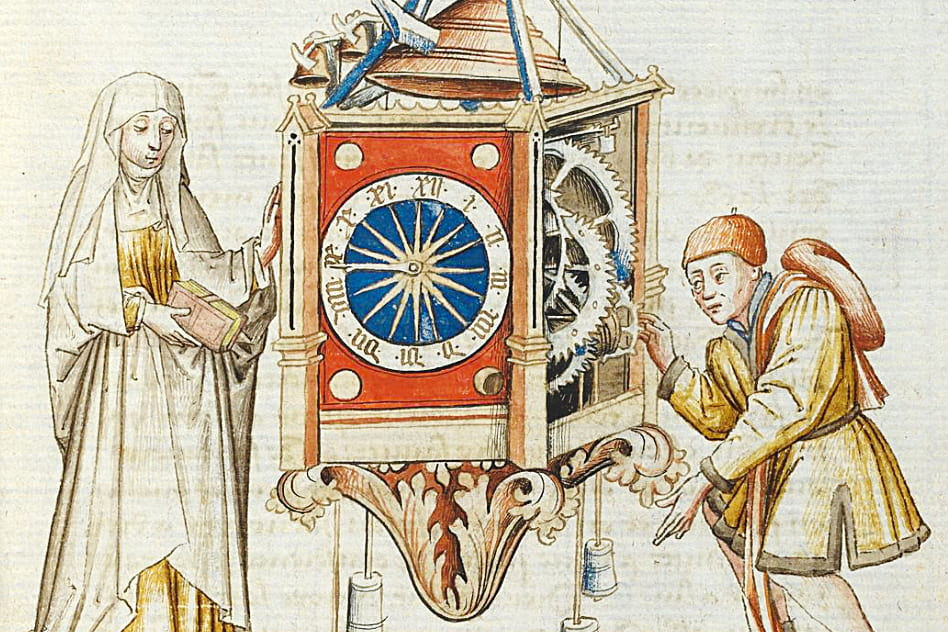
This image represents the overarching theme of the article regarding the clock as a metaphor for cosmic and political order.
These metaphors extended into the realms of theology and politics, where the 'horologist' (the clockmaker or repairer) represented divine providence or a wise monarch. For instance, the advisor Philippe de Mézières used the clock to describe the Virgin Mary’s role in restraining divine justice, and later depicted the kingdom of France as a broken clock that required the king's reform. In these contexts, the clockwork mechanism symbolized a social and cosmic order where lawlike regularity was not a given, but a fragile state sustained by intelligent stewardship. By focusing on the clock's fallibility, medieval authors were able to argue for a universe and a state that remained dependent on active, purposeful governance.