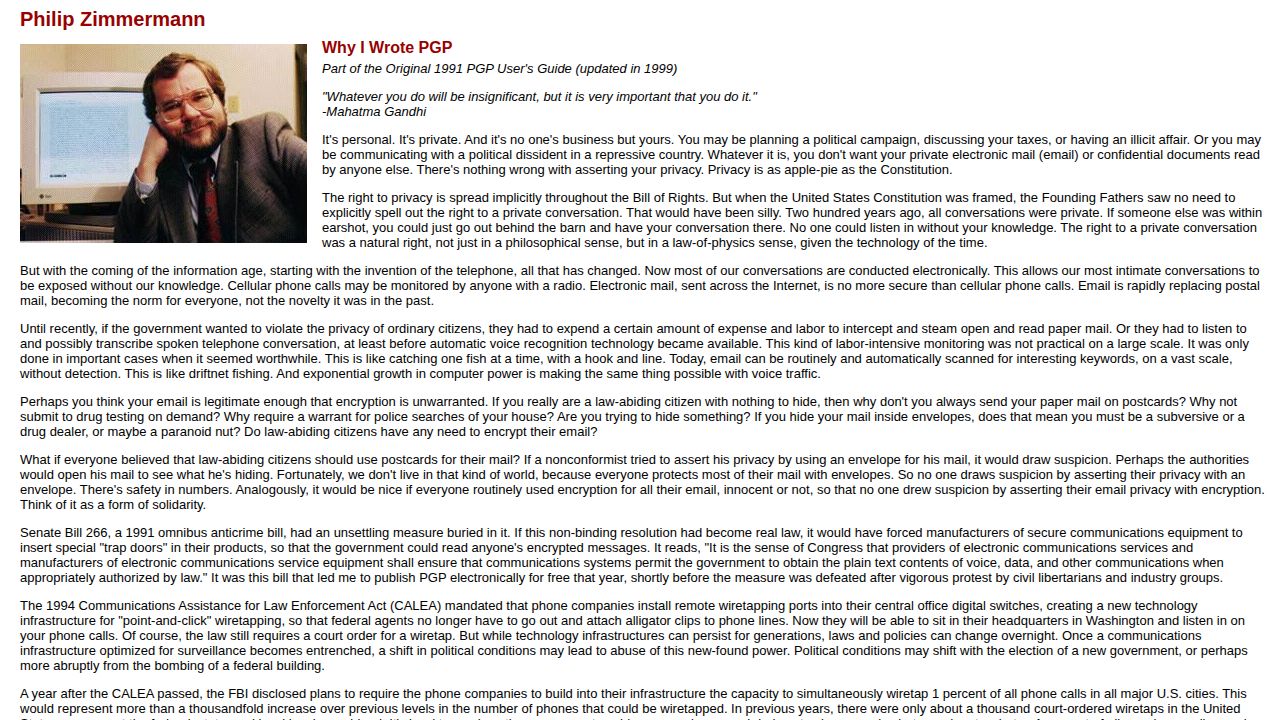
Pretty Good Privacy (PGP) was developed by Phil Zimmermann as a tool for secure communication, establishing one of the first widely accessible methods for public-key cryptography. In his reflections on its creation, Zimmermann noted a recurring theme often referred to as "Zimmermann's Law": the tendency for technology to evolve in directions that facilitate easier surveillance. This observation underscores a fundamental conflict in software development—balancing the desire for private communication with the systemic pressures of data collection and monitoring.
Despite its historical significance, many users have identified substantial usability barriers that prevented PGP from becoming a universal standard. Historically, the process required manual key exchanges and moving text between different applications for encryption before sending via email. Modern commenters note that these friction points persist; even today, managing identities as files remains an abstract concept for most people. While some developers appreciate the transparency of seeing raw ciphertext rather than hidden background processes, others argue that the focus should shift away from perfecting underlying cryptography toward creating unified standards for E2EE usability.
In contemporary web environments, implementations like OpenPGP.js are being used to integrate these principles into modern architectures. For example, some projects use browser-side generation to ensure private keys never leave the client device, while servers only store public keys for signature verification. This approach minimizes risks such as database leaks of password hashes by allowing clients to own their session identity directly. However, the debate continues over whether individual cryptographic tools can ever achieve mass adoption without solving the core problem of making complex security invisible to the average user.
Ultimately, PGP serves as both a technical milestone and a case study in trade-offs. It proved that end-to-end encryption is technically feasible but also demonstrated how high interaction costs—such as manually handling keys or navigating multi-app workflows—can limit its reach. As surveillance capitalism and automated data processing continue to scale, the challenge remains to provide robust privacy protections that do not require users to be experts in the mechanics of the system they are trying to protect.
(Note: The discussion highlights various perspectives on 'Zimmermann's Law,' with commenters debating whether increased traffic volume makes automated voice recognition more likely an inevitable tool for bulk surveillance.)