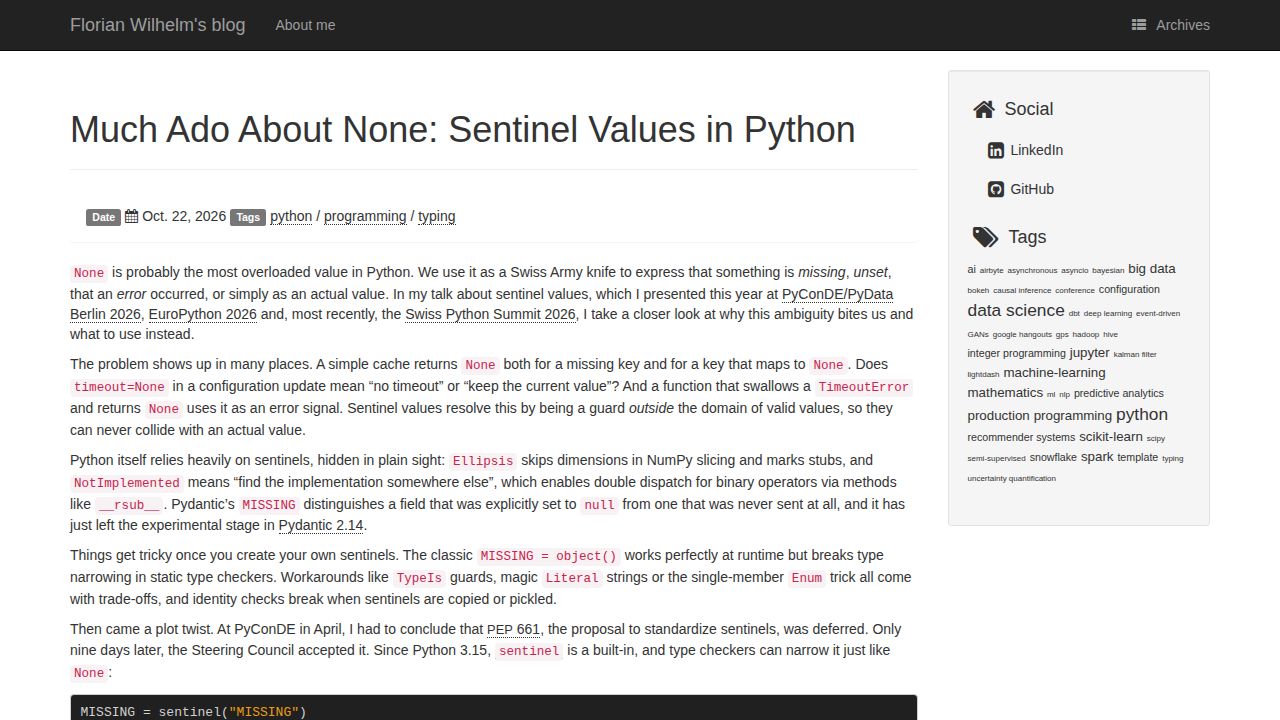
In Python, 'None' is frequently used as a 'Swiss Army knife' to signal that a value is missing, an error occurred, or a configuration is unset. However, this versatility creates semantic ambiguity. For example, in a cache system, a return value of 'None' could mean a key is missing from the dictionary or that the key exists but is explicitly mapped to 'None'. Similarly, in configuration updates, a 'timeout=None' parameter might be interpreted as 'no timeout' or 'keep the existing value,' depending on the implementation. To resolve these collisions, developers can use sentinel values—unique objects that exist outside the domain of valid data, ensuring they never overlap with actual values.
Python's standard library already utilizes several built-in sentinels to manage complex behaviors. The 'Ellipsis' (...) object is used to skip dimensions in NumPy slicing, while 'NotImplemented' serves as a signal to find an implementation elsewhere, enabling 'double dispatch' for binary operators. More recently, the Pydantic library introduced a 'MISSING' sentinel to distinguish fields that were never sent from those explicitly set to null. Historically, developers created custom sentinels using 'object()', but this approach often broke static type narrowing in tools like MyPy. While workarounds like 'Literal' strings or 'Enum' tricks were common, they often came with trade-offs regarding identity checks or pickling.
With the acceptance of PEP 661, Python 3.15 introduced a dedicated 'sentinel' built-in to standardize this pattern. This allows type checkers to narrow types just as they do with 'None'. For instance, a function can now check if a parameter is exactly the 'sentinel' value to determine if an action should be skipped, while still allowing 'None' to represent a valid 'empty' state. While the new built-in provides a cleaner path for API design, developers on older versions can use 'typing_extensions' for a backport. The shift toward formal sentinels highlights a move toward more precise semantics in Python, moving away from the overloaded use of 'None' toward explicit, type-safe representations of absence.