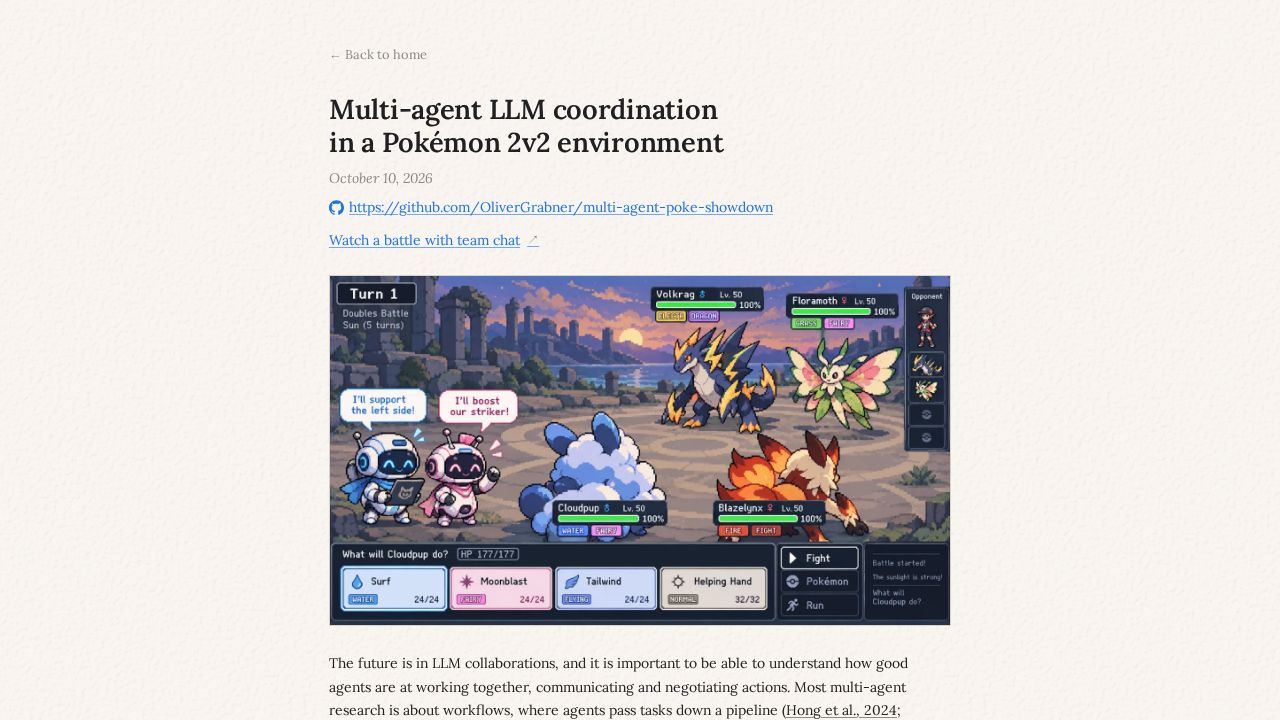
Researchers are testing the utility of Large Language Model (LLM) agents in Pokémon Showdown, a battle simulator that presents a unique challenge for artificial intelligence. Unlike games with perfect information, such as Chess, Pokémon battles involve hidden variables, including an opponent's specific move sets and items. The experiment explores how these general-purpose language models can navigate the game's mechanics, which require both tactical planning and the ability to interpret hidden information.
The current implementation uses a fixed, random seeded pool of teams to ensure consistency during testing. While the agent performs better than an amateur player, it remains beatable by human opponents. The project highlights the growing capability of general-purpose LLMs to act as 'agents'—systems that can reason through multi-step processes and make decisions in dynamic environments. This contrasts with traditional reinforcement learning approaches, which often require specialized engines and massive self-play iterations to achieve high-level performance.
Discussion around the project reveals several technical nuances and limitations. One point of interest is the role of 'reasoning' within the model; it is unclear if the agent's internal messaging serves as a proxy for deeper reasoning or if it simply processes the immediate state of the game. Additionally, the game's mechanics include semi-random elements, such as damage rolls, which can complicate an agent's ability to predict outcomes perfectly. While the agent currently operates in a controlled environment, the ultimate goal is to see how these models compare to specialized bots that have already reached the top of the leaderboard using dedicated reinforcement learning techniques.