The pursuit of high-performance software using pure functional programming (FP) often encounters a hurdle when competing with mature systems written in low-level languages like C. Recent benchmarking by Richard Feldman highlights this dynamic by evaluating different FP implementations against standard DEFLATE compression tools. The tests demonstrate that while modern functional languages are closing the gap, specific architectural optimizations available in C remain difficult to replicate without native access.
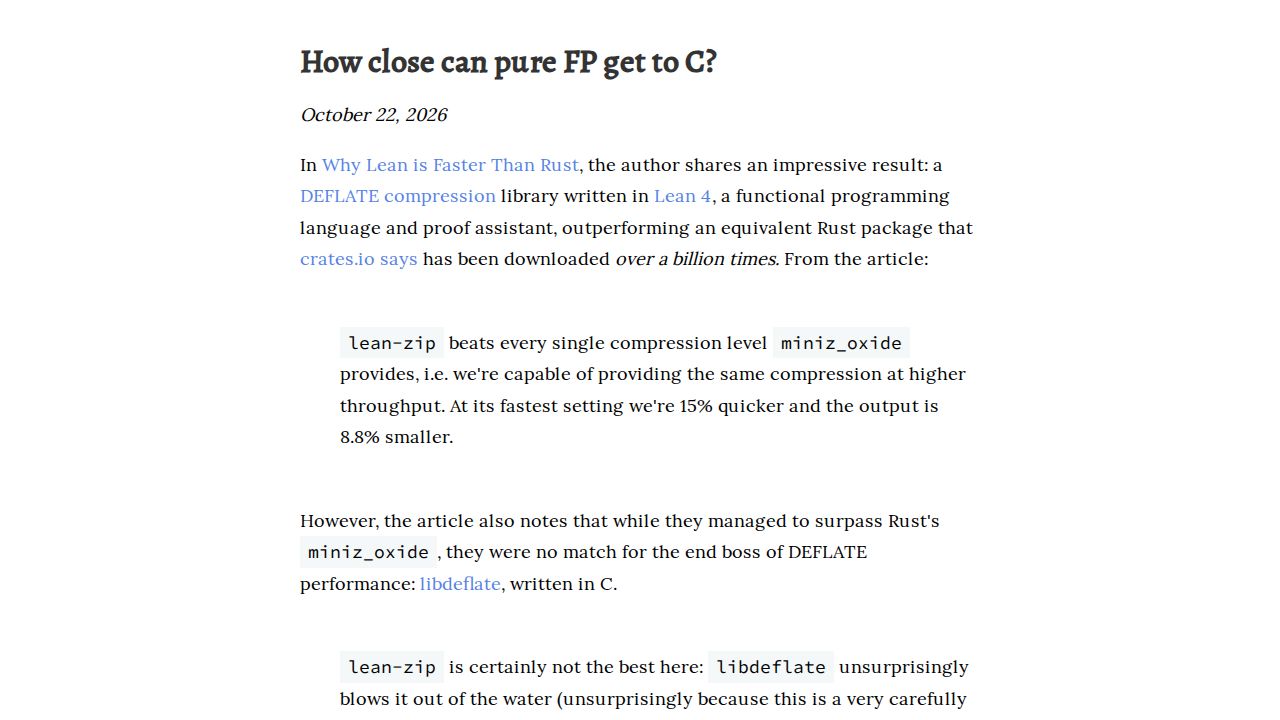
One notable success was achieved using Lean 4, a functional programming language and theorem prover. A library named `lean-zip` outperformed an equivalent Rust package (`miniz_oxide`) across all tested compression levels. At its fastest setting, the Lean implementation was up to 15% quicker and produced outputs that were 8.8% smaller than the Rust alternative. However, despite surpassing one major ecosystem's standards, it could not match `libdeflate`, a specialized C library. This disparity is attributed to `libdeflate`’s use of architecture-specific SIMD (Single Instruction, Multiple Data) instructions, which provide hardware-level parallelism that current functional abstractions cannot easily leverage.
To further test the limits of these languages, benchmarks were conducted on Roc, a nascent functional language designed specifically for runtime performance. Using a package called `roc-deflate`, researchers compared its output against `libdeflate` using the Silesia corpus—a standard set of files used for testing compression algorithms. On an AMD Ryzen 9 3900X machine, `roc-deflate` performed within roughly 8.9% of `libdeflate`'s speed; on an M1 MacBook Pro, the gap narrowed significantly to just 2.6%. These results suggest that while pure FP may currently struggle to reach the absolute peak of hand-tuned C code due to compiler limitations regarding specific CPU instructions, they are capable of achieving high-performance parity in many production contexts.
One critical limitation identified in these tests involves streaming APIs and architectural constraints. For instance, some optimizations achieved in Roc have yet to be implemented for non-streaming operations. Additionally, because functional compilers often prioritize safety and abstraction over direct memory manipulation or specialized instruction sets, there remains a 'ceiling' where manual tuning at the assembly level (as seen in libdeflate) provides a definitive edge. The data suggests that as functional compilers evolve, the focus will likely remain on narrowing this percentage difference through better automated optimization rather than attempting to replicate every hardware-specific trick manually.
These benchmarks serve as a practical look at the trade-offs between programming paradigms. While Rust has become a popular choice for systems engineering, these findings indicate that Lean and Roc can provide competitive alternatives depending on the required throughput and the degree of hardware specialization needed by the application. Ultimately, the proximity of these languages to C performance is a moving target influenced by both language design and the maturity of their respective toolchains.
The primary source establishes several key points: first, it confirms that `lean-zip` outperformed `miniz_oxide` across all compression levels; second, it quantifies the specific performance gap between `roc-deflate` and `libdeflate`, showing median slowdowns of 8.9% and 2.6% respectively on different architectures. These claims are supported directly by the author’s benchmarking results provided in the original article.
Evidence Mapping: 1. Claim: lean-zip outperforms miniz_oxide. Source ID: [primary] 2. Claim: roc-deflate performs within ~3% to 9% of libdeflate's speed on tested CPUs. Source ID: [primary]