A new theoretical breakthrough in computational complexity has introduced an integer multiplication algorithm with a worst-case time complexity of o(n log n). While O(n log n) multiplication has been achievable via Fast Fourier Transform (FFT) methods for some time, the o(n log n) result represents a strict improvement, indicating a complexity strictly lower than the standard linear-logarithmic bound. This advancement is rooted in recent research, including work by David Harvey and Joris van der Hoeven, which established the foundational O(n log n) results and provided the framework for these further refinements.
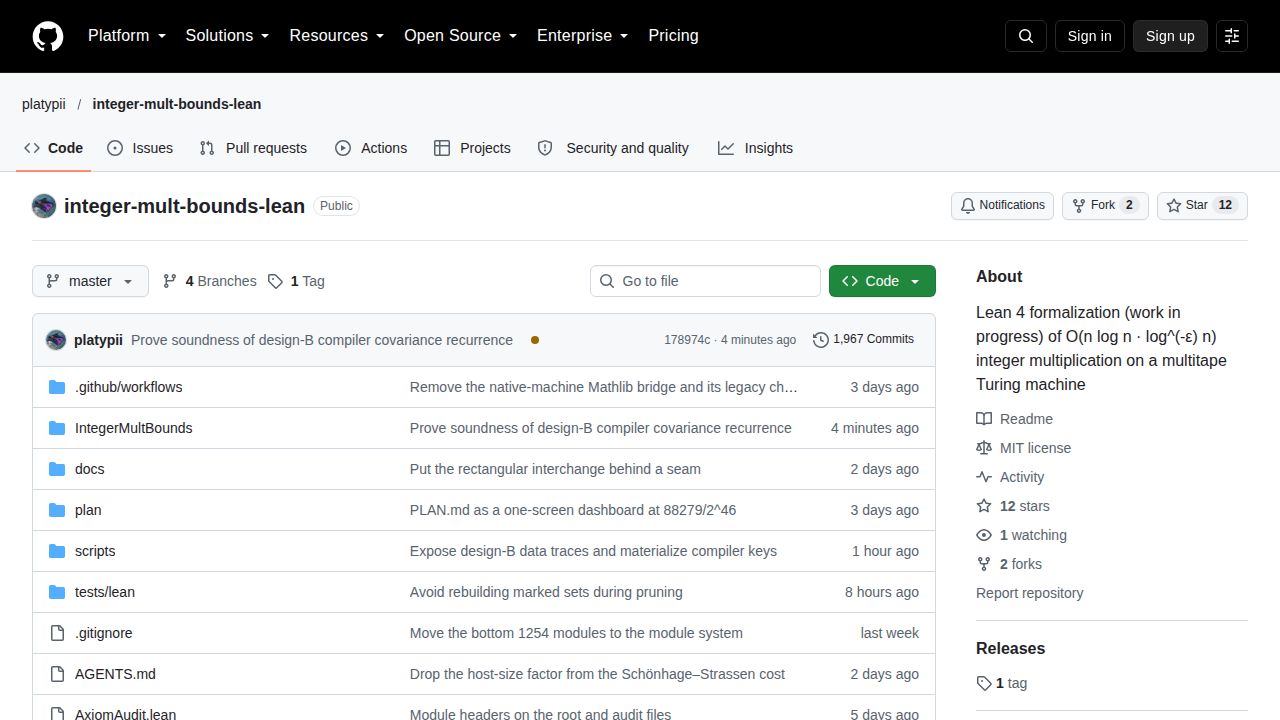
To ensure the mathematical integrity of this new result, developers are currently formalizing the algorithm using Lean 4, a functional programming language and interactive theorem prover. The project, hosted on GitHub, aims to provide an unconditional proof that a fixed multitape Turing machine can perform the multiplication within the O(n * (log n)^(1-kappa)) bound. The current formalization has achieved a positive saving of kappa approx 2^(-14.38). The implementation involves a complex architecture combining linear direct Chinese Remainder Theorem (CRT) routing with compact controls and full-width chunks. By using Lean, the researchers can verify that the machine's transition functions and the resulting complexity bounds are mathematically sound without relying on unapproved axioms or admitted proofs.
Despite the progress in formalization, certain technical hurdles remain. While the current proof is complete for the 2^(-14.38) saving, the project's ultimate goal is a stronger exponent saving of 83/10^12. Additionally, the current result does not directly translate to new complexity bounds for polynomial multiplication over fixed finite fields, such as F_2[x], which remains a distinct problem in computational complexity. The formalization process also requires significant computational resources; the project utilizes guarded build scripts to manage memory limits and execution time, highlighting the intensity of verifying such high-level mathematical proofs in a formal environment.