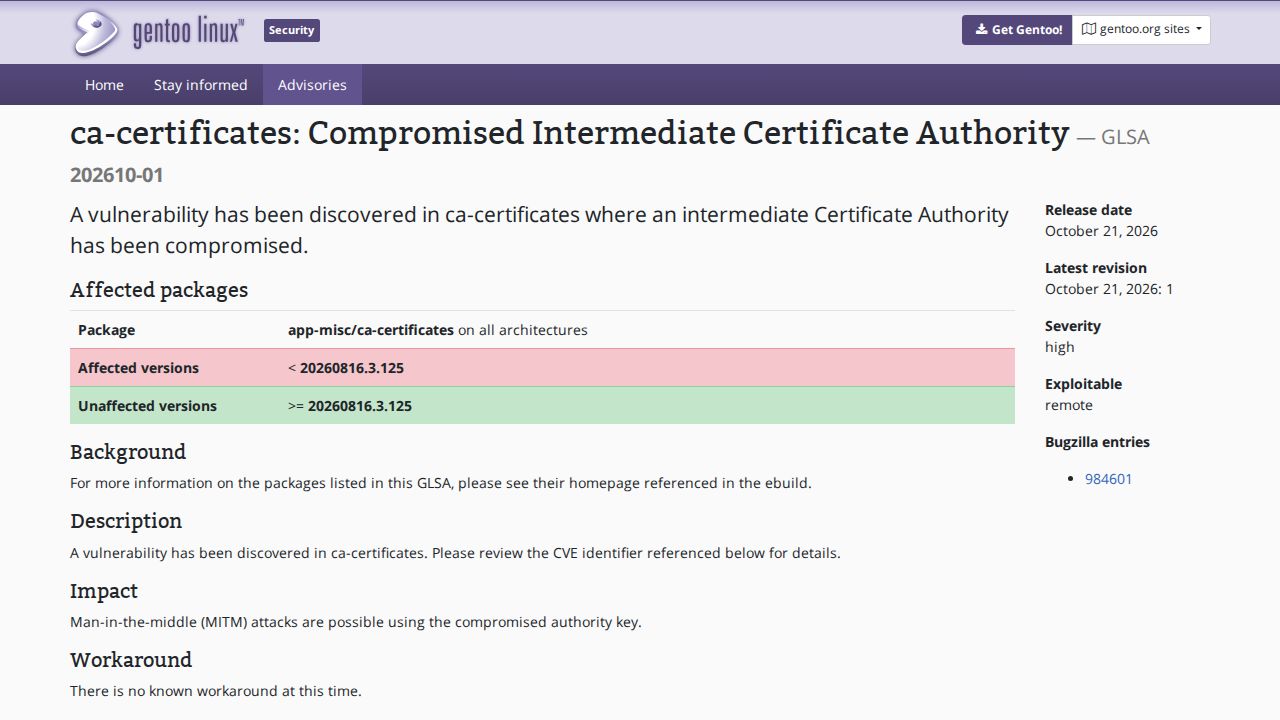
The identification of CVE-2026-111943 marks a formal recognition by the National Institute of Standards and Technology (NIST) of a compromised intermediate Certificate Authority (CA). A Certificate Authority is a trusted entity that issues digital certificates, which verify the identity of websites and servers. When an intermediate CA—a subordinate entity authorized by a root CA to issue certificates—is compromised, it can be used to issue fraudulent certificates that appear legitimate to browsers and software, potentially enabling man-in-the-middle attacks.
Technical discussions regarding the vulnerability highlight how different software ecosystems are responding to the breach. Some observers noted that the issue may be related to the 'eMudhra' debacle, suggesting that while the CVE is new to NIST, the underlying compromise may have been known in certain circles for some time. A key technical distinction emerged regarding how software handles trust: some tools, such as the Go programming language, may proactively block these compromised certificates even if the underlying operating system's trust store has not yet been updated. This proactive blocking is a defensive measure to ensure that applications do not establish secure connections to servers using fraudulent credentials.
For users and developers, the primary remediation involves updating system-level certificate packages and specific software binaries. For example, Gentoo Linux users were advised to update the 'ca-certificates' package to a specific version to ensure the local trust store reflects the revocation of the compromised CA. Furthermore, because some software bundles its own set of trusted certificates directly into its binaries (rather than relying solely on the OS), users of tools like 'uv' or 'certifi' must update those specific packages to remove the compromised certificates from the bundled data. This highlights a fragmentation in security: a system may be patched at the OS level, but individual applications may still remain vulnerable if they use internal, outdated certificate stores.