WorldTUI represents a shift toward 'learned' applications, where a model predicts the next state of a user interface rather than executing code to render it. Developed by SimEdw, the project uses a 360M-parameter model—a scaled-down version of the Qwen2.5-Coder-0.5B architecture—to simulate a terminal environment. Unlike standard terminal emulators that interpret commands against a real operating system, WorldTUI has no backend; every character on the screen is a prediction made by the model based on the history of previous inputs and the current visual state.
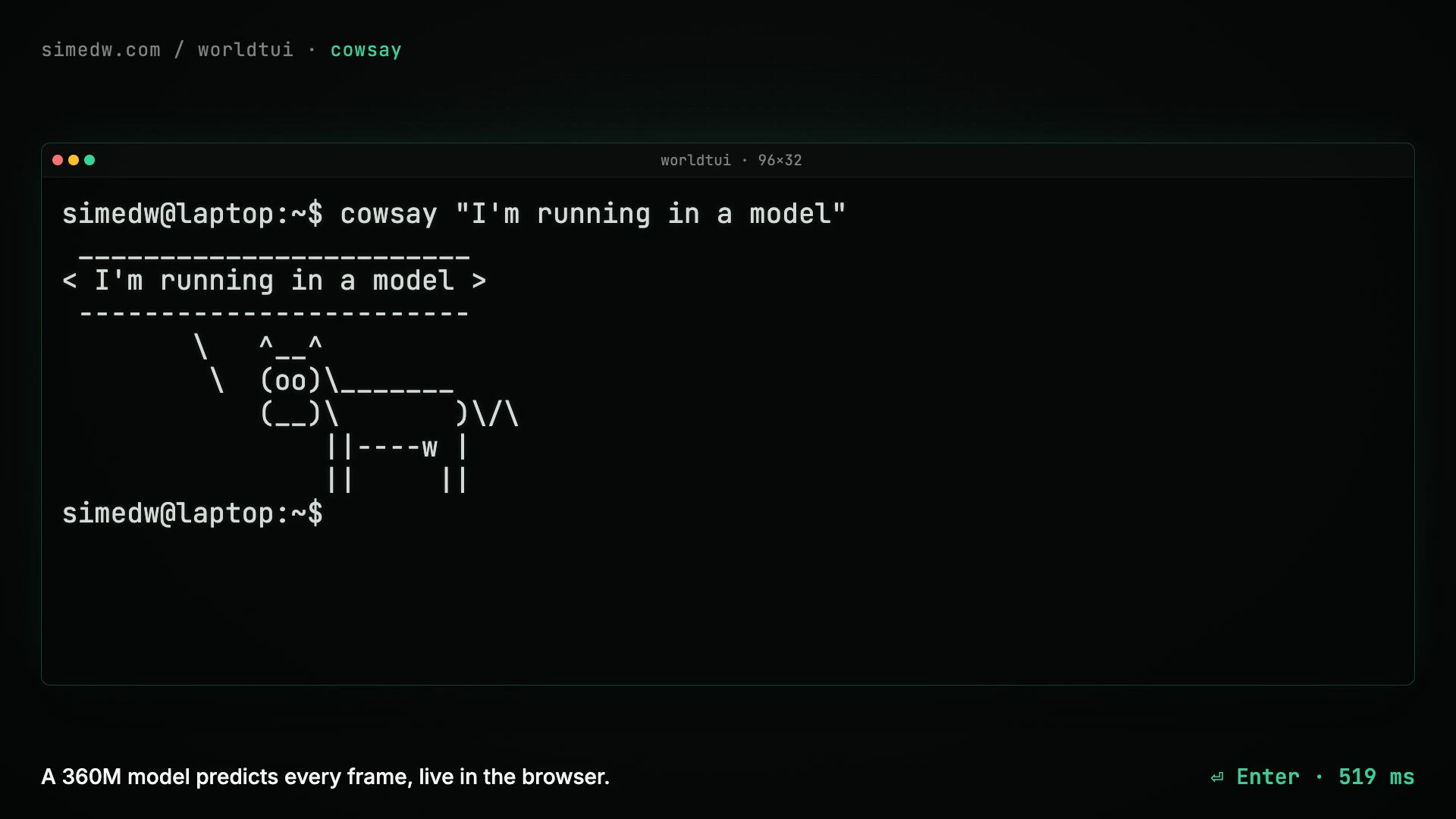
The image demonstrates the model's ability to predict visual terminal states based on user inputs.
To handle the complexities of a terminal, the model treats the screen as a grid of characters. Because a single keypress (such as 'clear' or an 'Esc' sequence in vim) can drastically alter the entire display, the system does not predict a stream of text. Instead, it predicts specific row updates and cursor movements. To maintain performance, the developer implemented a 'COPY' operation, allowing the model to move entire rows of text (like during a scroll) using a few tokens rather than re-generating every character. This approach allows the model to maintain a consistent internal 'world' where it can remember files created in previous steps and navigate complex multi-window environments like tmux.
One of the most significant technical hurdles was achieving real-time performance for large screen updates. Because autoregressive models generate tokens one by one, a full screen redraw could take several seconds. The developer solved this by implementing parallel row decoding, where the model generates updates for different rows simultaneously. To ensure these independent rows remain coordinated (e.g., preventing multiple rows from adding food to a game of Snake at once), the system uses speculative decoding: the parallel rows provide a 'draft' that the model then verifies sequentially. The final model is small enough to run in a web browser via WebGPU, where it is quantized to 208 MB to allow for local, low-latency inference.
Despite its capabilities, WorldTUI still faces limitations in long-term memory and complex logic. While it can successfully perform file readbacks and navigate vim, it can still fail when combining commands in novel ways, such as failing to show an appended line after an 'echo' command. Furthermore, experiments with model distillation showed that while a smaller version of the model could pass memory tests, it often lost the ability to execute a wide range of standard shell commands, highlighting the difficulty of shrinking a 'world model' without sacrificing its functional breadth.