Monte Carlo simulations are a class of computational algorithms that rely on repeated random sampling to obtain numerical results. The core principle is the Law of Large Numbers, which suggests that as the number of independent trials increases, the average of the results will converge toward the expected value. This technique is particularly effective for problems where an analytical solution is difficult to derive or where the number of possible variables is too high to calculate exhaustively. Historically, one of the first documented uses of these methods was by Stanislaw Ulam and John von Neumann to simulate nuclear weapon effects following World War II.
One common way to visualize the mechanism is by estimating the value of pi. By simulating a scenario where 'darts' are thrown uniformly at a square board containing a quarter-circle, the ratio of hits inside the circle to the total number of throws can be used to calculate pi. While simple, this demonstrates a fundamental concept in numerical integration: Monte Carlo methods are often preferred for high-dimensional integrals because their accuracy depends on the number of samples rather than the complexity of the dimensions. However, this method has limitations; for example, estimating pi to four decimal places with reliability requires approximately 10 billion samples because the sampling error decreases in proportion to the square root of the number of trials (1/\sqrt{N}).
Beyond pure mathematics, these simulations are used to solve complex combinatorial and financial problems. In game design, they can be used to balance mechanics—such as determining the win probabilities of a 'Tortoise vs. Hare' race game by simulating millions of turns to ensure equal odds. In finance, Monte Carlo simulations are a standard tool for retirement projections. Unlike a simple average return calculation, which can be misleading because the sequence of returns matters, a Monte Carlo simulation can model thousands of different scenarios involving volatile inflation and fluctuating market returns. This allows planners to see a distribution of outcomes, such as the specific percentage of cases where funds might be depleted before a target age, providing a more realistic view of risk than a single 'average' estimate can offer.
The image illustrates the application of Monte Carlo simulations in balancing game mechanics, specifically for the Tortoise vs. Hare project.
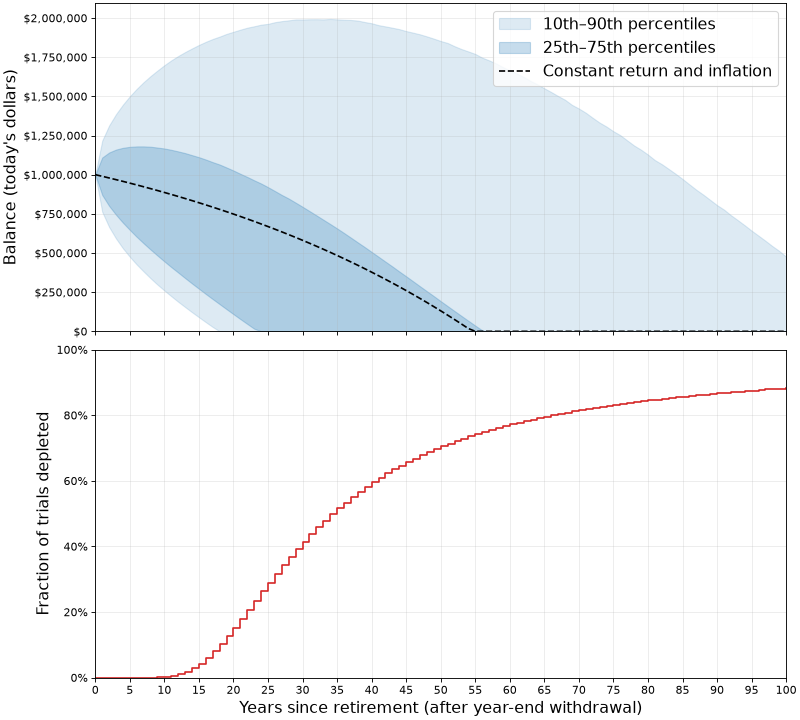
This figure visualizes how Monte Carlo simulations model thousands of scenarios to show the probability of various financial outcomes.