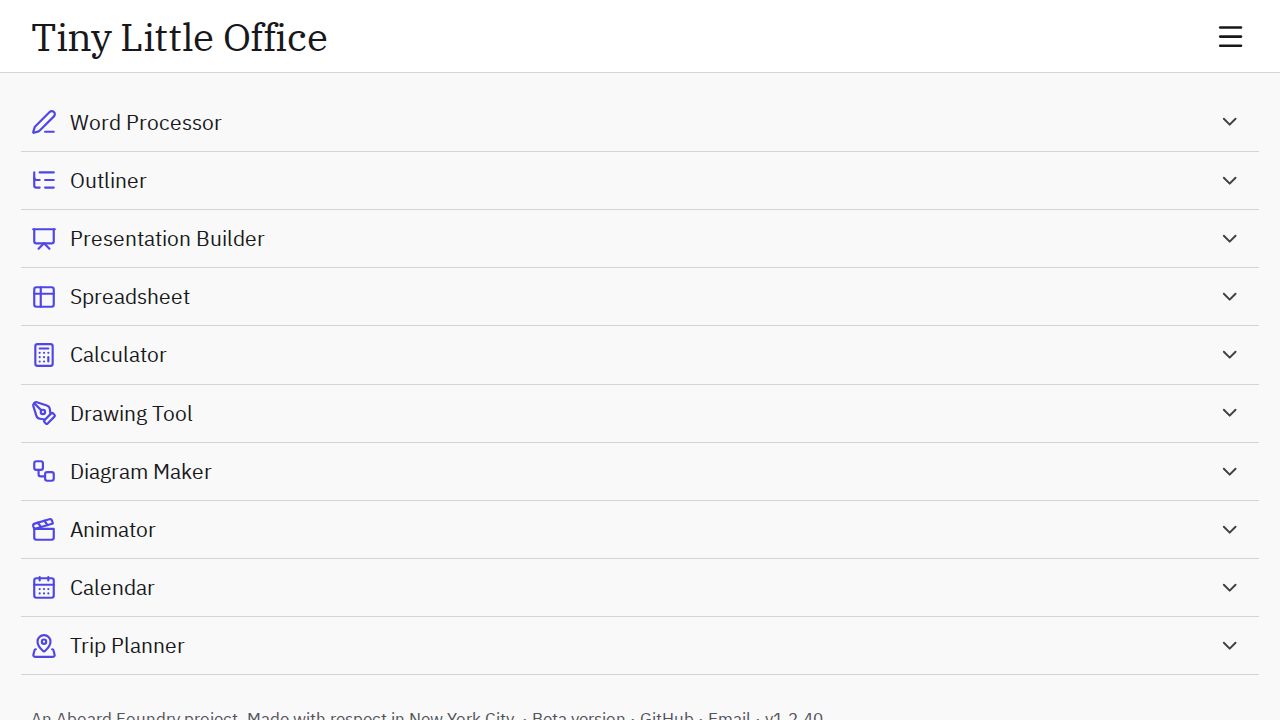
Tiny Little Office is a web-based productivity suite that functions by encoding document data directly into a URL. Unlike traditional office software that relies on a backend database to store and retrieve files, this project allows users to share documents via a simple link where the URL itself contains the content. The suite includes basic tools for word processing, spreadsheets, and presentations, designed to be accessible without the friction of account creation or persistent storage. This approach allows for immediate sharing and self-hosting, though it introduces specific technical constraints regarding the size of the data that can be transmitted in a single link.
The mechanism behind the project relies on the fact that modern browsers can render complex documents if the data is provided in the request. This allows for a 'stateless' experience where the service provider only holds ciphertext temporarily, if at all. However, this architecture creates a hard limit on document complexity. Because URLs have maximum character lengths, text documents in Tiny Little Office are capped at approximately 2,000 characters. This design choice prioritizes portability and ease of distribution over the ability to manage large-scale, complex files, making it more suitable for brief notes or small data sets than for comprehensive corporate reports.
Discussion surrounding the project highlights both its philosophical appeal and its practical limitations. Some users praised the project as a democratizing force in software because it removes the barriers of logins and paid services, while others noted the inherent fragility of 'vibecoded' tools—software built quickly to achieve a specific aesthetic or functional goal. Technical observers pointed out that while the tool is highly portable, it faces real-world hurdles such as rate-limiting and potential blocking by external services like OpenStreetMap. Furthermore, while the project offers a unique way to share information, its utility is currently bounded by its small scale, requiring users to balance the convenience of URL-based sharing against the necessity of larger storage solutions for more extensive work.