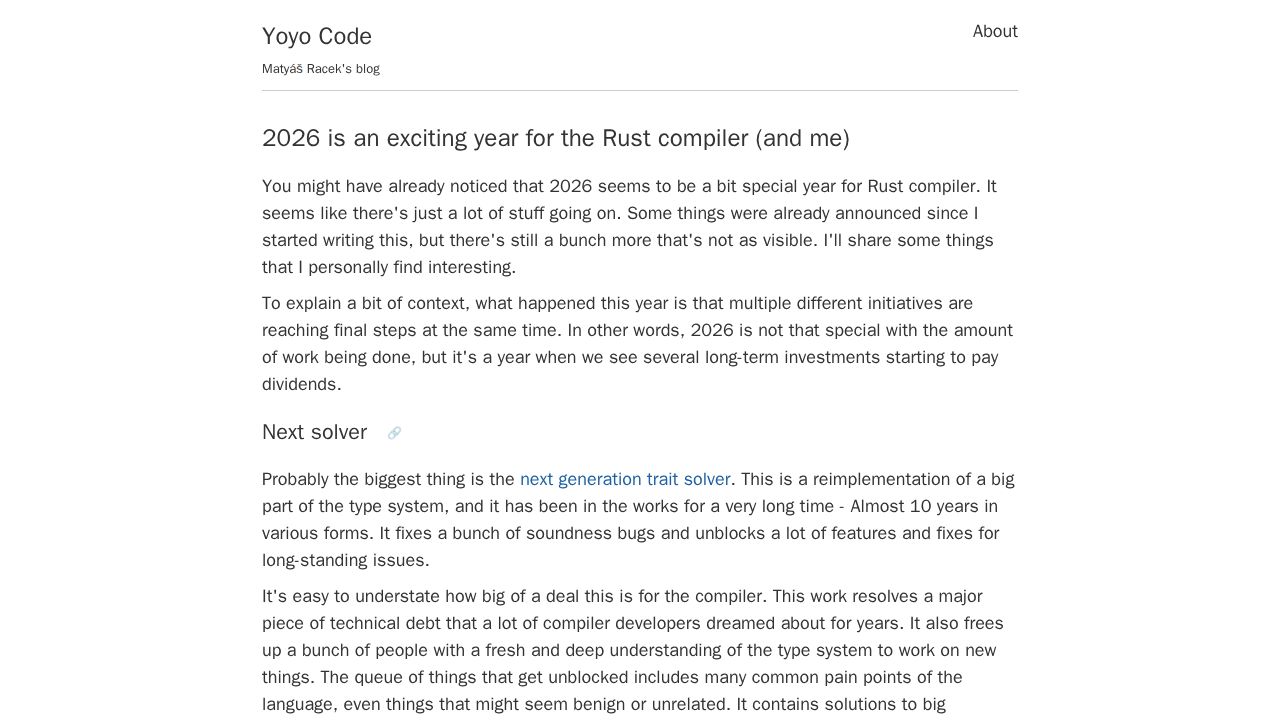
The Rust compiler (rustc) is approaching a pivotal year as several multi-year initiatives reach their final stages of implementation. According to a report by a Rust project contributor, 2026 represents a period where long-term investments in the language's infrastructure are beginning to yield significant dividends. This evolution is characterized by the simultaneous maturation of several core components, including the type system, borrow checker, and the underlying LLVM backend performance.
One of the most significant technical shifts involves the next-generation trait solver. This project represents a nearly decade-long effort to reimplement a core part of Rust's type system. By resolving substantial technical debt, the new solver aims to fix long-standing soundness bugs and unblock features that have been stalled for years, such as specific limitations in asynchronous Rust and 'impl Trait' functionality. Additionally, the 'Polonius' project—a new borrow checker implementation—is moving toward completion. While its impact on the compiler's internal structure is less drastic than the new solver, it is expected to enable more code to compile and potentially unblock internal references.
Compiler performance is also seeing a resurgence after a period of relative stagnation. Key developments include the near-stabilization of a parallel frontend, which allows different parts of the compilation process to run simultaneously. Furthermore, recent updates to LLVM (the backend used by Rust) have shown unexpectedly large positive changes in performance, largely due to a renewed focus on optimization over new feature additions. Other specific optimizations, such as 'move elimination'—a pass designed to remove redundant copies that the LLVM backend struggles to optimize—are being implemented directly in the Rust intermediate representation (MIR) to improve both compile and runtime speeds.
Beyond these technical milestones, the Rust project is refining its organizational framework through 'project goals.' This system provides a structured roadmap for 'Fast Builds' and other performance-related targets. These efforts are supported by new funding models and programs like 'Maintainers in Residence.' These structural changes are designed to ensure that the compiler's development remains sustainable and that performance concerns are integrated directly into the daily workflow of the development team. The culmination of these efforts is intended to reduce target directory sizes, improve build-time caching, and provide a more robust foundation for the language's future growth.