Studying antimatter presents a unique engineering challenge: because antimatter annihilates instantly upon contact with regular matter, it cannot be held in standard laboratory containers. To overcome this, a team of physicists led by Gerald Gabrielse at Northwestern University developed a method to isolate a single positron, the antimatter equivalent of an electron. By using a radioactive isotope of sodium (sodium 22), the team generated positrons that were then guided through a sliver of cold tungsten. This crystal lattice acted as a decelerator, causing the particles to lose energy as they collided with the material. While some particles annihilated during this process, others emerged into a vacuum chamber maintained at just 0.3 degrees Celsius above absolute zero.
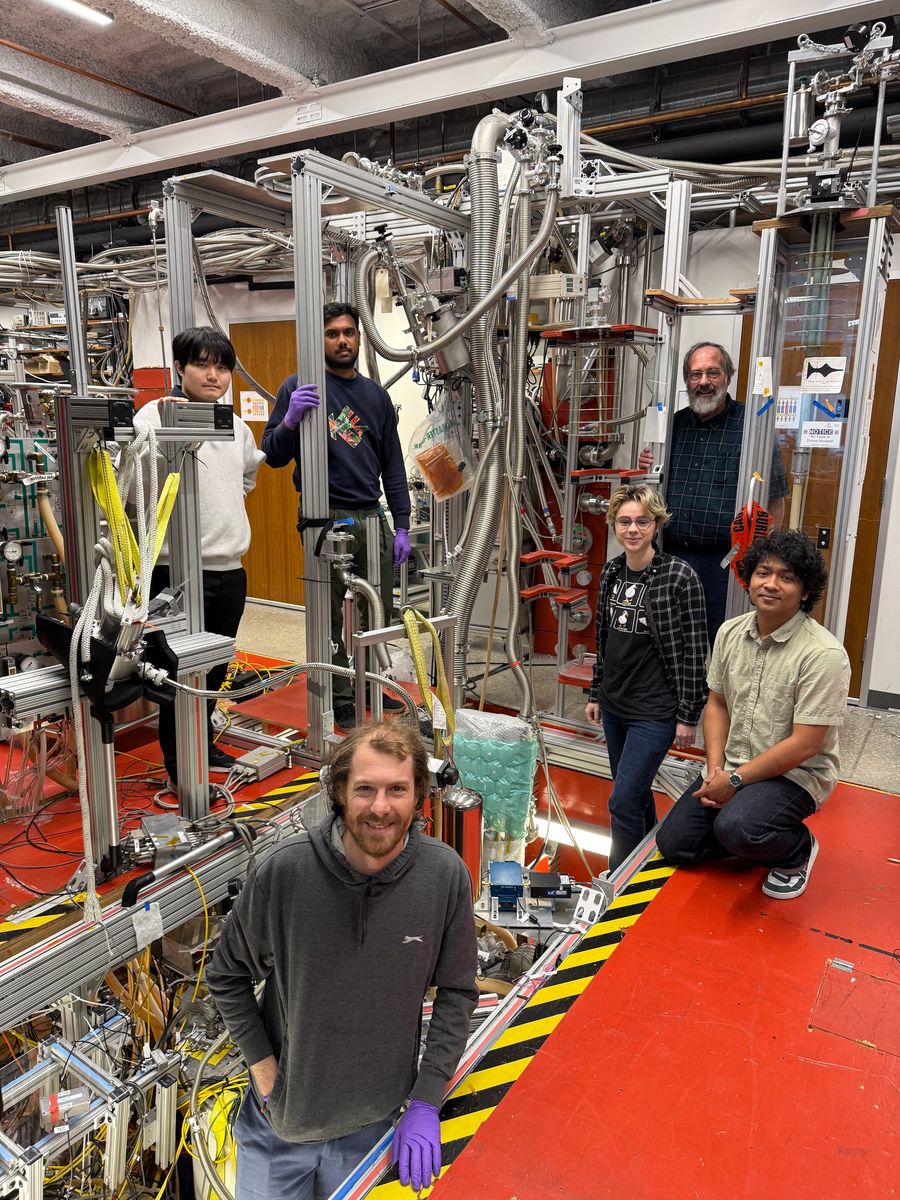
This photo depicts the research team and the laboratory environment where the experiment took place.
Once in the vacuum, the positrons were held in place by a 'wall-less' container consisting of electric fields on the top and bottom and magnetic fields on the sides. This configuration allowed the researchers to maintain a solitary positron in a stable state for an entire month. This breakthrough is significant because it provides a stable platform for making precise quantum measurements, such as determining the positron's magnetic moment—the strength and orientation of its magnetic field. The team aims to measure the energy required to flip the particle's spin and the energy needed to move it from its ground state to its first excited state.
These measurements are intended to test the Standard Model of particle physics, which predicts that a positron should have a magnetic moment exactly opposite to that of an electron. The team has already achieved a precision of one part in 10 trillion when measuring an electron; they now seek to replicate this for the positron. Such a comparison is vital for understanding the 'matter-antimatter asymmetry' of the universe. Current theory suggests that the Big Bang produced equal amounts of both, yet most antimatter vanished, leaving a small excess of matter to form the stars and planets. If the positron's magnetic moment deviates even slightly from the predicted opposite of an electron's, it could provide a key hint as to why matter won out over antimatter in the early universe.