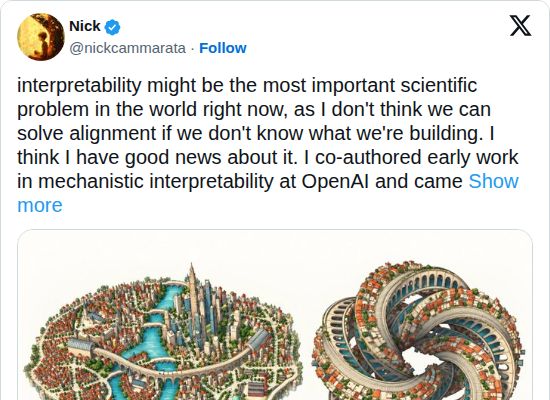
The study of mechanistic interpretability aims to reverse-engineer artificial neural networks to understand how they process information and reach specific outputs. A central challenge in this field has been 'polysemanticity,' the observation that individual neurons often appear to activate for multiple, seemingly unrelated concepts (e.g., a 'dog' and a 'car'). This phenomenon led many researchers to believe that neural networks are inherently 'tangled knots' of overlapping functions, making them difficult to decode into human-understandable logic.
Recent analysis suggests this complexity may be overstated. The core argument is that many neurons are actually 'clean'—performing a single, specific role—but were misidentified as polysemantic due to the limitations of early interpretability tools. By using modern agentic tools and a more granular approach, researchers have found that the vast majority of neurons in models with up to trillions of parameters are legible and organized into beautiful, coherent circuits. The 'messy' neurons often turn out to be representing shared geometric features (such as a 'V-shape') rather than a bundle of unrelated semantic concepts. This shift suggests that the primary hurdle to interpretability may be a 'model-description' issue: our preconceived notions of what a 'concept' is might be too narrow to capture the latent features the network actually learns.
However, the transition from 'messy' to 'clean' interpretations faces several technical and philosophical hurdles. Critics point out that even if 96% of a model's weights are legible, the remaining 2-4% of 'unexplained' neurons might represent the central hubs of emergent cognition, which could be the most critical parts to understand for safety and alignment. Furthermore, there is a risk of circularity: if the tools used to interpret the model are themselves generated by large language models, researchers must ensure they are not being 'fooled' by an AI that provides a simplified, human-friendly explanation while hiding its true internal logic. Ultimately, while the 'clean' hypothesis offers a more optimistic path toward sequencing the 'AI genome,' the practical ability to reconstruct complex algorithms from these circuits remains an open question.