DuckDB, an in-process analytical database, has released version 2.0.0 LTS, codenamed "Cinnamon Teal." This release marks a significant shift from the stability-focused 1.0 series to a feature-heavy iteration. Key architectural updates include the integration of a first-class VARIANT type, which allows the database to store and execute semi-structured data like JSON with columnar performance. Unlike standard JSON formats, the VARIANT type is processed as a native type, allowing DuckDB to detect common structures and "shred" them into compressed, high-performance columns.

This diagram explains the mechanism of the first-class VARIANT type introduced in the 2.0.0 release.
One of the most impactful performance improvements in 2.0.0 is the introduction of asynchronous I/O for reading Parquet and CSV files. By decoupling the I/O layer from the query processing layer, DuckDB can now issue multiple background reads simultaneously. This architecture is specifically designed to maximize throughput when querying data from remote object storage, such as Amazon S3, where network latency can otherwise bottleneck query execution. The team provided benchmarks showing that this change significantly improves network utilization and reduces total runtime for remote data fetches.
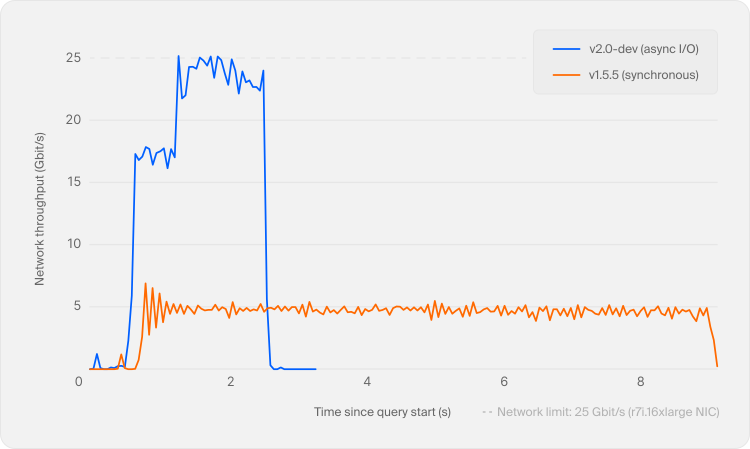
The chart illustrates how decoupling the I/O layer from query processing maximizes throughput for remote object storage.
The release also introduces "agent mode" in the DuckDB CLI, specifically tailored for AI coding agents like Claude Code or Cursor. When the CLI detects it is being operated by an agent, it automatically switches to a mode that outputs compact Markdown tables, reports truncated results clearly, and provides errors in JSON format. This reduces the amount of data the model must parse—by up to 59% in TPC-H experiments—and allows agents to see expected query costs before execution. Additionally, the update replaces the legacy PostgreSQL-derived parser with a modern, extensible PEG-based parser, which simplifies the addition of new SQL syntax without risking conflicts with existing rules.
While DuckDB remains an in-process database, version 2.0.0 polishes the Quack protocol, enabling a client-server architecture. This allows users to attach and switch to remote databases using a new CONNECT statement. The protocol is designed to work with other databases like PostgreSQL and MySQL, utilizing a remote pushdown optimizer that sends queries directly to the remote server rather than pulling entire tables over the network. The 2.0.0 release is a long-term support (LTS) version, with the team providing a transition period for users moving from the 1.5 series.