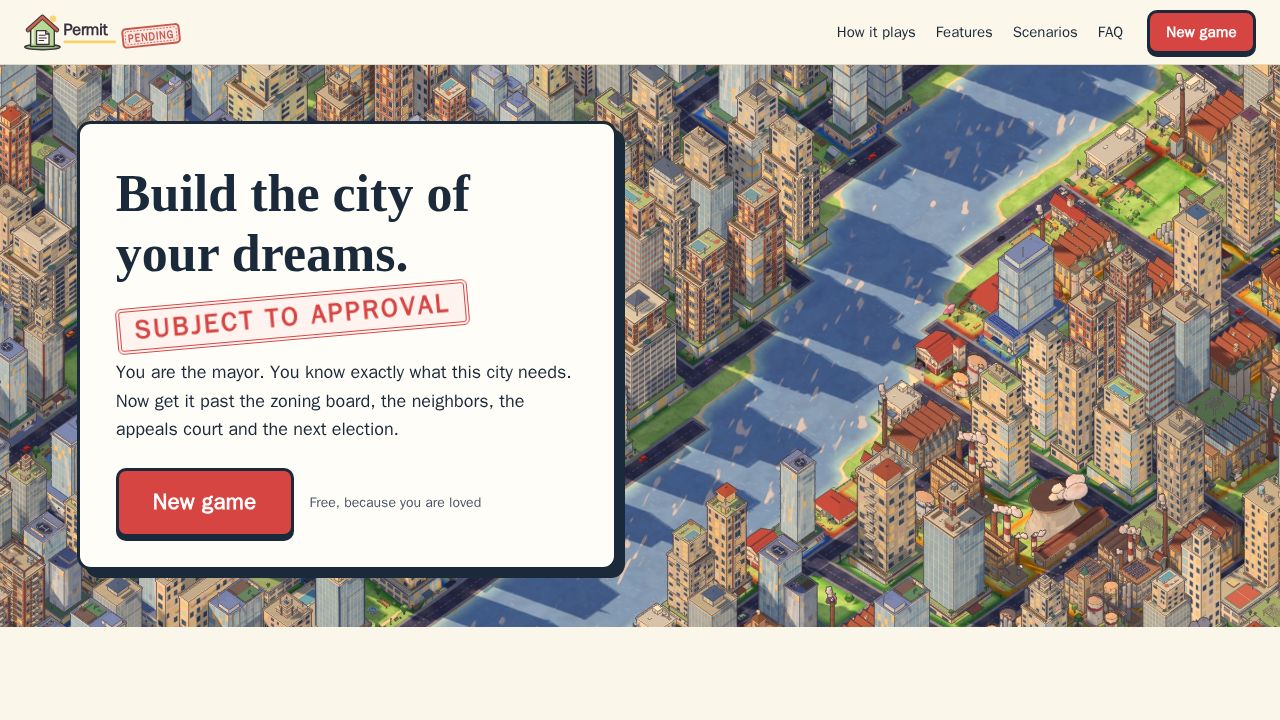
The web-based simulation 'SimCity, but with Permits' presents a departure from traditional city-building games by centering the gameplay on the bureaucratic hurdles of urban development. Instead of focusing primarily on the aesthetics or layout of a city, the game emphasizes the friction created by municipal rules, zoning laws, and the necessity of keeping a diverse set of stakeholders satisfied. Players must navigate a system where every construction project is subject to community feedback and regulatory constraints, mirroring the real-world challenges of democratic urban planning.
Technical details of the project reveal a modern web stack designed for accessibility. The game utilizes Three.js for 3D rendering and a React 18+ UI built with Vite. It features custom-built charts and a main bundle size of approximately 1MB (290KB gzipped). To manage state and persistence without heavy frameworks like Redux or Zustand, the project employs IndexedDB and service workers for saving progress. This architecture allows the simulation to run directly in a browser, providing a lightweight way to experience complex administrative simulations.
Discussion surrounding the project highlights the inherent difficulty of 'keeping everyone happy' in a democratic system. Commenters noted that while city-building games often allow for a 'bulldozer tool' to quickly clear land, this simulation captures the reality where noise restrictions, traffic concerns, and neighborhood impacts create a web of competing motives. Some users described the experience as overwhelming, noting the responsibility of managing everything from 4-way stop signs to community petitions. While some pointed out technical issues like WebGL errors or UI scaling on tablets, the core appeal remains the exploration of how regulations—while often seen as obstacles—serve as a mechanism to balance the conflicting desires of a population.
One notable limitation identified by players is the immersion-breaking nature of certain procedural elements, such as petitions with impossible signature counts or references to non-existent landmarks. However, the game serves as a commentary on the trade-offs of urban development: the tension between the desire for rapid growth and the necessity of community oversight. It illustrates that the 'slow' pace of bureaucracy is often a byproduct of trying to ensure that no single group is subjectively harmed by the growth of the collective.