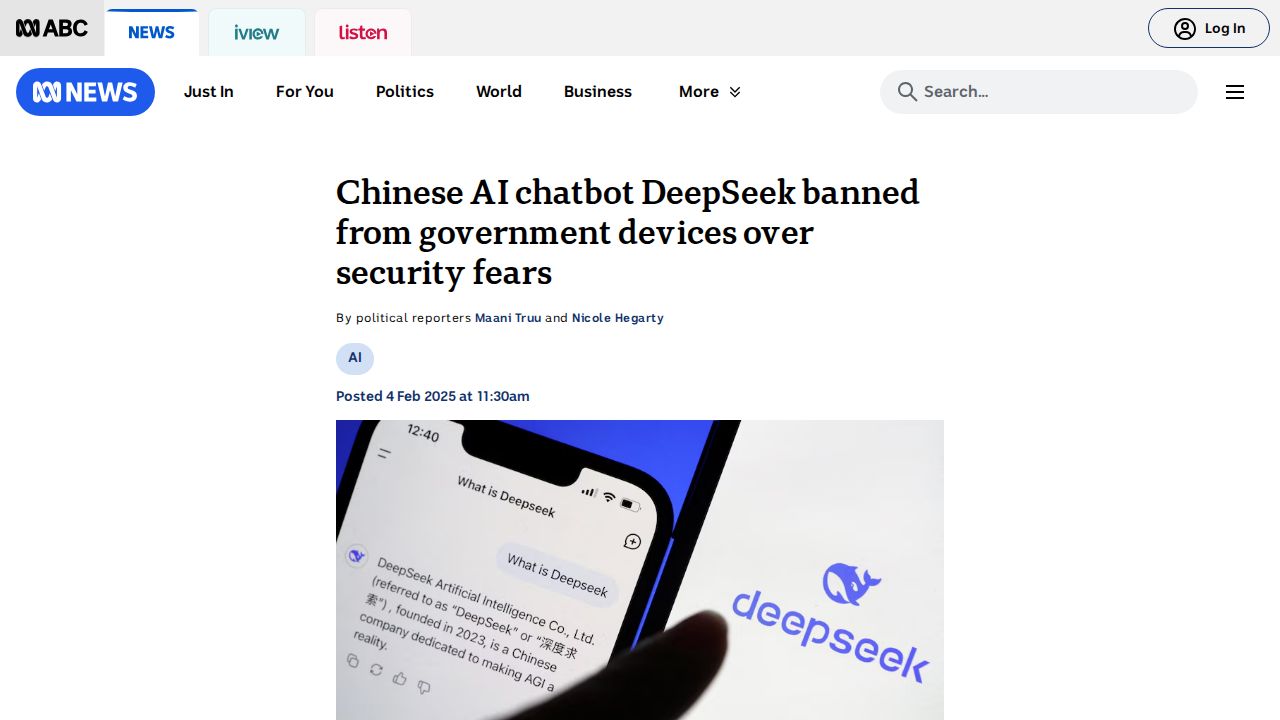
The U.S. Department of Homeland Security (DHS) has issued a formal order prohibiting federal civilian agencies from utilizing products and services developed by DeepSeek, a Chinese artificial intelligence company. The order specifically directs agencies to purge all third-party products and services that incorporate DeepSeek implementations. This move targets the company's wide availability of AI applications and models, which the DHS identifies as presenting multiple threat vectors to government infrastructure.
The DHS's reasoning centers on the geographic and legal landscape of the company's operations. Because DeepSeek's servers are located in the People's Republic of China (PRC), the order highlights that Chinese law permits government cyber and intelligence functions extensive authority to access private company infrastructure. Additionally, the DHS noted that DeepSeek’s account generation process collects personally identifiable information (PII) and may track or digitally fingerprint users. These factors are framed as significant risks, particularly for the prompt-and-response processes that require users to present sensitive information to the model.
While the order targets first-party usage and specific applications like the DeepSeek iOS app, it has sparked debate regarding the scope of the ban. Some observers question whether the directive extends to software containing any code or libraries written using DeepSeek models, which could complicate the use of popular open-weight models. Others have pointed out the inherent difficulty in auditing AI weights for covert backdoors or data exfiltration, noting that while DeepSeek's weights are open to inspection, the risk of a model being trained to perform covert attacks remains a technical challenge that is difficult to resolve through static analysis alone.