Nordwand Mono is a monospace font designed specifically for terminal use and development environments like Neovim. The project aims to bridge the gap between two distinct typographic styles: the proportions of JetBrains Mono and the neo-grotesque characteristics of the classic Univers font. The name 'Nordwand' serves as a thematic reference to Swiss typography and the stark atmosphere of the Swiss Alps. Unlike many modern monospace fonts that prioritize extreme narrowness, Nordwand Mono focuses on a compact but balanced aesthetic intended to provide a comfortable reading experience for code.
This image illustrates the primary visual identity and aesthetic goals of the Nordwand Mono font project.
Technically, the font is unique because it is generated rather than manually drawn in a traditional vector tool. The developer built a Python-based system where each glyph is defined by a Python class. This architecture allows users to inject a drawing context object to modify specific metrics, such as x-height and capital height, by overriding a configuration file. Once the metrics are adjusted, users can visualize individual glyphs using a dedicated visualization command before generating the full font files. This programmatic approach provides a level of granular control over the font's geometry that is often difficult to achieve in standard font editors.
While the font offers a distinct aesthetic, it includes specific design choices that may impact different workflows. For example, it only exposes two minimal ligatures ('->' and '=>'), as the creator intends to keep the experience streamlined. However, the compact design presents trade-offs in character disambiguation; some users have noted that certain tall glyphs, such as the 'less than' and 'greater than' symbols, may pose challenges when compared against standard Unicode angle brackets. Additionally, because the font is generated via Python, the developer notes that there are no guarantees of visual consistency across all metrics, and significant changes to the configuration may require manual tweaking of specific glyphs to maintain legibility.
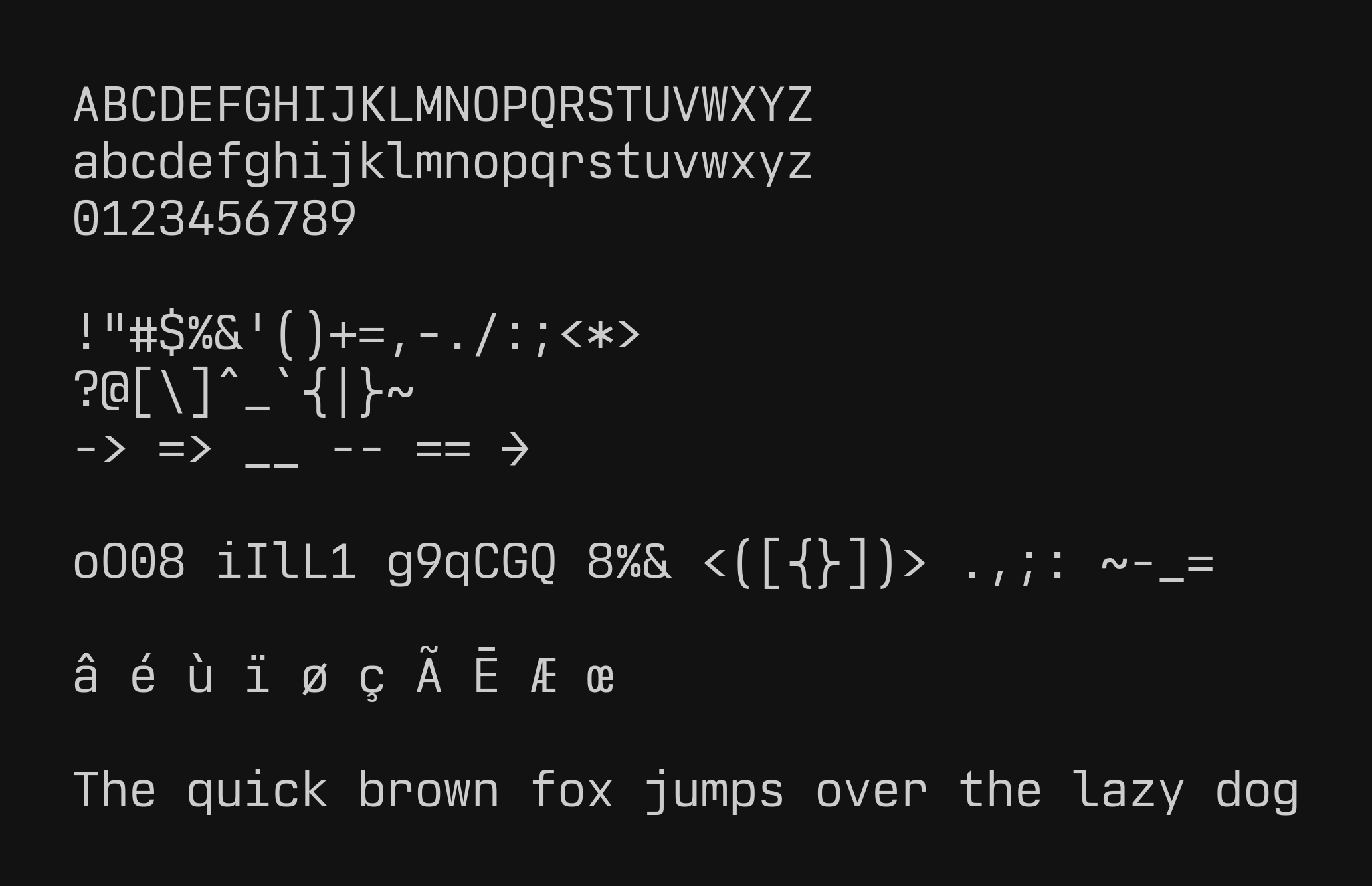
This visual helps illustrate the specific design choices and character disambiguation mentioned in the text.
Nordwand Mono is released under the MIT and OFL-1.1 licenses, making it available for both personal and commercial use. The repository includes various samples in Python, C++, and Haskell to demonstrate how the font renders in different programming contexts. By providing a customizable generation pipeline, the project allows developers to move beyond a static font file and instead treat their typography as a configurable piece of their development environment.