MiniMax has officially released M3.1 Flash, a new large language model (LLM) designed to optimize the balance between computational efficiency and performance in 'agentic' tasks—workflows where an AI model must plan, use tools, and execute multi-step actions to achieve a goal. The model is positioned as a high-speed alternative to the standard MiniMax M3, aiming to provide a generational leap in capabilities for software development, computer use, and cybersecurity while significantly lowering the cost of online inference.

The image serves as a primary visual for the announcement of the M3.1 Flash model and its core value proposition of balancing speed and performance.
To achieve these gains, MiniMax utilized aggressive sparsity to optimize inference efficiency. According to the company, the model can reach output speeds of over 200 tokens per second (TPS), with median speeds consistently hitting 170+ TPS. These performance improvements are paired with a substantial reduction in pricing; the company claims that for agentic tasks, the overall usage cost is 70% lower than its predecessor. The model is priced at $0.15 per million input tokens and $0.60 per million output tokens, with a $0.015 rate for cached input.
This image illustrates the technical optimizations and performance gains discussed in the second paragraph regarding token speeds and pricing.
MiniMax highlights several specific benchmarks to demonstrate the model's capabilities in complex environments. It scored 76.2 on BankerToolBench, which evaluates multi-step planning and financial compliance, and 73.7% on DeepSWE v1.1, a benchmark for software engineering tasks that require models to independently understand code and validate fixes through testing. In the realm of computer use—where models interact with operating systems and cross-application tasks—M3.1 Flash scored 61.7 on OSWorld V2 and 29.6 on Agents’ Last Exam (ALE). While the model is currently available via API and the MiniMax M Plan, the company has stated that the model weights will be released at a later date.
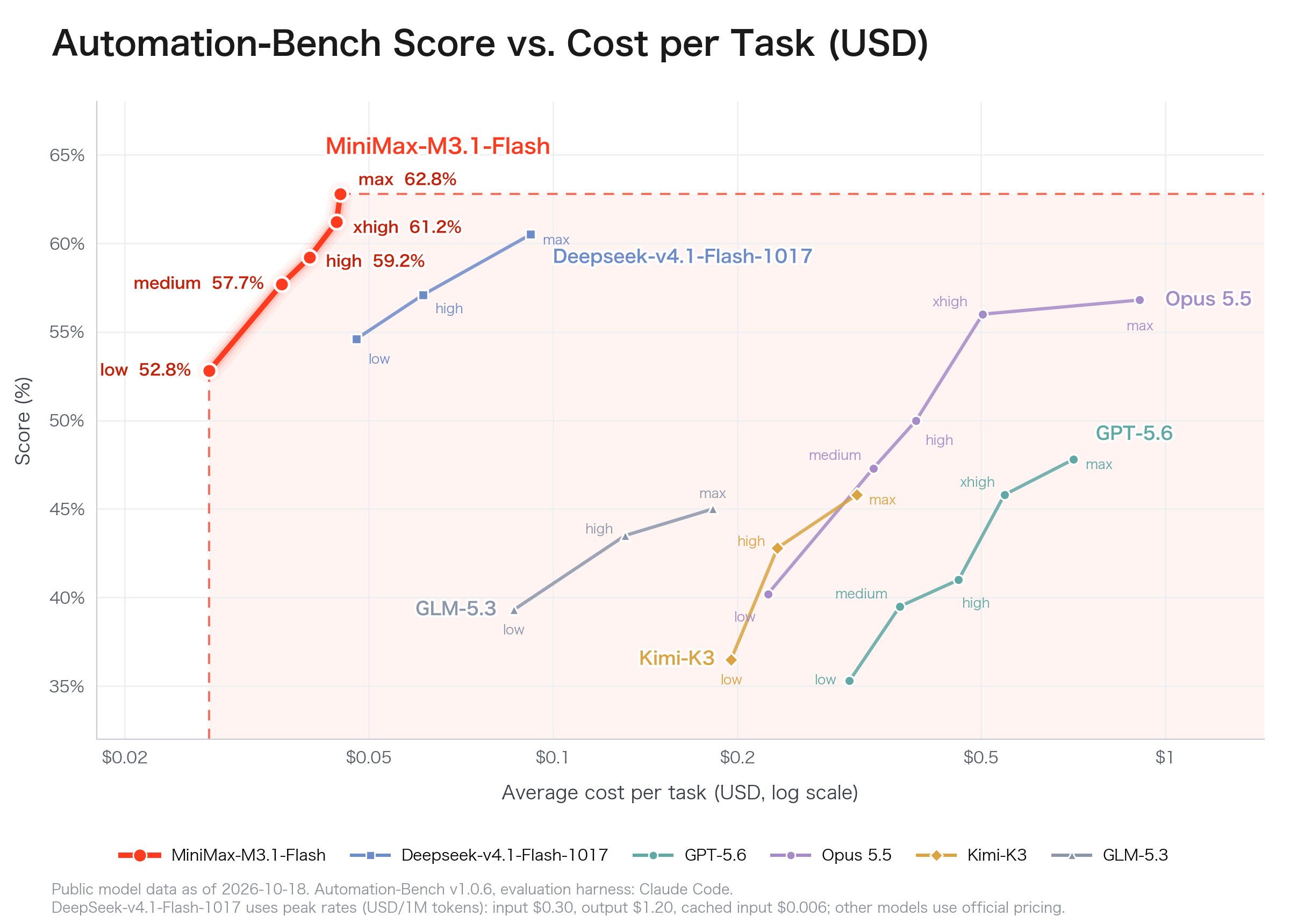
This visual supports the specific benchmark data provided in the final paragraph regarding software engineering and financial compliance.