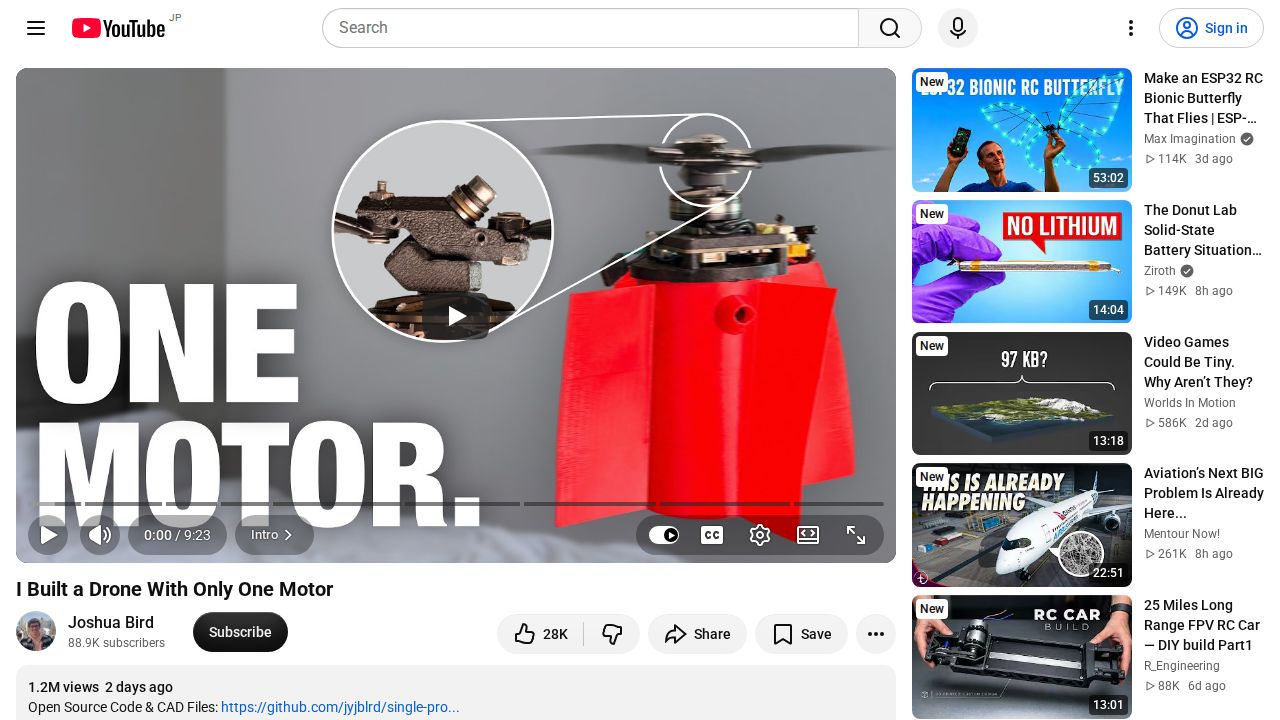
Joshua Bird has developed a drone capable of flight using a single motor, a feat that typically requires multiple rotors or complex mechanical linkages to maintain stability. Unlike conventional multi-rotor drones that rely on varying the speeds of several independent motors, this single-motor design—often referred to as a monocopter—utilizes a specialized hinge system. This mechanism allows the drone to control the lift and orientation of the rotor as it spins, effectively replacing the swash plate found on traditional helicopters. The system relies on a magnetic encoder and torque modulation to provide the necessary flight dynamics.
The core of the innovation lies in the shift from mechanical complexity to algorithmic complexity. Because the single motor causes the drone to spin as soon as it takes flight, the control software must constantly calculate and adjust the rotor's position to maintain a stable heading. Commenters on Hacker News noted that this approach mirrors 'underactuated robotics,' where a system has fewer control inputs than degrees of freedom. This is similar to how some modern fighter jets lack vertical stabilizers and instead rely on highly sensitive, real-time software to manage banking and yaw. The builder also utilized high-resolution, high-speed cameras to investigate and mitigate 'flutter'—vibrations that can occur at the high speeds required for stable flight.
While the design is mechanically elegant, it introduces specific practical trade-offs. One commenter pointed out that a two-motor setup with a tail motor might be more practical for everyday use, as the single-motor drone is inherently prone to rotation. Additionally, while the concept of a single-motor rotor has been explored in RC helicopters, applying it to a drone frame presents unique challenges regarding frame vibration and the margin of error in the control loops. The project also highlights a growing trend in engineering where complex software is used to overcome physical limitations, potentially opening doors for smaller, cheaper, or more specialized drone configurations, such as those intended for high-speed scanning or imaging applications.
Evidence: 1. The drone's mechanism involves a special hinge design, magnetic encoder, and torque modulation to control lift without a swash plate (hn-50150089). 2. The project demonstrates the principle of underactuated robotics, where software manages the drone's orientation to compensate for the single-motor rotation (hn-50150089). 3. The builder used high-speed cameras to investigate and address rotor flutter during the development process (hn-50150089).