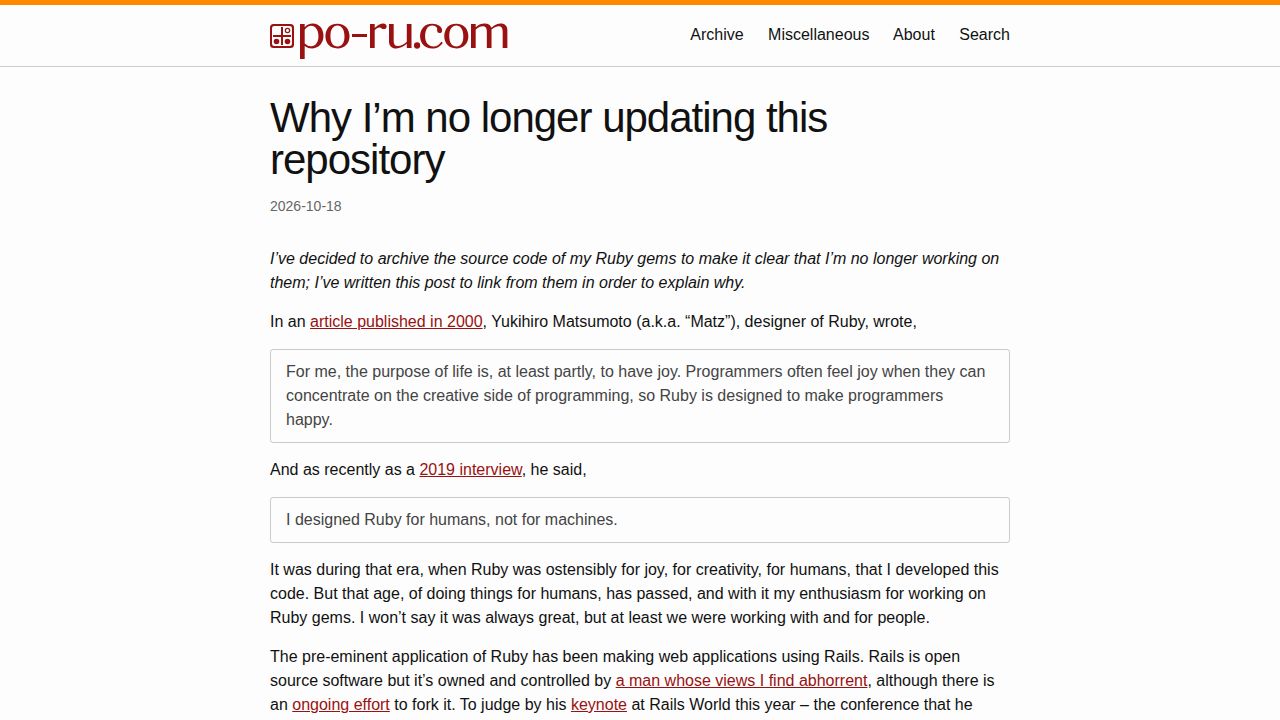
A developer has announced the archiving of their Ruby repositories, expressing a fundamental shift in their motivation to maintain open-source software. The decision stems from a feeling that the traditional craft of writing and maintaining code is being fundamentally altered by the rise of AI agents. While these tools can accelerate project progress and improve security or performance, the developer notes that the human-centric, collaborative joy of community-driven improvement is diminishing. This sentiment reflects a growing tension between the efficiency of automated code generation and the intrinsic value of manual software craftsmanship.
Discussion surrounding this move highlights a perceived 'renaissance' in software that has yet to materialize in significant new tools. Some observers argue that while LLMs can perform 'combinatory' and 'exploratory' tasks—standardized programming tasks that were once considered creative—they lack the ability to provide the same level of semantic malleability as a human-designed library. There is a concern that as talented developers exit the ecosystem in response to AI, the stability and quality of the underlying building blocks of software may decline, as AI is often described as being able to 'parrot' rather than innovate.
Other perspectives in the community suggest that AI offers a liberating opportunity to build complex systems that were previously inaccessible due to time or cost constraints. However, this is contrasted by concerns regarding the 'LLM-washing' of open-source work, where AI companies may ingest community contributions to train models without providing credit or sustainable support to the original authors. For some, the shift represents a 'grieving process' for the era of hand-coded software, while others view it as a transition toward a higher-level stream of work where human developers focus on architecture and high-level problem solving rather than the minutiae of implementation.
Ultimately, the move underscores a significant trade-off in the current technological landscape: the gain in speed and accessibility provided by AI agents comes at the cost of the traditional developer experience. As the barrier to entry for creating functional software drops, the value of the human 'craft' is being redefined, leading some to walk away from the very ecosystems they helped build in favor of new, yet-to-be-defined creative outlets.
Evidence: - The developer's decision to archive repositories and their stated reasons for doing so are documented in the primary source (primary). - The discussion regarding the loss of human collaboration, the 'combinatory' nature of AI tasks, and the potential for ecosystem decline is captured in the Hacker News thread (hn-50154518).