The Domain Name System (DNS) is the foundational protocol of the internet, primarily designed to map human-readable domain names to IP addresses. However, because DNS is a ubiquitous, globally distributed, and highly cacheable system, it has served as a playground for engineers seeking to push the protocol's boundaries. The DNS Museum, a project by Peter Lowe, serves as a curated archive of these 'bizarre and unusual' implementations, ranging from artistic traceroute displays to unconventional data transport methods.
One of the most common categories in the museum involves manipulating traceroute outputs. By using Pointer (PTR) records—which map IP addresses back to domain names—developers have turned network diagnostics into storytelling tools. For example, some configurations use PTR records to spell out lyrics from songs like "American Pie" or "Let It Snow" as a packet hops through a network. Other experiments use DNS to display live sports scores or even draw visual shapes, such as a Christmas tree or a hand, where each successive hop in the traceroute reveals a new piece of the image. These projects demonstrate how the reverse-DNS lookup mechanism can be repurposed as a sequential display system.
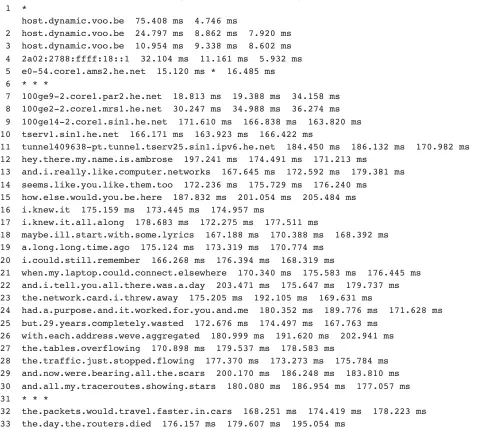
This image illustrates the use of PTR records to turn network diagnostics into storytelling tools by displaying lyrics.
Beyond aesthetics, the museum highlights the use of DNS as a transport layer for diverse data types. Because DNS traffic is frequently permitted through firewalls that block other protocols, it has been used to tunnel web browsing data, files, and even full IP tunnels (VPNs). Other experiments treat DNS as a functional database or a content delivery system, such as hosting blog posts within TXT records or using it as a key-value store. While these methods are often intentionally inefficient—such as streaming MP3 files or images by fragmenting them into DNS-sized packets—they highlight the unique properties of DNS, such as its inherent caching and its ability to bypass restrictive network environments. The museum preserves these stories as a record of technical curiosity, even when the original services are no longer online.
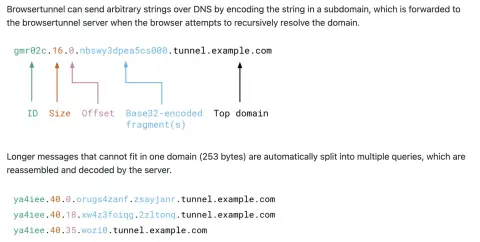
This screenshot demonstrates the museum's documentation of DNS being used to tunnel web browsing data through firewalls.
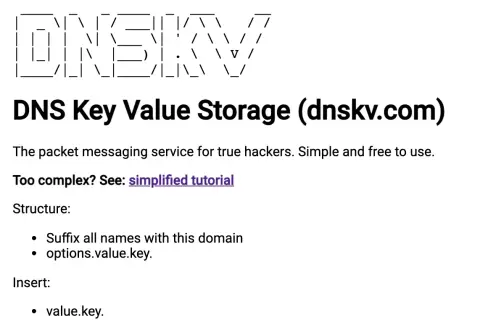
This image supports the description of DNS being used as a functional database or key-value store.