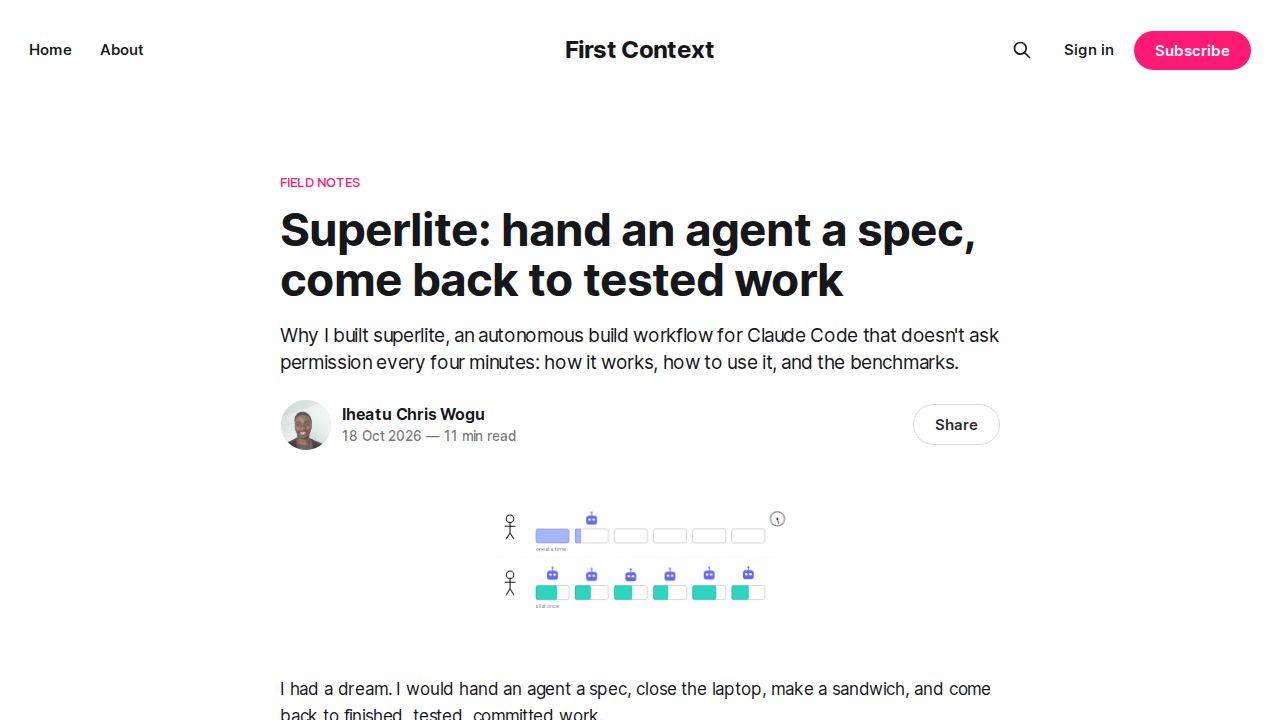
Superlite is a new specification introduced to provide a faster alternative to 'Superpowers,' a framework used to guide AI agents through complex software development tasks. While Superpowers establishes a rigorous process for agents to follow, Superlite aims to reduce the friction and time overhead inherent in such systems. The goal is to provide a more efficient way for agents to move from initial ideas to implementation without the 'endless approval prompts' and excessive token consumption that can occur in more heavy-handed frameworks.
The core distinction between these approaches lies in the balance between process and autonomy. Some users argue that modern frontier models, such as Claude Opus 5.5, have already internalized many software development best practices through reinforcement learning (RL), potentially making complex 'skills' or external process frameworks redundant. However, others contend that while models may have better general coding abilities, they still lack a 'durable process' for complex tasks. In this view, Superlite and similar specifications act as necessary procedural guardrails, ensuring that agents consistently produce specific artifacts—like design plans and implementation specs—in a predictable format that the model might not otherwise generate reliably on its own.
The debate surrounding Superlite highlights a significant trade-off in AI agent development: the cost of 'enterprise-grade' process versus the speed of autonomous execution. Critics of complex frameworks suggest they can lead to 'cargo culting,' where the process becomes a bureaucratic hurdle that slows down development and wastes resources. Conversely, proponents of these specifications argue they are essential for maintaining consistency in multi-agent workflows, where different agents need to work on shared plans without overlapping or conflicting. For developers, the choice depends on whether their primary goal is the raw speed of a single model's output or the reliable, repeatable production of a structured development lifecycle.
Ultimately, the utility of Superlite may depend on the specific model and the complexity of the task at hand. For simpler tasks, a direct prompt to a high-performing model might suffice. For larger projects requiring a consistent set of artifacts and a clear roadmap, a streamlined specification like Superlite offers a middle ground—providing enough structure to ensure project integrity without the heavy overhead of more exhaustive agentic frameworks. Whether these specifications remain necessary as models continue to improve their internal reasoning remains a central question for the community.
Evidence: - The primary source (https://contextfirst.blog/superlite-hand-an-agent-a-spec/) introduces Superlite as a faster alternative to Superpowers, focusing on a streamlined specification for agentic workflows. - Discussion on Hacker News (hn-50147492) highlights the tension between 'baked-in' model capabilities and the need for durable, externalized processes to ensure consistent artifact production and avoid 'cargo culting.'