Modern Large Language Model (LLM) agents typically reason and interact with the world through text. While this allows for transparency and easy integration with external tools, it can be computationally expensive and less efficient than 'latent reasoning'—where a model processes information in its internal hidden states rather than generating every word of a thought process. Researchers have introduced Hybrid Reasoning Agents (HybridAgents) to bridge these two approaches, allowing an agent to navigate between latent and text modes within a single generation process.
The architecture relies on a component called HybridLink, which maps the model's last-layer hidden states back into the input-embedding space. This allows the agent to enter a 'latent mode' for fast, internal thinking that can still be inspected by humans as readable pseudo-text. When the agent needs to perform a tool call, provide a final answer, or interact with an external environment, it transitions back to 'text mode.' To ensure the agent maintains context across these shifts, a continuous working memory preserves the history of both text interactions and latent thoughts, ensuring that the internal reasoning remains relevant to the external actions.
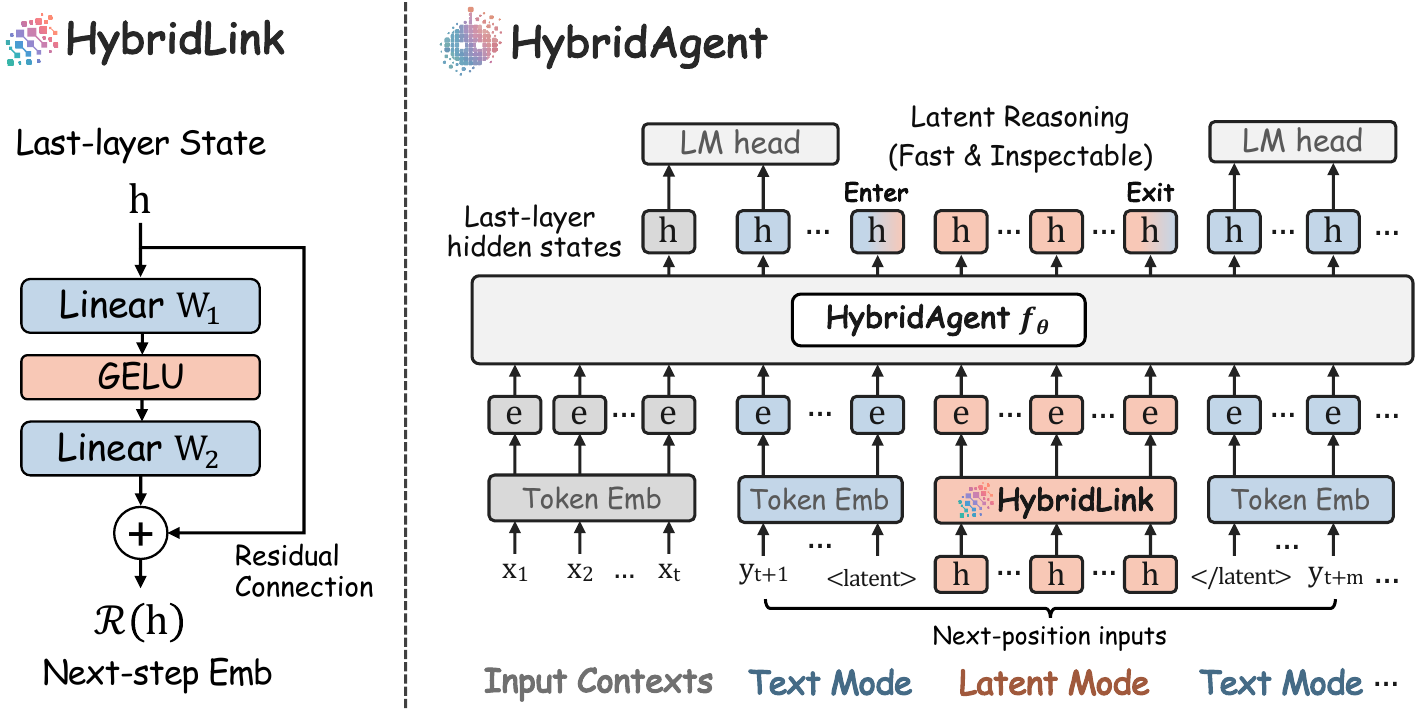
This diagram explains the core architecture of HybridAgents, specifically how they transition between latent and text modes.
To train these models, the researchers developed two post-training algorithms: HybridSFT and HybridRL. HybridSFT stabilizes the model's ability to coordinate with the HybridLink, while HybridRL teaches the agent to decide when it is most efficient to think in latent space versus when it must act through text. In evaluations across 11 benchmarks—including mathematics, science, and medicine—HybridAgent outperformed frontier LLM agents by an average of 10.4%. The researchers also reported significant efficiency gains, including a 35.5% to 54.7% reduction in token usage, inference speeds up to 2.6x faster, and cost savings of up to 3.7x compared to traditional text-only agentic frameworks.