Josephine Pfeiffer, an Arch Linux package maintainer, successfully ported Arch Linux ARM to an ASUS ProArt P16 laptop (H7607BA-SE033W). The project was motivated by the laptop's high-end specifications—including 128 GB of RAM and an NVIDIA N1X GPU with 6,144 CUDA cores—and the fact that official support for this hardware is restricted to Windows. Pfeiffer chose Arch Linux ARM to maintain a local development environment for open-weight models, fine-tuning, and quantization without the privacy concessions or advertising associated with the Windows operating system.
The technical implementation involved integrating NVIDIA's kernel work for Ubuntu as a foundation. Pfeiffer addressed several hardware-specific hurdles, including fixing ACPI override allocations and framebuffer mapping to achieve a functional console. The setup required a patched `hid-asus` driver for keyboard support and a custom machine driver for audio. The final configuration supports a 3840 × 2400 display at 120 Hz, utilizes NetworkManager and PipeWire, and runs rootless Podman with NVIDIA CDI. Pfeiffer also provided build scripts and patches to dump ACPI tables and extract speaker firmware, allowing others to replicate the installation.
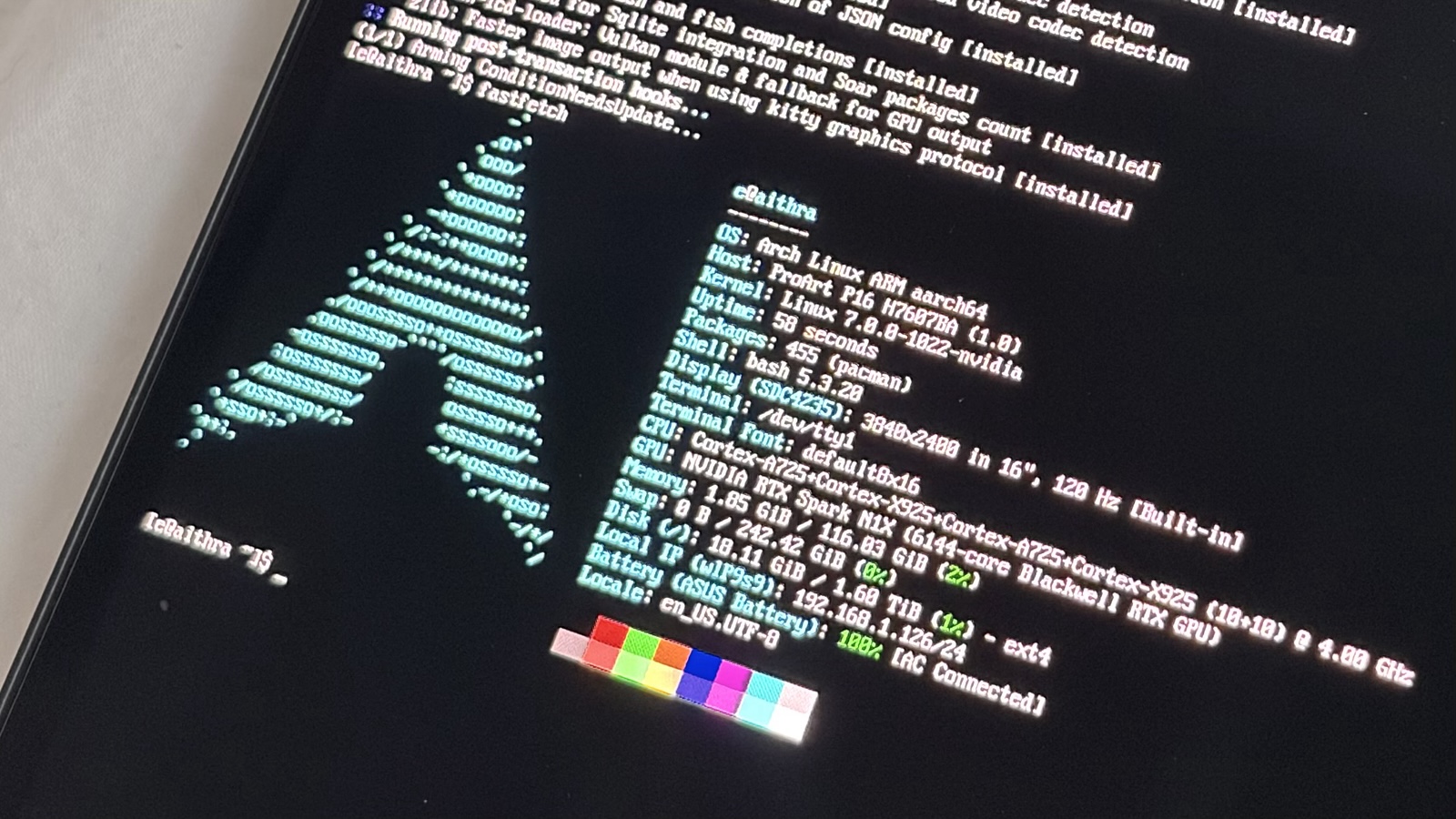
This image confirms the successful installation of Arch Linux ARM on the specific hardware mentioned in the article.
Performance testing revealed that the Linux setup performs comparably to Windows in standard workloads. In 7-Zip compression tests, the Linux configuration was roughly 5% faster than a comparable HP OmniBook running Windows ARM64. A significant technical distinction noted by Pfeiffer is the memory management: while Windows divides RAM into dedicated, shared, and CPU-only regions, the Linux setup reports the full 116.0 GiB as a unified pool accessible to both the system and CUDA. This allows for larger model allocations without manually adjusting memory reservations. In practical tests running the Qwen3.8-Flash-Next model, the setup successfully handled complex tasks like code reviews and incident log analysis with consistent response times and high accuracy across multiple iterations.
Despite the success of the port, the hardware remains a high-cost entry point for local AI development, retailing for approximately $6,000. While the unified memory pool offers a technical advantage for large model inference, the hardware's power requirements and the complexity of the manual Linux port may limit its appeal for users who do not require specific OS-level customizations. Furthermore, while the Linux port bypasses the need for a Microsoft account, it requires significant manual effort to configure drivers and firmware compared to the out-of-the-box Windows experience provided by the manufacturer.
One notable limitation of the current setup is the reliance on specific kernel and driver versions (Kernel 7.0.0-1022-nvidia and driver 615.78.08) to maintain stability. As the hardware and software ecosystems evolve, maintaining these custom patches and ensuring continued compatibility with new NVIDIA drivers will be a recurring task for users seeking to keep the system updated. Pfeiffer's work provides a viable path for developers who prioritize open-source environments, but it highlights the ongoing friction between high-end specialized hardware and non-proprietary software support.
One of the most significant advantages of this Linux port is the unified memory architecture. Unlike Windows, which partitions the 128 GB of RAM into specific buckets for the CPU and GPU, the Linux environment treats the memory as a single pool. This allows the system to dynamically allocate as much as 90 GiB for a single model and its KV cache (Key-Value cache) without the user needing to reboot or manually adjust