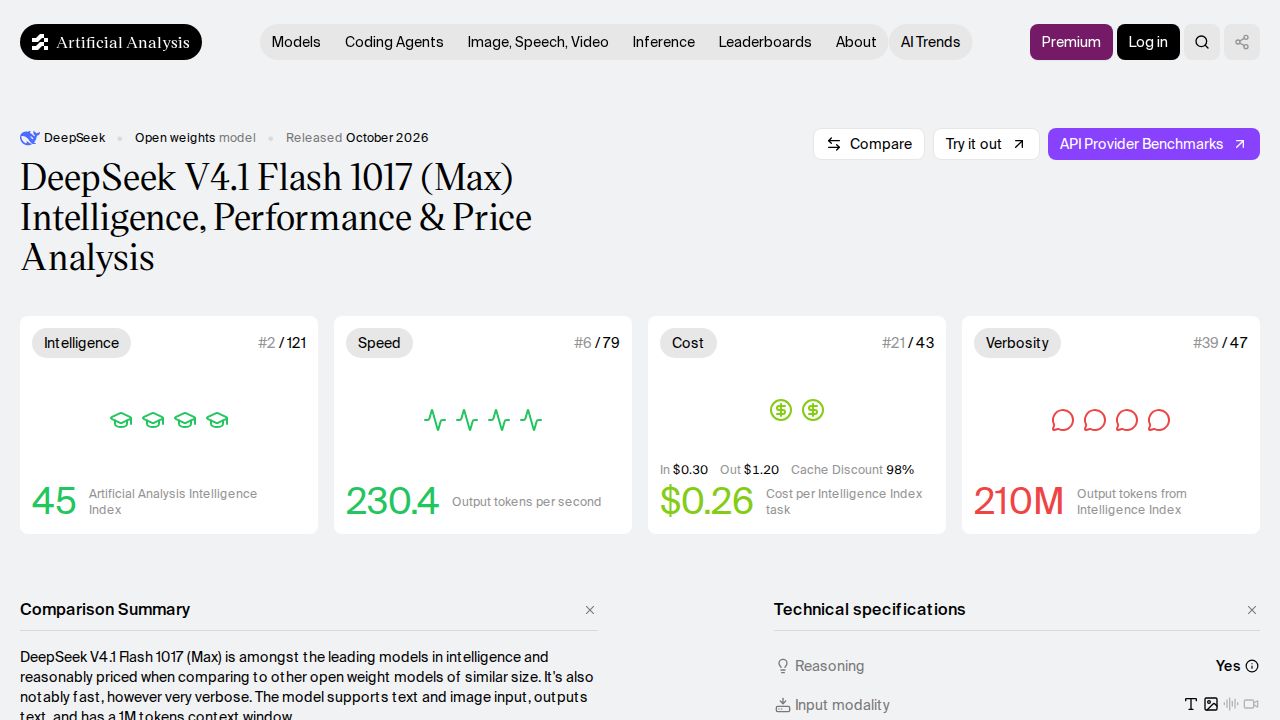
The DeepSeek V4.1 Flash 1017 (Max) model has sparked significant discussion regarding its balance of parameter count, speed, and reasoning capabilities. One notable technical detail is its architecture, which utilizes a 536+16B (passive+active) parameter structure. This configuration allows it to achieve performance comparable to larger models, such as the Mimo v2.6 Pro, despite being roughly half the size. While the model is praised for its high throughput (tokens per second), some users noted that it can be verbose in its outputs, suggesting that future fine-tuning might be necessary to improve token efficiency.
Comparisons with other models reveal varying trade-offs in cost and speed. For instance, some users pointed out that GPT 6.1 Sol (medium) may be both cheaper and faster per task than the DeepSeek V4.1 Flash 1017 (max) configuration. This highlights a critical distinction between 'max' reasoning efforts and standard configurations; while 'max' effort aims for higher intelligence, it can significantly increase the time and token count required for a relatively small performance uplift. Some testers reported that the 'max' setting used nearly twice as many tokens as the 'high' setting with little to no noticeable benefit in specific use cases.
Practical deployment on consumer hardware also remains a key point of interest. While some users have successfully run DeepSeek V4 Flash models on high-end consumer setups like a Mac Studio with 128GB of RAM, there is ongoing debate about whether these models can run effectively on lower-end hardware (e.g., a 2080ti with 128GB of RAM) while maintaining reasonable intelligence. Additionally, technical possibilities such as streaming weights from an SSD—which may lower throughput but increase accessibility—are being explored as ways to make these large models more usable on general hardware configurations.