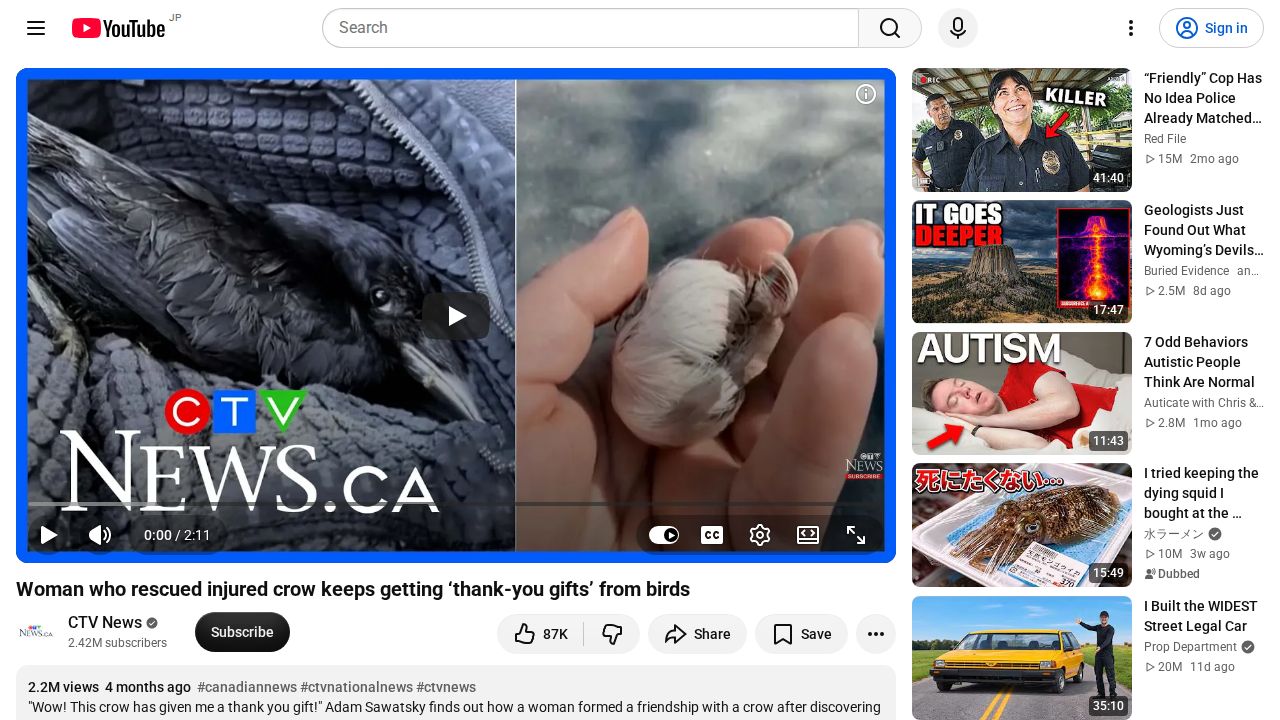
A video featuring a woman who rescued an injured crow and subsequently received 'thank-you gifts' from birds has highlighted the unique cognitive abilities of corvids. These birds, which include crows and ravens, are known for their high level of intelligence and social complexity. The interaction described in the video serves as a modern example of the long-standing observation that these species can form bonds with humans and exhibit behaviors that suggest a degree of intentionality and memory.
Observers and researchers have noted several specific mechanisms of corvid intelligence. For instance, crows have demonstrated the ability to use tools, such as dropping rocks into water containers to raise the liquid level to reach a floating treat. They also exhibit sophisticated social learning; one account describes a crow attempting to teach its offspring how to interact with humans by establishing a consistent feeding ritual. Furthermore, some individuals have reported crows displaying a 'number sense,' potentially tracking the number of people in a space to determine if it is safe to return to a nest. These behaviors suggest that corvids possess a complex understanding of their environment and the entities within it.
However, the interpretation of these interactions remains a subject of debate. While some see these behaviors as evidence of sentience and a 'theory of mind,' others argue that such actions may be simpler forms of associative learning or routine-following. For example, a crow bringing a 'gift' might be a learned behavior associated with food rewards rather than a conscious expression of gratitude. Additionally, the reliability of such anecdotes can vary, as some famous claims regarding crow intelligence have been debunked as fabrications. These nuances highlight the difficulty in distinguishing between complex cognitive processing and highly successful environmental adaptation in wild animals.
Ultimately, the interaction between humans and corvids reveals a spectrum of behaviors ranging from simple food-seeking to complex social cooperation. Whether these actions constitute a true 'friendship' or a sophisticated survival strategy, they underscore the remarkable adaptability of these birds. The ongoing study of corvid behavior continues to provide insights into non-human intelligence, challenging human perceptions of sentience and the boundaries of animal cognition. As humans continue to interact with these intelligent species, the distinction between anthropomorphism and genuine biological observation remains a key area of interest for both researchers and the public.
Evidence: - The primary video and submission describe a woman receiving gifts from birds after rescuing a crow (primary). - Commenters on Hacker News discussed specific instances of crow intelligence, including tool use (dropping rocks into water), social learning (teaching offspring to work humans), and the potential for a 'number sense' (hn-50065859). - Commenters also highlighted the diversity of bird behaviors, such as ravens following vehicles and providing 'gifts' like food scraps or even bird parts (hn-50065859). - The discussion also touched on the ethics of anthropomorphism and the history of human-animal bonds (hn-50065859).
Editorial: - editorial.evidence_sufficient: true - editorial.source_limited: true - editorial.discussion_digest: true - editorial.submission_only: false - editorial.coverage_mode: "discussion" - editorial.author_biographies: false - editorial.image_candidates: [] - editorial.reader_orientation_audit: true - editorial.editorial_angle_research: true - editorial.code_fidelity: false - editorial.adversarial_context_review: true - editorial.adsense_quality_standard: true - editorial.thesis_statement: "Corvid behavior, while often interpreted as social bonding, reflects a sophisticated blend of tool use, social learning, and environmental adaptation." - editorial.material_caveats: "The article acknowledges that while many behaviors suggest high intelligence, some may be results of associative learning rather than complex theory of mind." - editorial.uncertainty: "It remains uncertain whether the 'gifts' provided by birds are conscious expressions of gratitude or learned behaviors reinforced by human interaction."