The Portable Network Graphics (PNG) format organizes image data into a series of discrete 'chunks.' Each chunk follows a specific structure: a 4-byte length, a 4-byte name, the actual data, and a Cyclic Redundancy Check (CRC) for error detection. The naming convention of these chunks dictates how a decoder handles them. For instance, uppercase letters signify 'Critical' chunks required to display the image correctly, while lowercase letters denote 'Ancillary' chunks. This distinction means that while metadata like the 'IHDR' (Image Header) is essential for defining width, height, and bit depth, other information like 'gAMA' (Gamma) or 'pHYs' (Physical Dimensions) is considered optional for basic rendering.
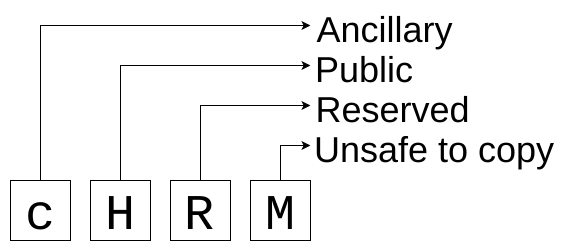
The naming convention of these chunks dictates how a decoder handles them. For instance, uppercase letters signify 'Critical' chunks required to display the image correctly, while lowercase letters denote 'Ancillary' chunks.
At the core of the decoding process is the 'IDAT' chunk, which holds the actual compressed image data. Because streaming encoders may not know the total data length in advance, a PNG file can contain multiple IDAT chunks that the decoder concatenates into a single stream. This stream is then decompressed using the standard zlib algorithm. However, decompression alone does not produce a viewable image; the resulting data appears skewed or distorted because each row of the image contains a 'filter' byte. These filters—such as 'Average,' 'Up,' or 'Paeth'—are designed to make the data more compressible by zlib by describing the relationship between a pixel and its neighbors. To reconstruct the final image, the decoder must 'defilter' the data, undoing these mathematical operations on a row-by-row basis.
Beyond standard decoding, the PNG format supports 'interlacing,' which allows an image to be loaded in progressive passes. This is achieved by splitting the image into seven non-overlapping areas, known as Adam7. These passes are stored sequentially in the file, allowing a viewer to display a low-resolution version of the image first, which gradually gains detail as more passes are loaded. This technique is particularly useful for human visual perception, as horizontal detail is often prioritized during the initial loading stages. While the format is robust, even small errors in the filter calculations—such as incorrect handling of integer overflows in the 'Average' filter—can result in significant visual artifacts, as the mathematical reconstruction of the pixels fails.",
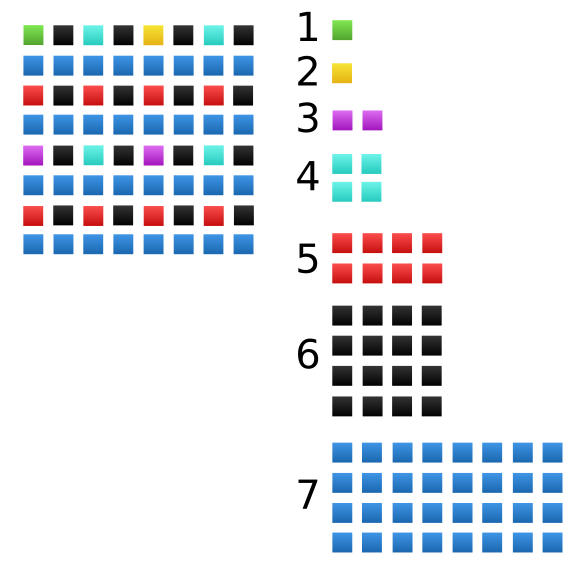
This is achieved by splitting the image into seven non-overlapping areas, known as Adam7. These passes are stored sequentially in the file, allowing a viewer to display a low-resolution version of the image first, which gradually gains detail as more passes are loaded.

While the format is robust, even small errors in the filter calculations—such as incorrect handling of integer overflows in the 'Average' filter—can result in significant visual artifacts, as the mathematical reconstruction of the pixels fails.