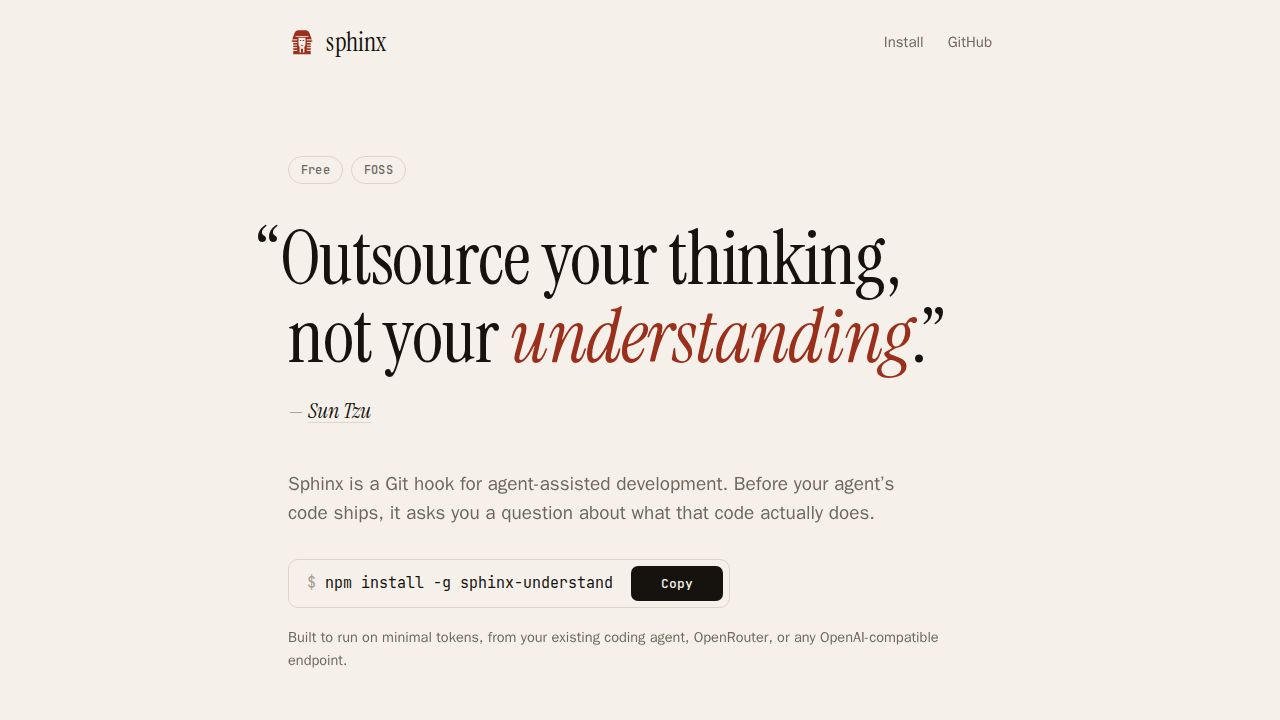
Sphinx is a Git hook designed to facilitate agent-assisted development by ensuring that developers maintain a deep understanding of the code they ship. When a developer or an AI agent attempts to push code to a protected branch, Sphinx intercepts the action and presents the user with a quiz based on the specific changes in the diff. The goal is to move beyond simply 'outsourcing' the writing of code to also ensuring the developer understands the underlying logic, particularly how the new code handles failure states or unexpected inputs.
The tool functions by analyzing the code diff and generating questions that test the developer's comprehension. For example, if a change involves a webhook handler that saves an event ID before calling a payment function, Sphinx might ask what happens if the payment provider times out and retries the request. The developer must provide a correct answer to proceed with the push. Sphinx is built to run on minimal tokens and can connect to various coding agents like Cursor, Claude Code, or OpenCode, or work with plain Git. It is designed to protect privacy by ensuring that user answers never reach the coding agent and that sensitive files like .env files are never opened during the process.
While the tool addresses the growing concern of 'slop'—code that is functional but poorly understood—it has sparked debate regarding its practical utility. Some users argue that the most effective way to maintain understanding is to write the code manually rather than using a gate to check AI-generated work. Others point out that the tool may create friction for efficient developers while potentially failing to catch 'silent' bugs, such as leftover debug prints or weakened assertions, which might be explainable in a quiz but still present in the code. Additionally, there is a risk of 'confirmation fatigue,' where developers might eventually use agents to answer the Sphinx questions themselves, potentially bypassing the intended learning mechanism entirely. Sphinx also includes a 'yolo' mode for situations where speed is prioritized, allowing pushes to proceed while logging every skipped understanding check for later review.
Evidence: 1. Sphinx functions as a Git hook that asks questions about the diff before a push is completed (primary). 2. The tool is designed to work with multiple coding agents and OpenAI-compatible endpoints while maintaining privacy (primary). 3. Commenters on Hacker News discussed the trade-offs of using a quiz as a gate, with some arguing it creates friction for efficient users while others see it as a necessary check against the lack of understanding in AI-assisted workflows (hn-50137950). 4. One commenter noted that a quiz might not catch issues that exist in the diff but not in the developer's comprehension, such as leftover debug prints (hn-50137950).