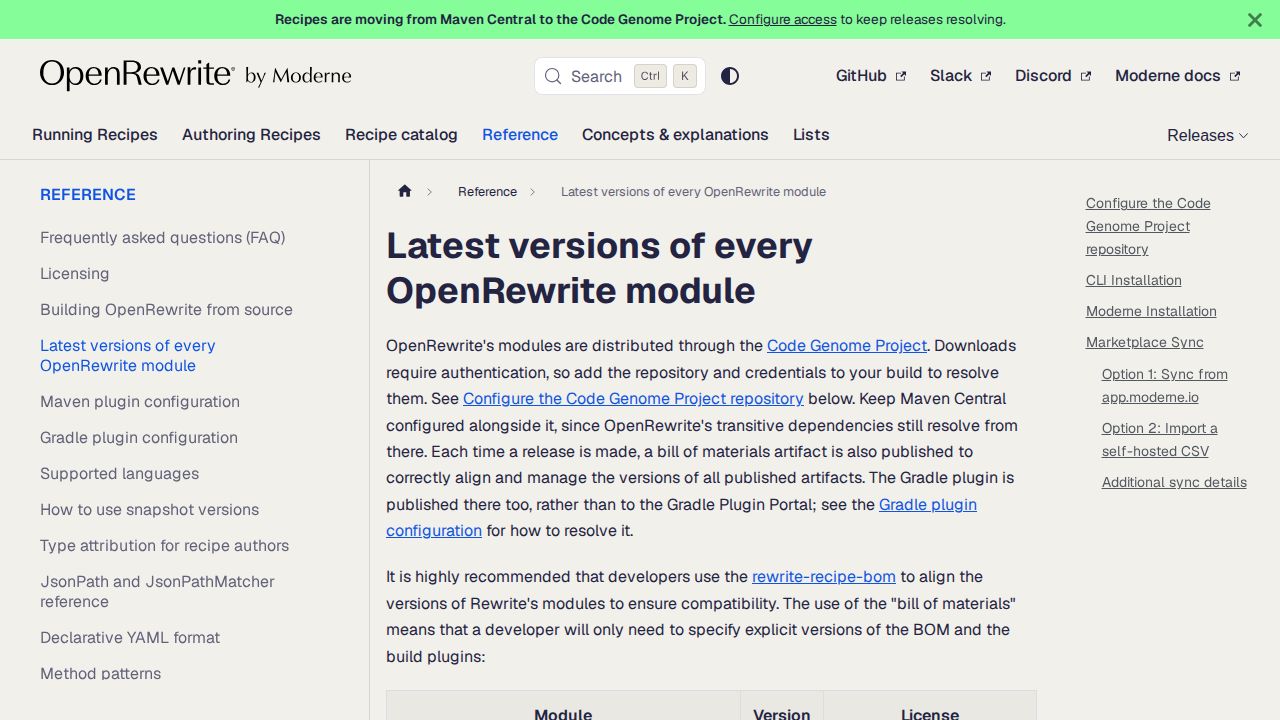
OpenRewrite, a tool for automated code refactoring, is transitioning the distribution of its 'recipes'—the modular units of refactoring logic—away from Maven Central. These modules will now be hosted on the Code Genome Project. This shift means that while OpenRewrite's transitive dependencies will still resolve via Maven Central, the core recipe artifacts and the Gradle plugin will now reside in a dedicated repository that requires specific credentials for access.
To accommodate this change, developers must modify their build configurations to include the Code Genome Project repository. For Maven users, this involves adding a new repository entry in the `pom.xml` and providing credentials (a username and a token) in the `settings.xml` file. Gradle users must similarly declare the new repository URL and provide credentials within their `build.gradle` or `build.gradle.kts` files. Because the Code Genome Project requires authentication, users who do not have internal mirrors like Artifactory or Nexus will need to obtain and manage these credentials to ensure their builds can resolve the necessary artifacts.
To manage the complexity of version alignment across these modules, OpenRewrite recommends using a 'bill of materials' (BOM) artifact, specifically `rewrite-recipe-bom`. Using the BOM allows developers to specify a single version for the entire suite of modules, ensuring compatibility across different refactoring tools like those for Java, Kotlin, and Python. While this move introduces a layer of administrative overhead—such as managing authentication tokens and updating build scripts—it centralizes the distribution of OpenRewrite's specialized refactoring logic under the Code Genome Project's infrastructure. This change primarily affects the retrieval of the recipes themselves, while the underlying dependencies remain accessible through standard public repositories.