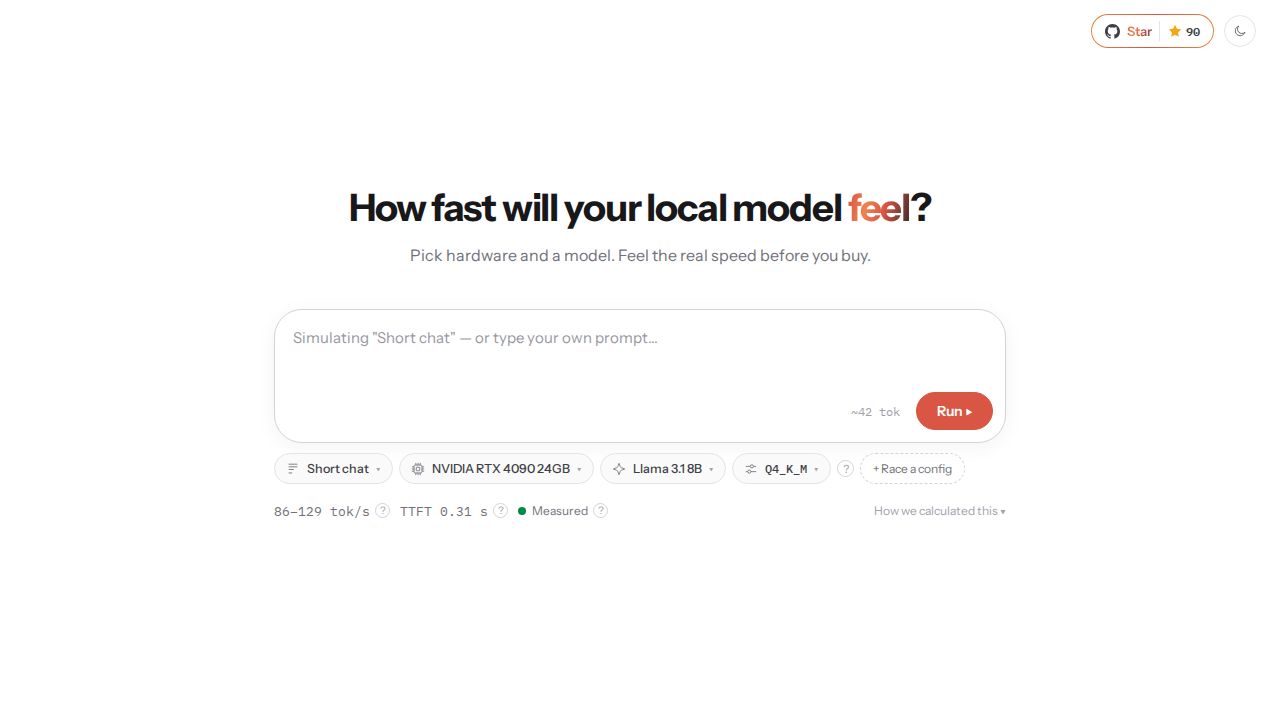
Llmspeed is a web-based tool designed to help users estimate how fast a local large language model (LLM) will run on specific hardware. By providing a catalog of hardware configurations—ranging from consumer GPUs like the NVIDIA RTX 5090 to high-end workstations like the Mac Studio M5 Ultra—and a variety of models such as Qwen, Gemma 4, and DeepSeek, the tool allows users to visualize performance metrics like tokens per second (tk/s) and time to first token (TTFT) without needing to download and run the models themselves.
The tool derives its estimates from community benchmarks (such as r/LocalLLaMA and localscore.ai) and projections based on hardware specifications. It provides a way for users to evaluate trade-offs between model size, quantization levels (e.g., 4-bit or 8-bit), and hardware memory limits. For example, it can show how a specific model might fit into a GPU's VRAM or whether a configuration is physically capable of running a particular model's parameters.
However, users and technical observers note that these estimates represent a specific snapshot of performance and may not capture the full complexity of real-world usage. Discussion around the tool highlights that performance can vary significantly based on inference engine implementations, specific software optimizations (like speculative decoding), and the size of the context window. For instance, while a model might perform well on a short prompt, performance can degrade as the context window grows. Additionally, some users pointed out that real-world agentic workloads—which often involve large prompts and complex KV cache management—might yield lower throughput than the peak numbers shown in simplified benchmarks. The tool serves as a high-level planning resource, but actual performance remains subject to the specific software stack and hardware nuances used by the end user.