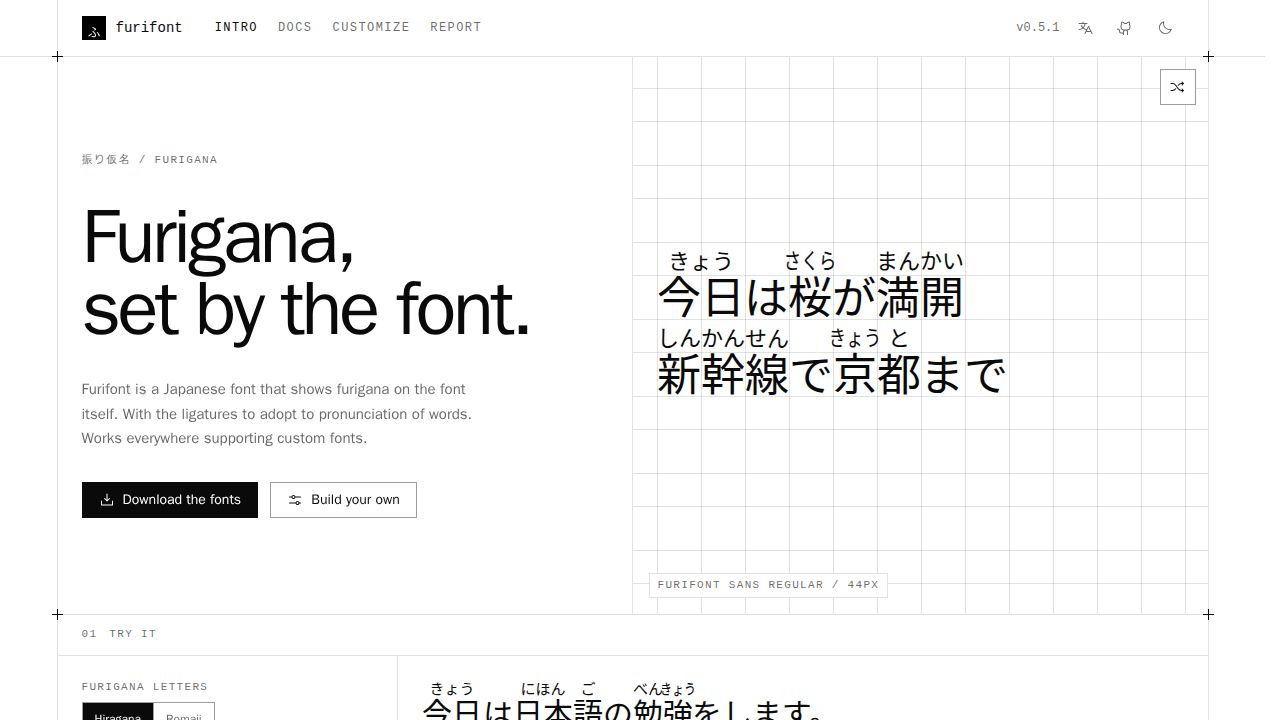
Furifont is a Japanese font designed to automatically display furigana—small phonetic characters placed above or beside kanji—directly through the font's rendering engine. By utilizing font ligatures, the project aims to provide a seamless way for users to see the readings of complex kanji without requiring the manual insertion of Ruby tags, which are the standard method for displaying furigana in web and print media. This approach is particularly useful in contexts where traditional formatting is difficult to apply, such as in certain e-readers, custom applications, or specific web environments.
The mechanism relies on the flexibility of the TrueType and OpenType font specifications, which allow for complex shaping and ligatures. When a specific sequence of characters is typed, the font replaces them with a single glyph that includes both the kanji and its corresponding furigana. However, this method faces a significant linguistic challenge: Japanese kanji readings are highly context-dependent. Many characters have multiple distinct readings depending on the surrounding words, and some can have dozens of different pronunciations. Because a font's shaping engine typically operates on local character sequences rather than full-sentence context, it can struggle to determine the correct reading for ambiguous words, potentially leading to inaccurate phonetic guides.
Users and observers have noted both the creative utility and the practical limitations of this approach. For language learners, the font provides a helpful bridge for reading complex text, though some have pointed out that it can fail when words are split across line wraps, causing the font to lose the context needed to select the correct ligature. Furthermore, because the font cannot currently account for the vast nuances of Japanese grammar and vocabulary—a task that even large language models struggle with—there is a risk of teaching learners incorrect pronunciations. While the project represents an innovative use of font engineering, its reliability remains limited by the inherent complexity of the Japanese language's phonetic rules.
In the discussion surrounding the project, some participants highlighted that while automatic furigana is difficult to perfect, the font could still serve as a valuable tool for those who struggle with basic kanji recognition. Others suggested that the project's primary value lies in its ability to function in environments where standard Ruby tags are unsupported, such as certain digital reading devices. The technical feasibility of improving accuracy was also discussed, with some suggesting that integrating more advanced segmenting algorithms or even running language models within the shaping engine could eventually address the context-dependency issues that currently limit the font's precision.
Ultimately, Furifont serves as a unique experiment in typography and linguistics. It demonstrates the power of modern font specifications to solve display problems, while simultaneously highlighting the boundaries of what can be achieved through local character shaping alone. For the time being, it remains a specialized tool that balances high-tech typographic