Researchers and hobbyists are exploring methods to make biological tissues transparent to facilitate easier fluorescence imaging in live animals. One such method involves modifying the optical properties of tissues like chicken breast by soaking them in a solution of tartrazine, a bright yellowish-orange food dye. The underlying principle is based on the refractive index: biological materials are opaque because they contain a mix of sub-materials (fibers, cells, proteins, and lipids) with different refractive indices than the surrounding water. This difference causes light to scatter as it travels through the tissue. By adding a dye like tartrazine to the water, the refractive index of the liquid can be shifted to more closely match that of the embedded proteins and lipids, thereby reducing light scattering and increasing transparency.
In a recent replication of this protocol, a chicken breast sample was soaked in a ~0.19 M tartrazine solution for 12 hours at room temperature. While the original research paper suggested a higher concentration (0.62 M) and a machine shaker, the lower-concentration replication achieved a 'gummy-bear' like visual quality where grid lines became visible through the meat. The experiment highlights a critical trade-off in optical physics: while increasing the concentration of the dye can improve the refractive index match, it also increases the absorbance of the material. If the dye concentration is too high, the material may absorb too much light (high $\kappa$ in the complex refractive index), which would negate the transparency gains.
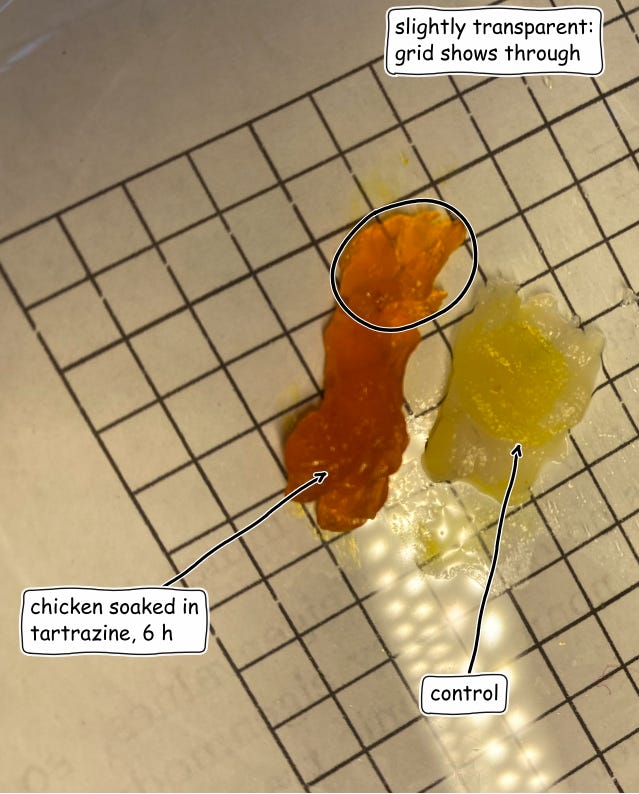
The replication achieved a 'gummy-bear' like visual quality where grid lines became visible through the meat.
Practical limitations remain for this technique outside of a controlled laboratory setting. The replication noted that higher concentrations of tartrazine tended to crystallize on the surface of the meat, creating a 'crusty' texture that hindered optical clarity. Additionally, the process is physically messy and requires precise molarity calculations to achieve the desired effect. While the goal is to enable independent scientists to probe internal structures more casually at a low cost, the current results show that achieving full transparency requires a delicate balance between matching the refractive index of the water to the tissue and maintaining a low enough absorbance to allow light to pass through.
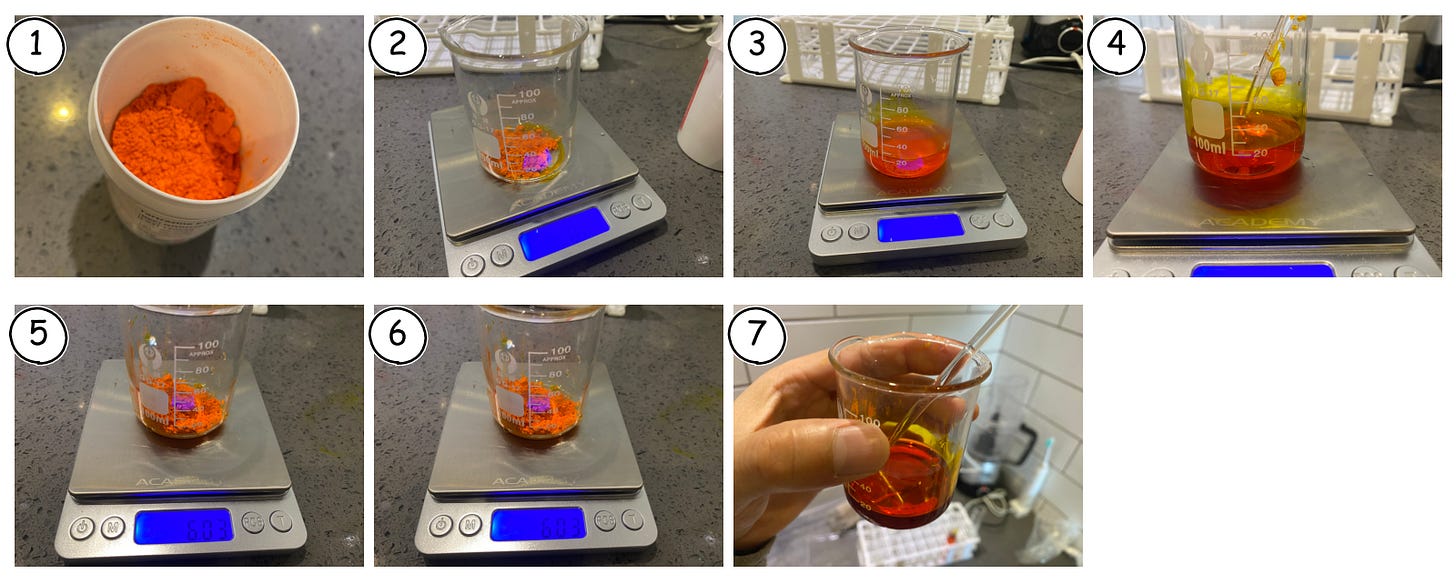
The replication noted that higher concentrations of tartrazine tended to crystallize on the surface of the meat, creating a 'crusty' texture that hindered optical clarity.