In recent months, the mathematical community has reacted with a mixture of astonishment and sorrow to OpenAI's publication of hundreds of new mathematical findings. These proofs, covering fields such as number theory, logic, and theoretical computer science, addressed problems that had remained unsolved by human mathematicians for decades or even centuries. For many in the field, the rapid output of these machine-generated proofs feels less like a tool and more like an existential disruption to the nature of scientific inquiry.
The core of this distress, as described by mathematicians like Steven Strogatz, lies in the distinction between science as a 'craft' and science as a 'conversation.' While AI excels at the craft—the technical mode of thinking and the ability to find hidden patterns—it disrupts the social and historical conversation of humanity. For centuries, science has been a collaborative, multi-generational effort where each discovery provides a foundation for the next. Mathematicians argue that when a machine 'smashes' a long-standing problem, it isn't just solving a puzzle; it is interrupting a thousand-year human dialogue. This creates a sense of 'technological grief' because it feels as though the machine is taking over the role of the discoverer, potentially rendering the human struggle for truth obsolete.
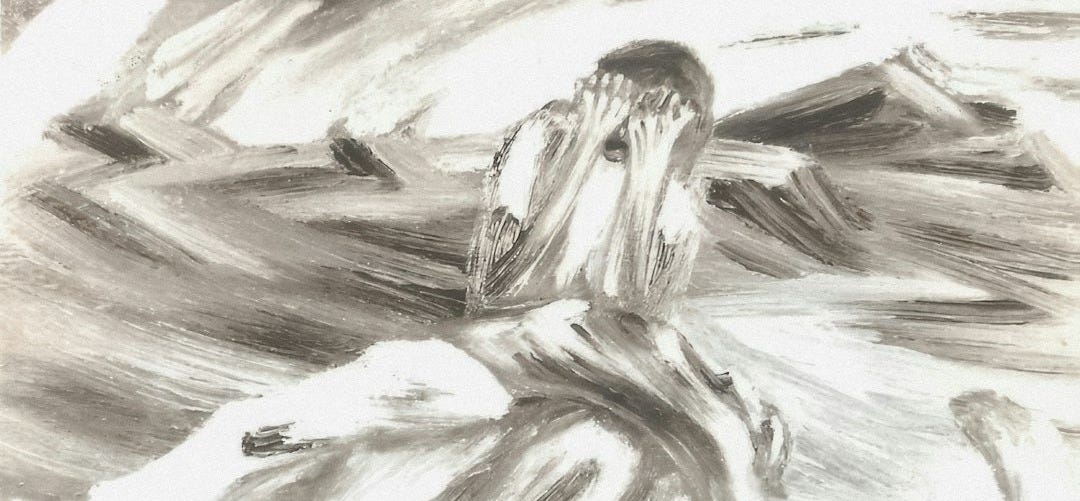
The image illustrates the emotional weight of 'technological grief' described in the article, where the automation of mathematical discovery causes a sense of loss.
Beyond the immediate loss of prestige or 'status obliteration,' there is a deeper concern regarding the loss of the 'voyage of discovery.' Some argue that the joy of mathematics lies in being the first to pull back the veil of ignorance to see a raw truth for the first time. If machines can now provide these truths instantly, the human experience of discovery may be relegated to the sidelines. Furthermore, the sheer volume of these outputs—hundreds of papers released at once—raises questions about the validity of unverified claims. Critics note that when a machine provides a result without a human-centric understanding of 'why' it works, it risks creating a landscape of 'knowledge without understanding,' where the focus shifts from the pursuit of truth to the mere production of believable outputs.
This shift presents a significant trade-off: while AI can accelerate the acquisition of mathematical facts, it may simultaneously erode the human-centric framework that gives those facts meaning. The challenge remains whether the human role in science will evolve into a different form of oversight or if the 'conversation' of human discovery will be fundamentally altered by a participant that can speak but does not participate in the social and normative commitments of human reasoning. The uncertainty lies in whether the human element of science—the social, emotional, and iterative process of discovery—can survive when the technical 'craft' of the field is automated at such a scale.