Following World War I, the newly independent Polish state faced a significant geographical challenge: it was largely landlocked and lacked reliable maritime access. While Woodrow Wilson’s 'Fourteen Points' promised Poland a 'free and secure access to the sea,' the reality was complicated by the proximity of Germany and East Prussia. Because the Free City of Danzig was predominantly German and often a source of tension, Polish experts identified Gdynia—a quiet fishing and holiday village—as the ideal site to develop a sovereign port. Construction began in 1921, driven by the need to shed the image of a fragile land-locked nation and establish Poland as a modern, global power.
By the late 1930s, Gdynia had evolved into a bustling maritime metropolis, characterized by a distinct 'Bauhaus fever dream' of architecture. The city featured functionalist buildings with whitewashed facades and sweeping windows, designed to face the Baltic Sea. It became a hub for the Polish navy and a center for commercial and passenger traffic. Beyond its industrial utility, Gdynia served as a cultural and political statement of self-confidence. It was a site of both utopian ambition and practical necessity, housing the Maritime and Colonial League, which promoted the creation of Polish colonies, and serving as a primary departure point for thousands of Polish emigrants seeking new lives in the Americas.
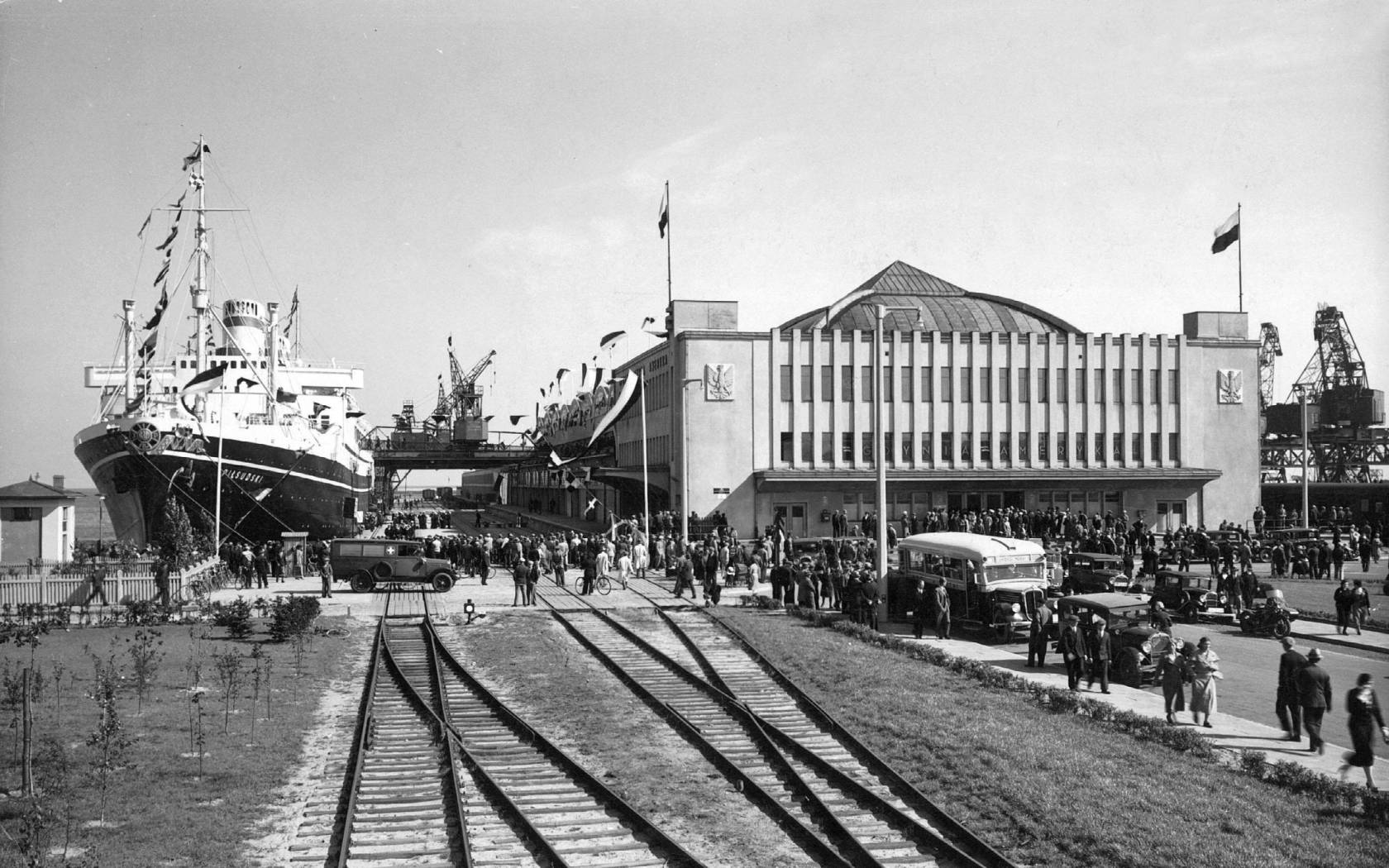
This image illustrates the transformation of Gdynia into a sovereign port and maritime metropolis.
Despite its rapid development and architectural splendor, Gdynia’s growth was inextricably linked to the geopolitical instability of the era. While the city successfully fulfilled the promise of a Polish gateway to the Baltic, it remained vulnerable to the expansionist designs of its neighbors. The port represented a triumph of modernization and a symbol of freedom, yet it could not fully guarantee the one element the Polish leadership deemed most essential for the future: permanent security. Today, the city remains a testament to the interwar period's vision of a maritime Poland, where architecture and infrastructure were used to project a nation's identity onto the global stage.