The Simons Foundation has announced a new initiative aimed at helping the mathematics community navigate the rapid integration of artificial intelligence into the field. In a collaborative partnership, the foundation, along with AI companies Anthropic and OpenAI, will commit a combined $15 million in funding and resources. The foundation will manage these funds, including through an open call for proposals, to support workshops and initiatives designed to help researchers evaluate AI-assisted results, learn new tools, and develop collective standards for AI usage in mathematics.
This initiative builds on the foundation's history of supporting machine learning for science. Notably, the Simons Foundation was an early backer of the Lean proof assistant, a tool that has significantly changed how mathematicians work by making AI-assisted proofs more feasible. Beyond the primary focus on mathematics, Anthropic and OpenAI will also provide AI tools and computing resources to a select group of researchers supported by the foundation, extending the reach of the initiative into other areas of basic science.
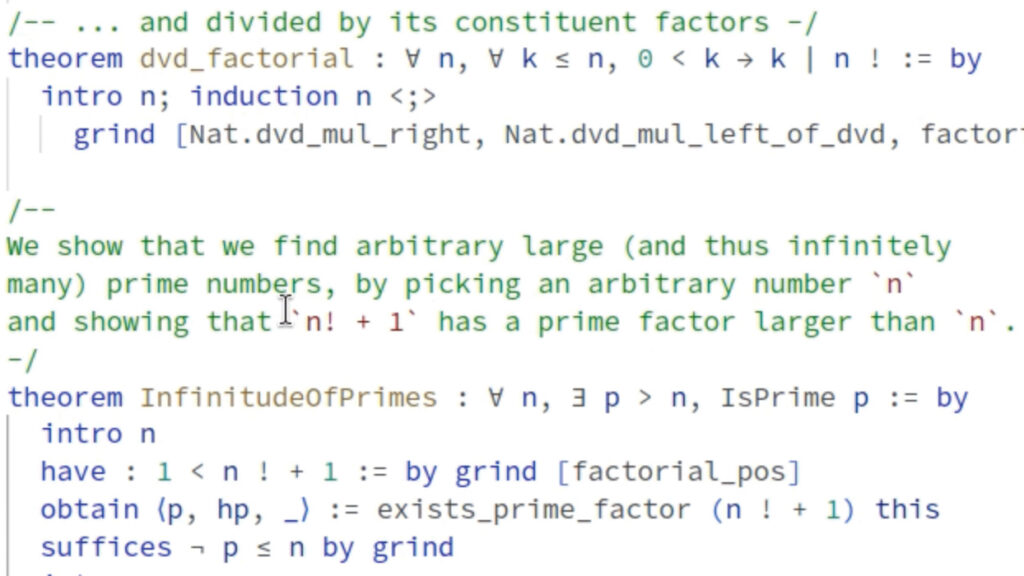
The image illustrates the Lean proof assistant, which the foundation supported to make AI-assisted proofs more feasible for mathematicians.
While the program aims to empower the community to drive its own standards, the partnership highlights a significant intersection between academic research and major AI labs. The foundation's goal is to move beyond viewing mathematics as a mere collection of theorems toward a collective understanding driven by human curiosity, supported by modern technology. Applications for the 'Targeted Grants to Math+AI Institutes' are currently open, with a submission deadline of December 1, 2026. The initiative seeks to ensure that the mathematical community—rather than any single corporation—shapes how these tools are adopted and evaluated as they continue to reshape the research landscape.