Mistral AI has introduced Timestral, its first family of time-series foundation models (TSFM). Unlike classical forecasting tools like ARIMA, which are typically fitted to a single data series, or deep learning models like PatchTST, which are often trained from scratch for specific datasets, Timestral uses a foundation model approach. By being pre-trained on a large and diverse corpus, the model learns underlying patterns that can be applied to new domains in a zero-shot fashion, even when historical data is scarce.
The Timestral family consists of four models ranging from 5M to 209M parameters. Mistral claims that the 209M parameter model achieves state-of-the-art performance on three major public benchmarks—GIFT-Eval, TIME, and fev-bench—while using only two-thirds of the parameters of some competing models. A key technical distinction of Timestral is its 'Decoupled Horizon Forecasting' (DHF) mechanism. Unlike some other models that use contiguous patch masking (where forecast values are treated as missing context), DHF keeps the full history in the sequence, allowing learned forecast tokens to read the entire history before them. This ensures that every observed value serves as both a target and context, while true gaps remain flagged as missing.

The Timestral family consists of four models ranging from 5M to 209M parameters.
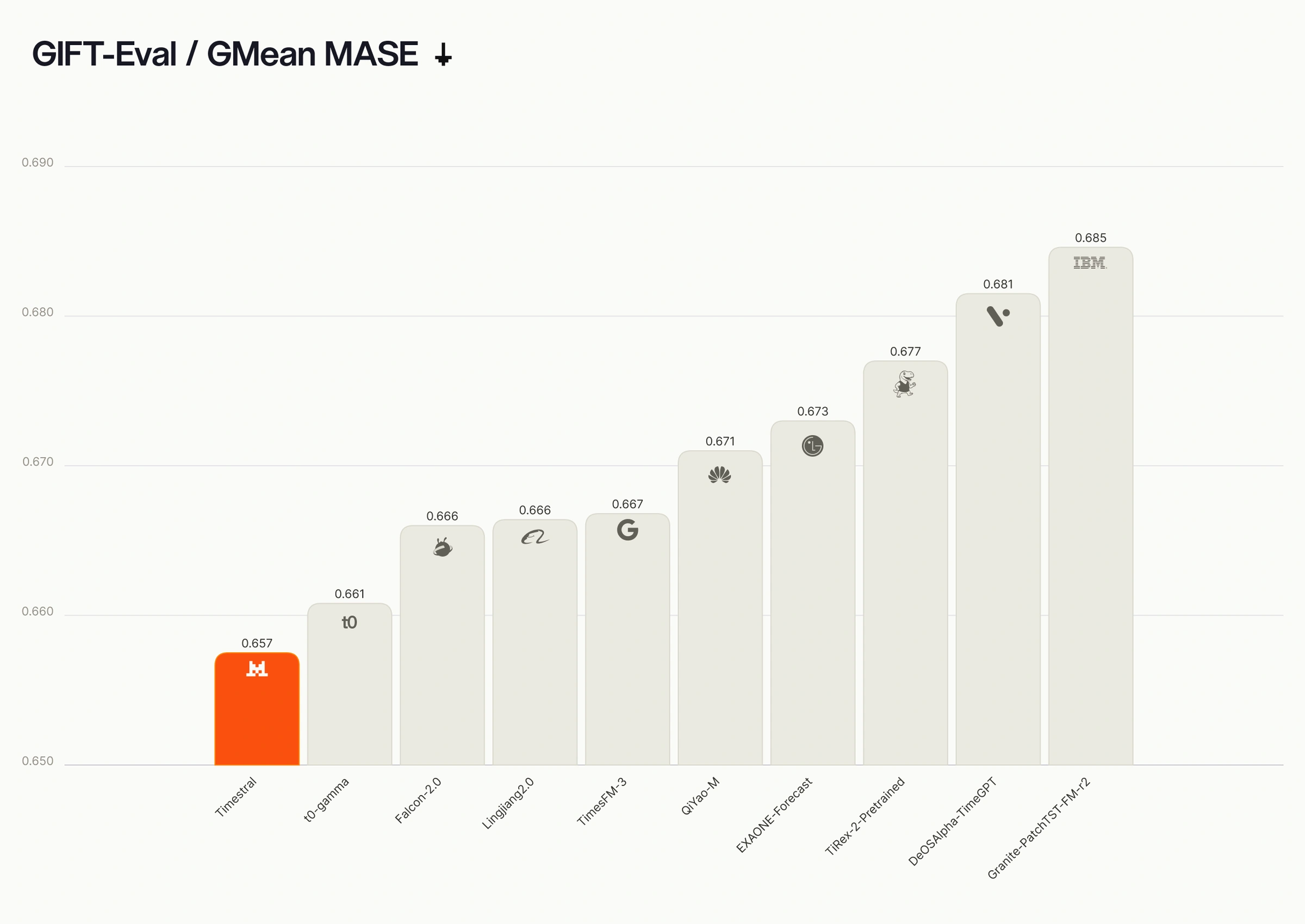
Mistral claims that the 209M parameter model achieves state-of-the-art performance on three major public benchmarks—GIFT-Eval, TIME, and fev-bench—while using only two-thirds of the parameters of some competing models.
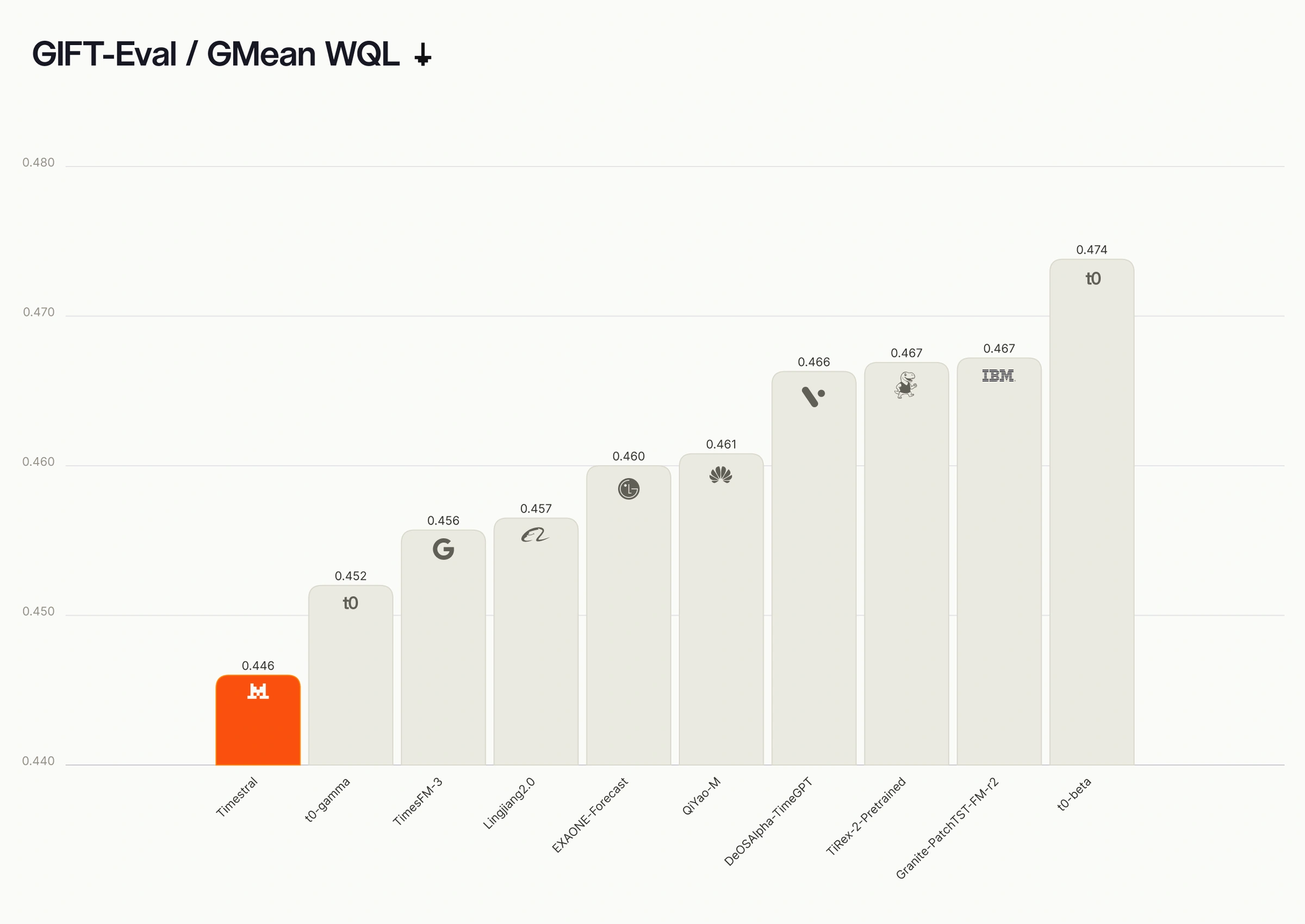
Mistral claims that the 209M parameter model achieves state-of-the-art performance on three major public benchmarks—GIFT-Eval, TIME, and fev-bench—while using only two-thirds of the parameters of some competing models.
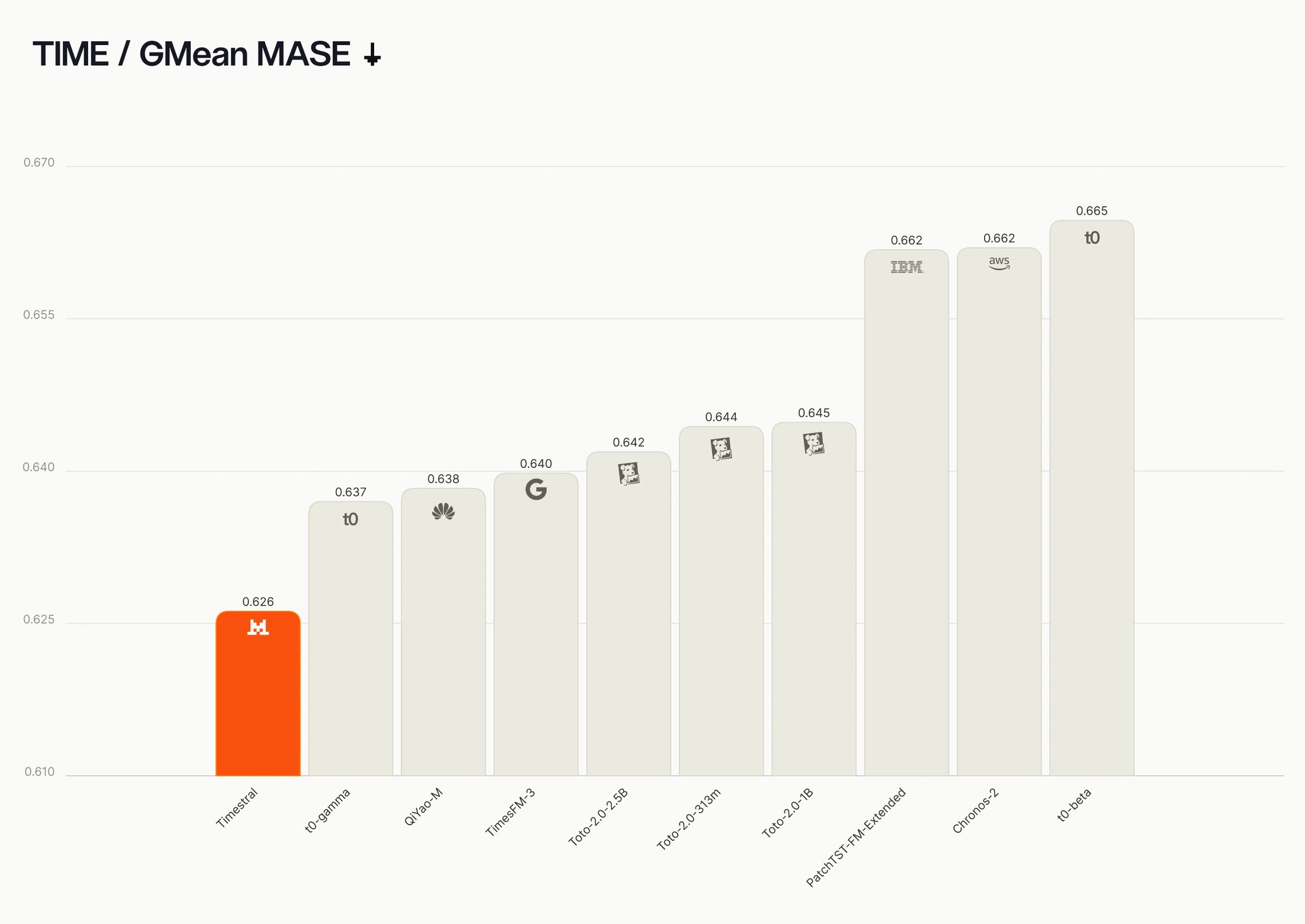
Mistral claims that the 209M parameter model achieves state-of-the-art performance on three major public benchmarks—GIFT-Eval, TIME, and fev-bench—while using only two-thirds of the parameters of some competing models.
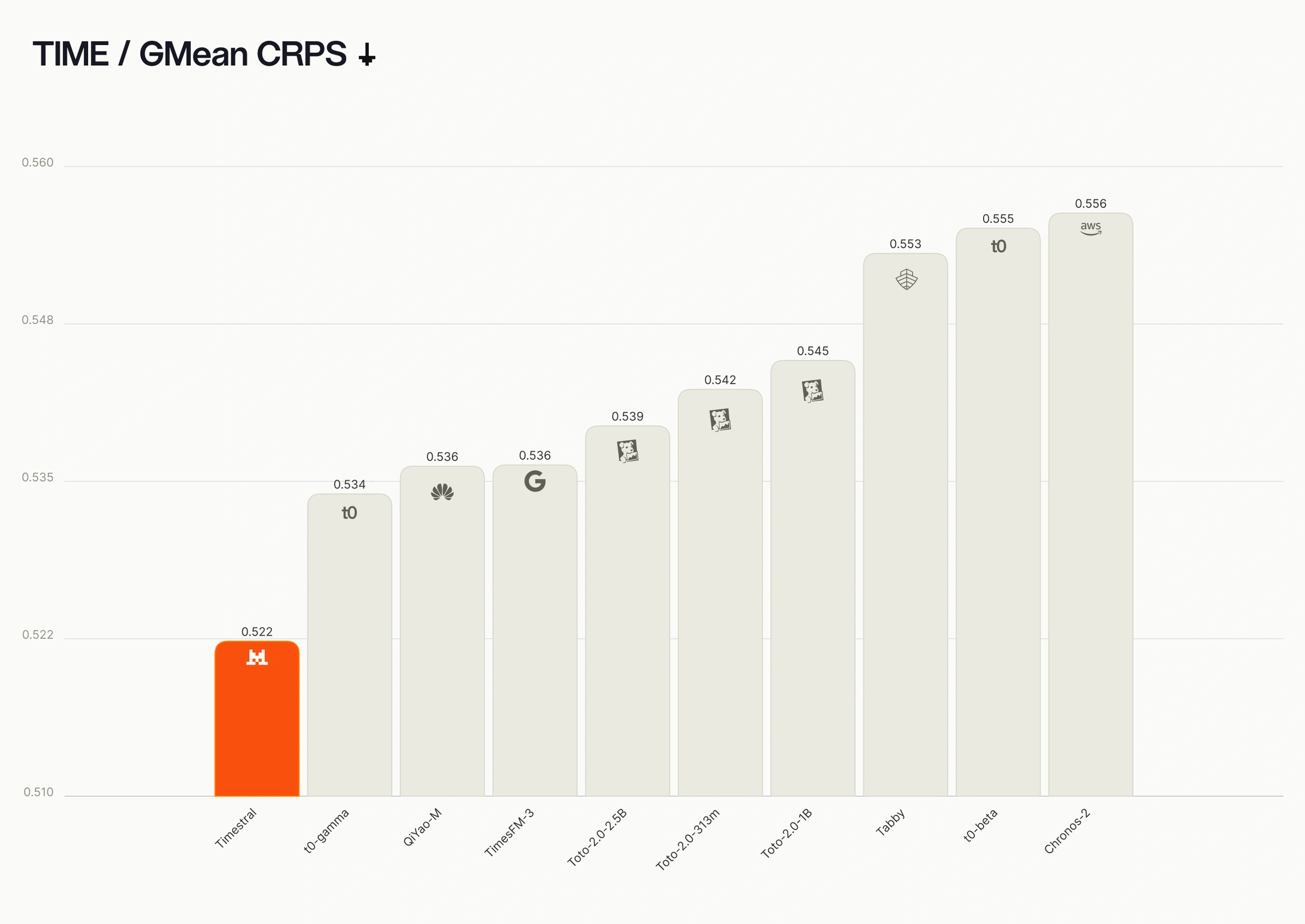
Mistral claims that the 209M parameter model achieves state-of-the-art performance on three major public benchmarks—GIFT-Eval, TIME, and fev-bench—while using only two-thirds of the parameters of some competing models.
Beyond standard forecasting, Timestral supports multivariate targets and both past-only and known-future covariates. For example, in an industrial setting, the model can jointly forecast related sensor data—such as a pump's vibration and temperature—while conditioning on known-future variables like production schedules or weather forecasts. To handle non-numerical data, such as a machine's state (e.g., 'idle' or 'maintenance'), Timestral accepts categorical inputs directly. The models are designed for efficiency, with the 209M version capable of running on standard server CPUs without a GPU. While the models are available for zero-shot inference, Mistral also offers a fine-tuning pipeline via Mistral Forge for organizations needing to adapt the models to proprietary, in-domain data or specific architectural extensions.