Anthropic's Claude Code team is navigating a significant shift in software engineering: the sheer volume of code produced by AI agents. In their internal monorepo, daily changes surged from 2,500 in May to over 30,000 by September. To manage this, the team has moved away from manual, line-by-line code reviews as a primary gate, instead adopting a system where machines perform the majority of the 'reading' and routine checks. The goal is to preserve human time for novel challenges and high-risk issues while ensuring that the speed of production does not lead to an increase in reverts or incidents.
The team employs a multi-layered review architecture where most changes are verified by AI before a human ever sees them. This includes a 'pre-PR' layer where Claude is tasked with running tests, builds, or generating screenshots to verify its own work. If the automated reviewer flags a recurring issue, the team updates the underlying instructions—such as the `CLAUDE.md` file, which defines project conventions—to fix the problem at the source. For every pull request, an AI reviewer evaluates the diff against the entire repository to ensure the change fits the system's intent. These findings are then verified by a separate group of agents that 'vote' on the validity of the bug before the comments are presented to a human author.
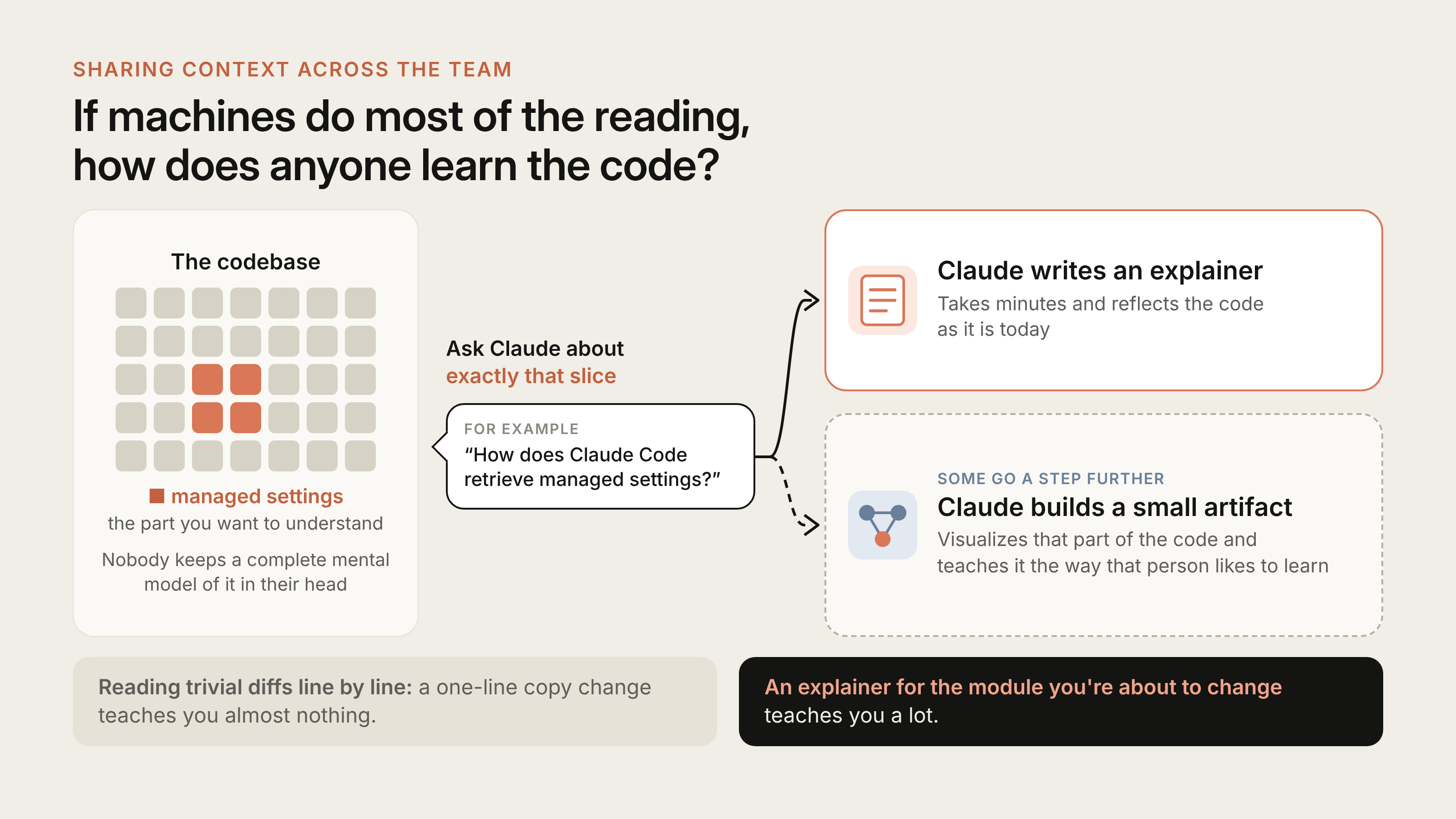
The diagram illustrates the team's philosophy on how developers maintain mental models of a codebase when machines perform the majority of the routine reading.
Human intervention is now scaled by risk rather than volume. A classifier determines the risk tier of a change, with low-risk updates like documentation requiring no human approval if automated checks pass. Medium and high-risk changes, such as those affecting caching or system prompts, require one or two human reviewers. To maintain quality, the team uses a 'live' evaluation set built from past incidents and reverts; every change to the AI reviewer is scored against this set to ensure it catches real bugs while minimizing noise. This approach allows the team to maintain a high velocity of merges—doubling the number of merged pull requests between June and September—while simultaneously reducing the share of those changes that required a revert by over 40 percent.