Coral bleaching occurs when rising sea temperatures stress marine organisms, causing them to expel the symbiotic algae (Symbiodiniaceae) that live within their tissues. Because these algae provide the majority of the coral's nutrients, their loss often leads to starvation and death. However, a new study published in Science Advances reveals a mechanism for rapid recovery: physical contact between a bleached fragment and a healthy neighbor can trigger a full restoration of the coral's health within days.
The mechanism relies on the formation of a 'tissue bridge.' When two coral fragments from the same genetic makeup (referred to as a 'genet') are placed in direct contact, they fuse together at the point of meeting. This bridge enables the symbiotic algae to migrate from the healthy coral into the bleached one. In laboratory tests using the species *Pocillopora damicornis*, researchers observed the symbiont population in the bleached coral doubling every four days—a significantly faster recovery rate than what is typically observed in natural, wild environments. Once the bleached branch receives enough symbionts to recover, it can maintain its health even after being separated from the healthy donor.
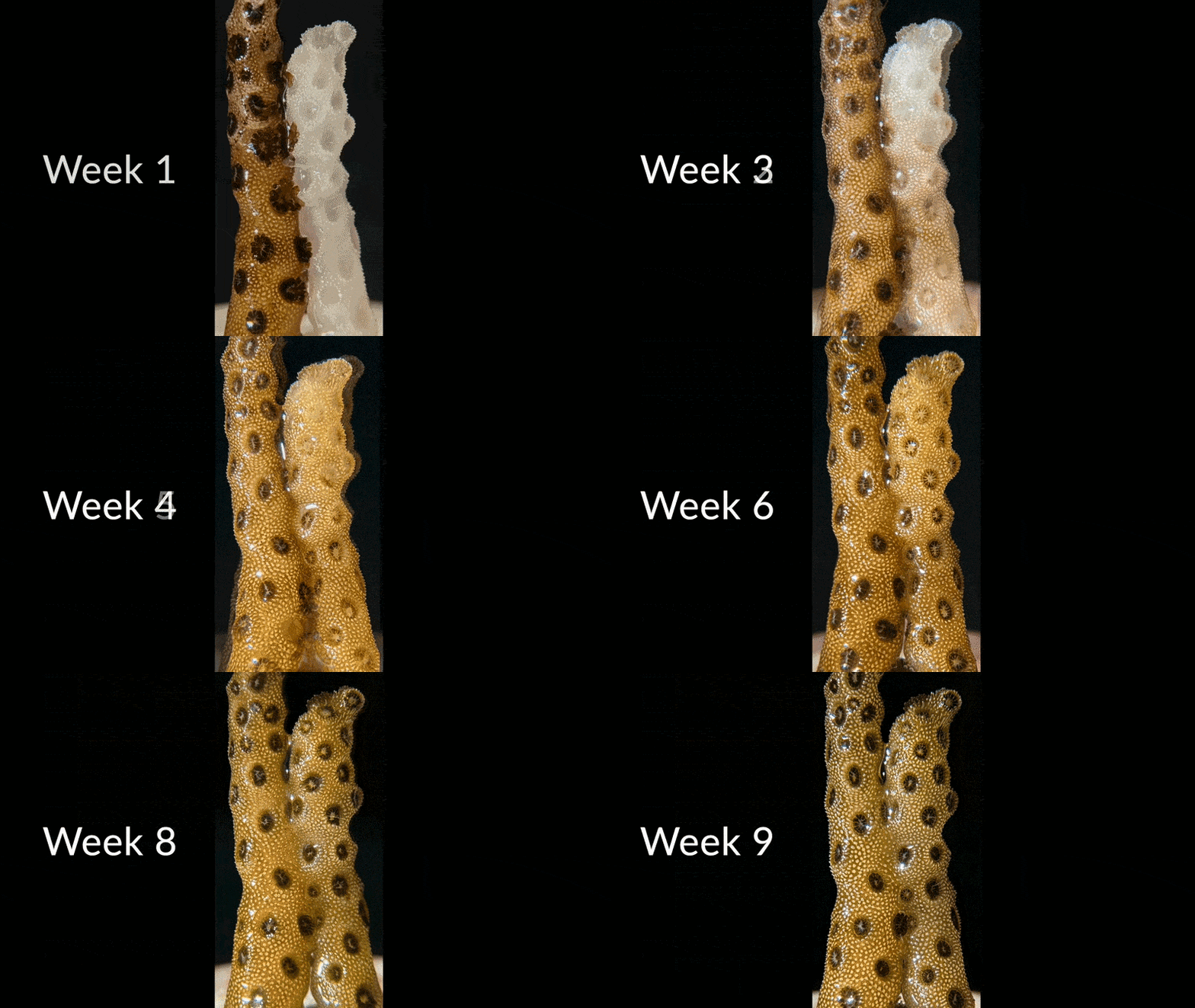
This visual illustrates the primary mechanism of the study: the physical contact and subsequent fusion of coral fragments.
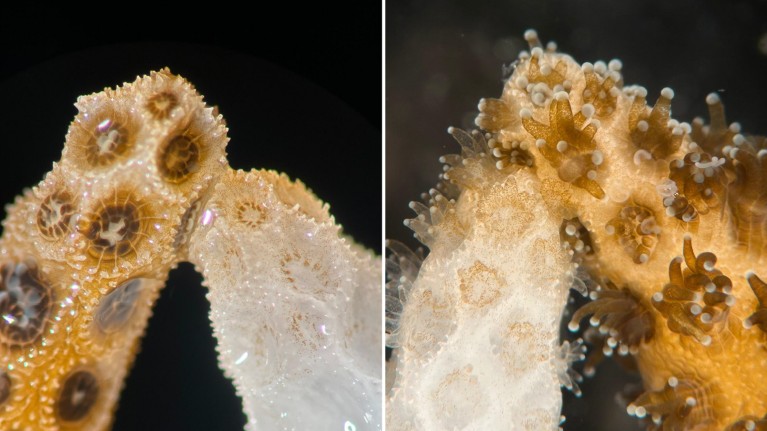
This image provides a clear visual of the 'tissue bridge' and the migration of symbionts described in the laboratory tests.
While this 'healing touch' offers a promising laboratory solution for reversing coral decline, several practical limitations remain. The fusion process is highly specific; the study found that fragments from different species or even different individuals of the same species failed to fuse or transfer symbionts. Furthermore, while the laboratory results are 'incredible' for their speed, scaling this to a reef environment presents challenges. In large-scale bleaching events, the distance between healthy and bleached corals may be too great for natural contact to occur, and the presence of environmental stressors like 'brown sludge' or high-temperature water could impede the fusion process or the survival of the newly transferred algae. Researchers hope these findings can eventually inspire scalable solutions to combat widespread reef degradation.
The study establishes that while the biological mechanism for rapid recovery exists, its effectiveness is currently tied to specific genetic compatibility and physical proximity. This distinction is critical for future conservation efforts, which must determine if human intervention can facilitate these 'bridges' on a reef-wide scale or if the method remains primarily a laboratory proof-of-concept for coral restoration.
Evidence: 1. The study confirms that bleached coral can fully recover within eight weeks when touching a healthy fragment of the same genet (Source: primary). 2. High-powered microscopy confirmed that the recovery is facilitated by the creation of a tissue bridge between the two fragments (Source: primary).