Anthropic recently introduced Scion, a version control system designed to handle massive monorepos. In its announcement, Anthropic stated that the system was built with 'hard-won lessons' from existing systems like Google’s Piper and Meta’s Sapling. However, the technical implementation of Scion—specifically its use of 'derived data' to optimize operations like 'blame'—has been identified by the open-source community as being nearly identical to the design of Mononoke, a component of Meta's Sapling project.
The core mechanism of Scion involves building additional data structures from changesets to answer complex queries efficiently. Because a changeset only records what changed, it cannot quickly identify who last edited a specific line. Scion solves this by creating 'derived data'—indices for file blame, path history, and commit graphs—that are computed recursively from parent changesets. This mirrors the architecture of Mononoke, which was developed as early as 2017-2018. Critics argue that while Anthropic acknowledged the broader Sapling project, the failure to credit Mononoke specifically—which provided the actual technical blueprint for the derived data model—borders on plagiarism, especially since the terminology and data models are nearly identical.
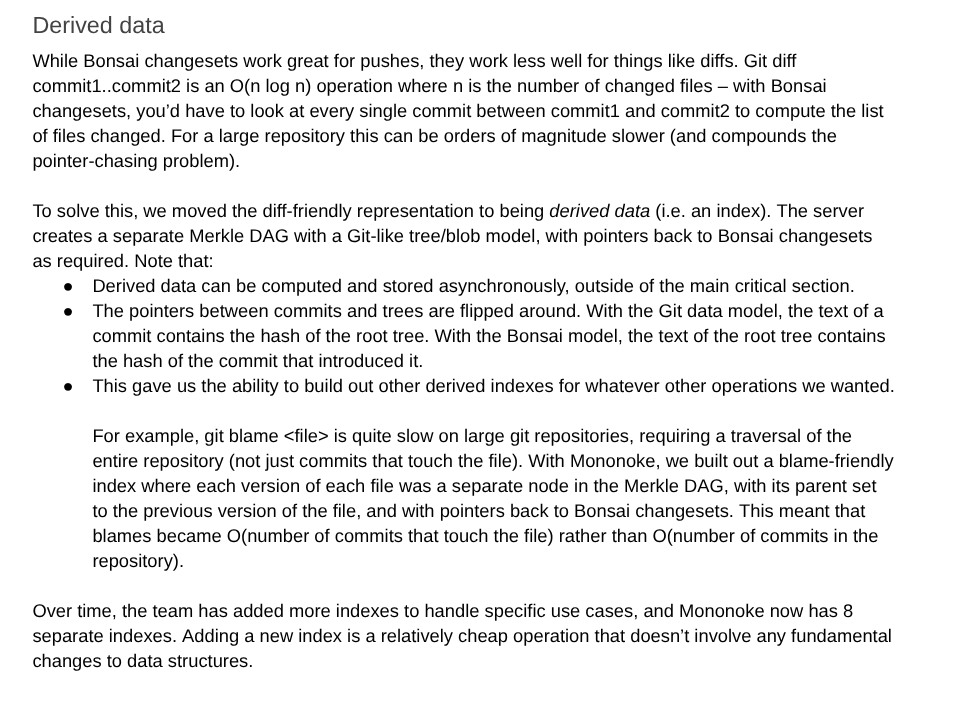
This image explains the technical architecture of Mononoke's derived data, which serves as the primary point of comparison for Scion's design.
This controversy highlights a growing tension in the era of large language models (LLMs). Because Mononoke is open-source and included in the training sets of models like Claude and GPT, these models can easily replicate complex, non-obvious engineering designs without providing attribution to the original human creators. Some observers suggest that as LLMs make it cheaper to 'vibe-code' or generate entire systems from scratch, the risk of 'IP laundering' increases. This creates a potential long-term risk where the incentive to share and maintain open-source projects diminishes if those contributions can be instantly distilled and rebranded by AI-assisted development teams without acknowledging the original source of the innovation.
While some argue that building a custom system is a valid engineering choice when off-the-shelf solutions do not perfectly fit a company's scale, others point out that the similarity is so high that it suggests a direct derivation rather than independent discovery. The debate remains centered on whether the use of LLMs to generate code based on existing open-source repositories necessitates a new standard for attribution, or if the current 'hard-won lessons' framing is sufficient for modern software development.
Ultimately, the situation underscores a shift in software production: the cost of building a complex system has dropped significantly due to AI, but the provenance of the underlying logic remains obscured. For the open-source community, the challenge is ensuring that the 'human' labor of original innovation continues to be recognized in a landscape where AI can effortlessly replicate the results of that labor.
The technical distinction between Scion and Mononoke remains a point of contention. While Scion's implementation is proprietary, the underlying logic of using a Merkle DAG to create blame-friendly indices is a direct carry-over from the Mononoke design. This highlights a specific trade-off in modern development: the speed of AI-assisted creation versus the preservation of the intellectual lineage of the software being built.
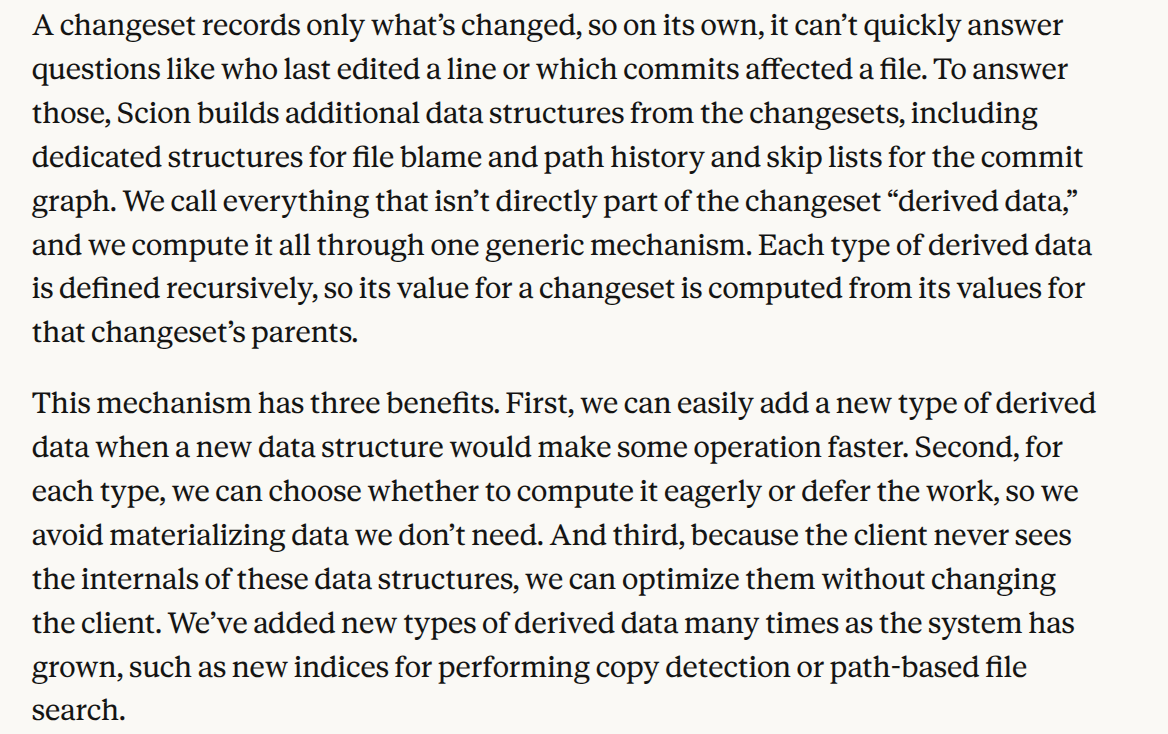
This visual depicts the specific technical implementation of Scion's derived data, which is the core of the design similarity controversy.
As Anthropic prepares for future milestones, including a potential IPO, the scrutiny of its engineering practices serves as a case study for the broader industry. It raises questions about how companies will navigate the ethics of using AI to 'strip mine' open-source repositories for high-value architectural designs while presenting the resulting products as novel innovations.