E. coli seeks nutrients by alternating between straight runs and random tumbles. In a uniform chemical environment, it swims in a random walk by balancing runs with periodic tumbles, with a run lasting about a second—ten times longer than a tumble. When moving toward an attractant, the bacterium extends its runs and reduces tumbles, biasing its motion toward higher concentrations. This behavior is controlled by the signaling molecule CheY, which, when phosphorylated (CheY-p), binds to flagellar motors and causes them to reverse spin, triggering a tumble. In the absence of attractant, a steady level of CheY-p maintains a balance of runs and tumbles, but an increase in attractant reduces CheY-p production, leading to longer runs and directed movement.
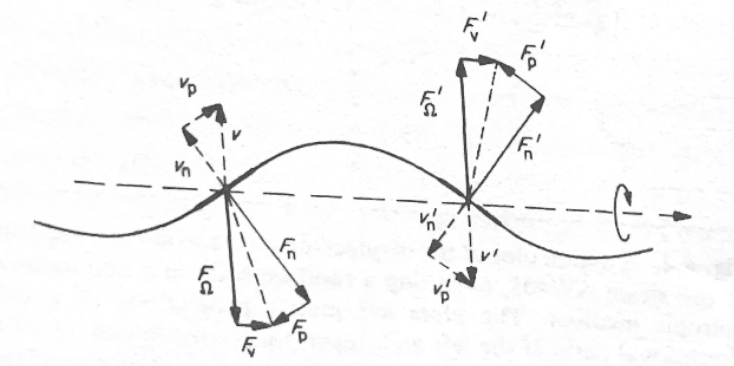
Visualizes the random walk behavior described in the opening paragraph of the article.
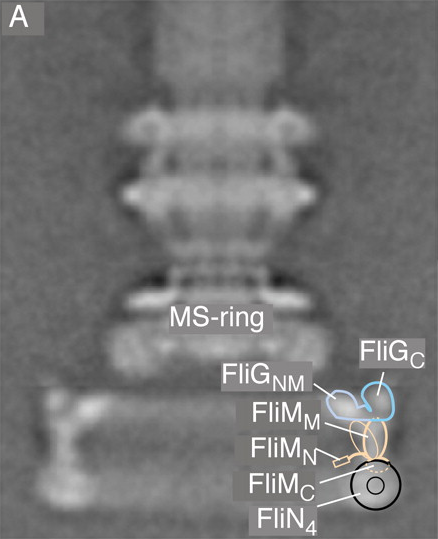
Shows the flagellar motor structure involved in the chemotaxis signaling pathway described in the first paragraph.
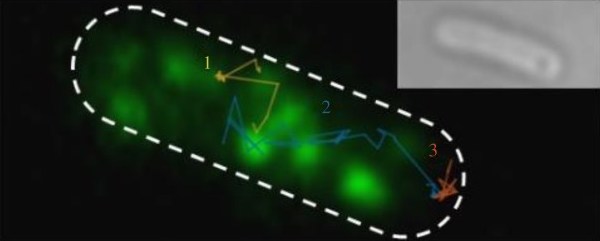
Illustrates the CheY protein whose phosphorylation level controls tumbling frequency, as discussed in the chemotaxis section.
The chemotaxis system amplifies minute chemical signals: bacterial cells can amplify signals more than 50-fold, meaning a 2% change in receptor occupancy can bring about a 100% change in the output of the system at the flagellar motors. This amplification enables detection of concentration changes as small as fewer than three molecules per cell volume, allowing the bacterium to sense tiny variations in chemical concentration despite the noise inherent in molecular interactions.
To handle varying background levels, E. coli adapts via methylation of receptor proteins. Methyl groups added to the receptors' structural components dampen their signaling power, resetting the system's sensitivity so that the cell can respond to relative changes across a wide range of concentrations—up to five orders of magnitude. This methylation provides a simple chemical memory that lasts several seconds, allowing the bacterium to remember whether attractant has become more or less concentrated in its surroundings and thus determine whether it’s swimming in a good or bad direction.