In the early days of 3D gaming, players typically had two choices: run a game in a software renderer at a low resolution or purchase a dedicated 3D graphics card to access an accelerated version. Today, a third option has emerged: using modern, high-powered CPUs to run original software renderers at high resolutions that were technically impossible during the 1990s. This approach allows players to experience titles like Quake, Doom, and Duke Nukem 3D in their original intended logic while pushing the visual output far beyond the limitations of the era.
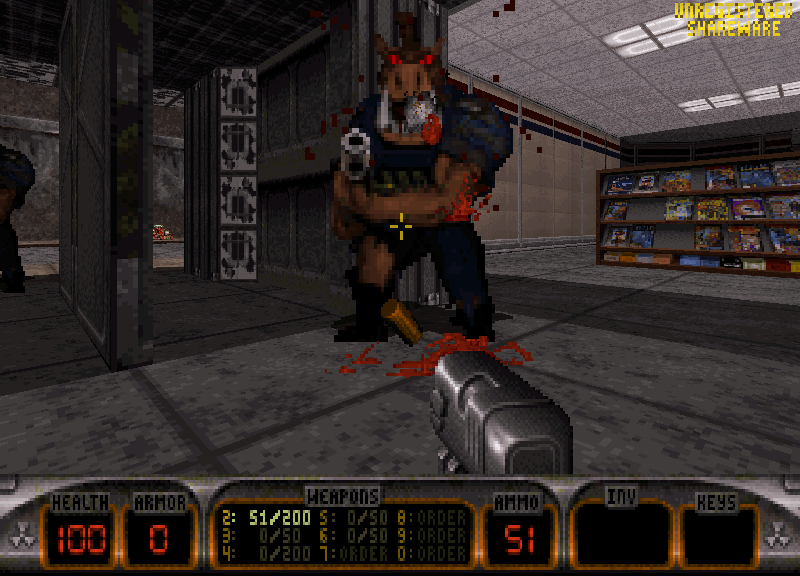
The image provides a concrete example of the titles mentioned in the first paragraph of the article.
The preference for software rendering often stems from its specific visual characteristics. Because the CPU draws every pixel directly, textures are sampled pixel-by-pixel, resulting in 'crisp' squares rather than the smoothed, blurry appearance produced by early 3D cards using bilinear filtering. Additionally, these games often utilized 256-color palettes with lighting calculated through lookup tables. This creates visible 'color banding' where shadows fall off in steps rather than smooth gradients. While technically a hardware limitation of the time, many enthusiasts find this gives the games a 'grimy' and authentic texture that modern hardware acceleration tends to polish away.
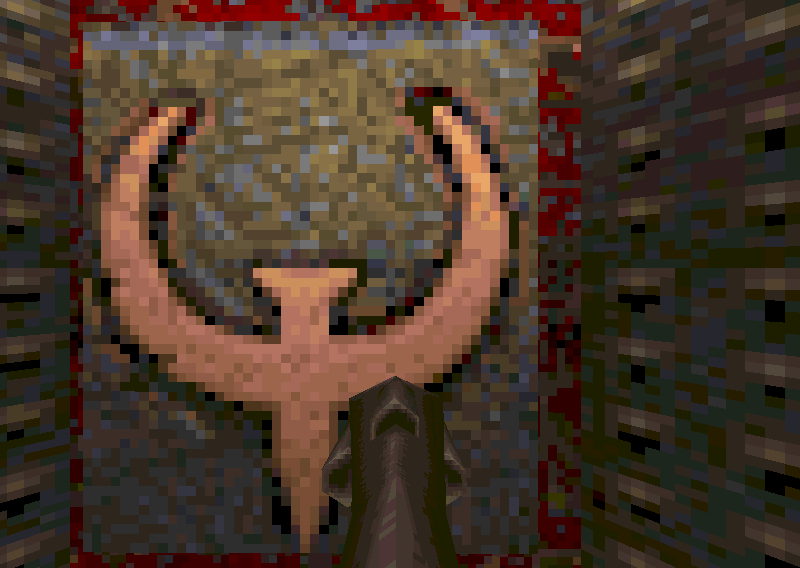
The image illustrates the 'crisp' squares and pixel-by-pixel sampling characteristic of software rendering.
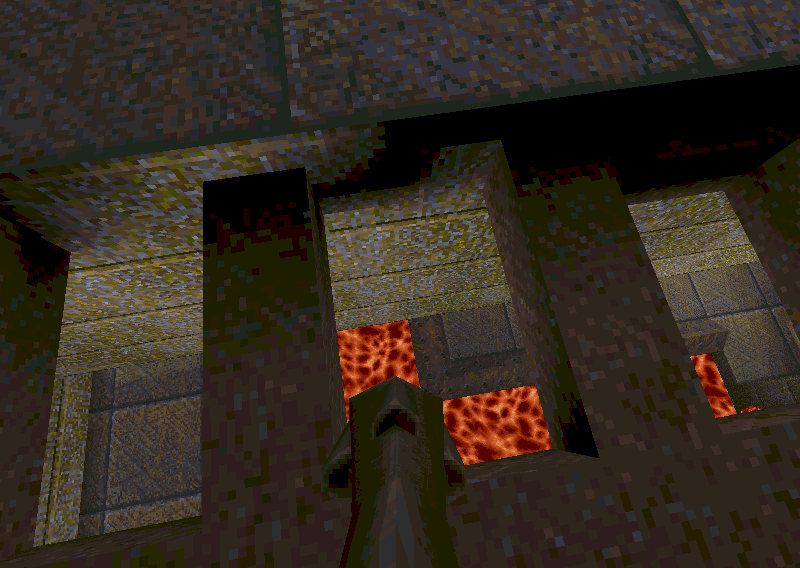
This visual demonstrates the 'grimy' texture and color banding mentioned in the discussion of software rendering aesthetics.
However, achieving this 'authentic best' experience on modern hardware presents a significant computational challenge. Because every extra pixel requires more CPU instructions, high-resolution software rendering scales heavily with processor power. While a modern machine can easily handle Quake at 800x600, more demanding titles like Shadow Warrior can struggle even on high-end quad-core processors at 1600x1200. Furthermore, while emulators like DOSBox provide a convenient way to run these games, they introduce an additional layer of CPU emulation that can bottleneck performance. For the most authentic experience, enthusiasts often turn to native DOS on fast, modern hardware to ensure the game's original code runs directly without an emulation overhead, though this requires navigating complexities like modern sound card compatibility.